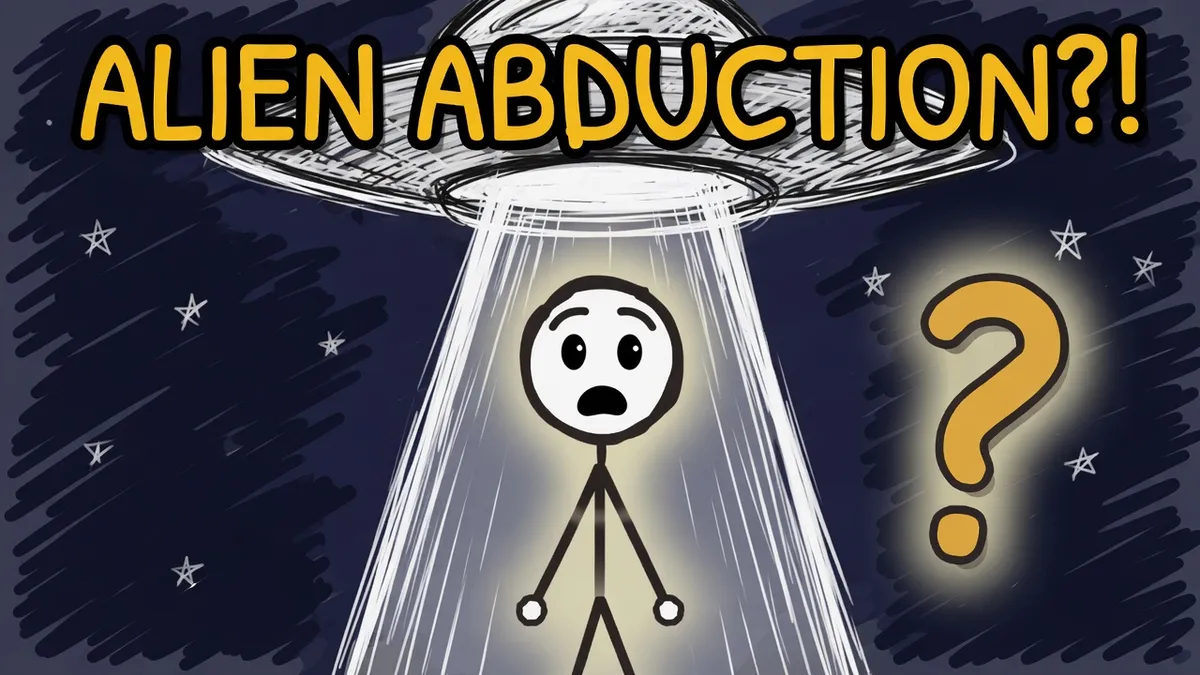
It always starts the same way. You wake in the dark, and you cannot move. A weight presses on your chest. There is something in the room, you can feel it, a presence at the edge of the bed. Lights, a buzzing in your ears, shapes that should not be there. You are utterly certain you are awake, and utterly unable to run. Later, perhaps in a hypnotist's chair, the missing pieces arrive: a table, a bright light, thin grey figures, an examination. Thousands of people describe some version of this, sincerely and in detail. They are not lying. So what on earth is happening to them?
01 · The triggerA body awake in a paralysed dream
The starting gun for most abduction stories is a real and well understood event: sleep paralysis. Every night, as you enter dreaming REM sleep, your brain quietly switches off your muscles so you don’t physically act out your dreams. Usually that switch flips back before you wake. Occasionally it doesn’t, and your mind surfaces into consciousness while your body is still frozen and the dream is still running. The result is a waking nightmare stitched onto your real bedroom: total paralysis, a crushing pressure on the chest, a terrifying sensed presence, buzzing, flashes of light, sometimes a feeling of floating. Read that list again. It is the abduction scene, almost line for line, before a single alien has been named.
02 · The researchersHarvard takes the abductees seriously
In the early 2000s, Harvard memory researcher Susan Clancy and clinical psychologist Richard McNally did something unusual: they studied self-described abductees carefully and respectfully, as a genuine psychological puzzle rather than a joke. The through-line they found was striking. Nearly everyone who had “recovered” an abduction memory had first lived through an episode that fit sleep paralysis to a tee. The story of aliens came afterwards, as an explanation for something frightening and otherwise inexplicable that had really happened to them in the night.
03 · The memoryMinds that are better at remembering things that never happened
Why aliens, though, and not a burglar or a bad dream? Part of the answer is that abductees, as a group, are measurably more prone to false memory. Using a classic word-list test, Clancy and McNally found that people reporting abductions were significantly more likely to confidently “remember” words that had never been shown to them. This is not an insult and not a diagnosis. It simply means their memory machinery is a little more willing to generate vivid, sincere recollections of things that did not occur, which is fertile ground for a story to take root and grow.
04 · The hypnosisWhere the greys actually come from
Here is the quiet scandal at the centre of the whole phenomenon. The rich, cinematic detail, the star maps, the implants, the medical tables, very often does not appear until the person is put under hypnosis to explain a patch of “missing time.” And hypnosis does not do what people think. It does not reliably unlock buried memories. What it reliably does is crank up suggestibility and confident confabulation, so people generate detailed, emotionally powerful accounts that feel like memories but are being assembled on the spot. The very tool used to “recover” the abduction is a tool for inventing one.
McNally played abductees recordings of their own abduction stories and measured their bodies. Their heart rate, sweating and facial tension spiked at levels seen in combat veterans and abuse survivors reliving genuine trauma. Their terror is completely real. And that is the twist: a false memory can drive a fully real physiological trauma response, so the more sincerely shaken someone is, the more it actually confirms the psychological explanation, not the alien one.
05 · The old storyAn ancient terror in a new costume
None of this is new. Long before flying saucers, people across the world described exactly the same night-time event under different names: the Old Hag crouching on the sleeper’s chest, the incubus, the demon that sits on you in the dark and steals your breath. The paralysis, the pressure, the presence, the dread, all of it is documented for centuries. The brain hardware has not changed. What changed is the label our culture hands us when we go looking for an explanation. Where a medieval sleeper found a demon, a modern one, raised on films and famous cases, finds a grey. The monster is the same. Only the story around it has been updated.
06 · The payoffSo why do people report alien abductions?
Because a real, ancient and frightening brain event collides with a modern myth in a mind that is a little more prone than most to building confident memories, often with a hypnotist helpfully filling in the gaps. Sleep paralysis supplies the raw terror. Culture supplies the greys. False memory and hypnosis supply the plot. And the body, reacting to it all as though it genuinely happened, supplies the unshakeable conviction that it did. The people reporting these experiences are not liars and not lunatics. They are ordinary humans who woke in the dark, could not move, felt something in the room, and were handed the only story their world had ready for it.

The animated version
Same answer, told as a little animated story with the strange little stickman acting it out. Dry, quick, and, obviously, correct.
Quick questions
Are alien abductions real?
There is no credible scientific evidence that anyone has been physically taken by extraterrestrials. What is real is the experience: people genuinely feel it happen, and feel it deeply. Researchers explain the reports through sleep paralysis, false memory and cultural suggestion rather than literal visitors.
Is alien abduction just sleep paralysis?
Sleep paralysis is the leading trigger for most abduction reports. It produces paralysis, a sensed presence, chest pressure, buzzing and shadowy figures, which are the raw ingredients of an abduction scene. The alien interpretation is usually added afterwards, through hypnosis and cultural expectation.
What is sleep paralysis and why does it feel like aliens?
Sleep paralysis is when you wake up but your body is still held in the muscle paralysis of REM sleep, and dream imagery leaks into the bedroom. Because the brain is half dreaming, you can hallucinate figures, lights and touch while completely unable to move. In a culture soaked in alien imagery, the mind reaches for the nearest script: a grey by the bed.
Why do people remember alien abductions so vividly?
Vivid does not mean accurate. Studies show abductees are more prone to forming false memories, and hypnosis dramatically increases confident but invented detail. Because their bodies react with real fear, the memory feels emotionally true even when it has been assembled after the fact.
Do abductees actually believe it happened?
Yes, overwhelmingly. Harvard research found their physiological stress responses matched those of genuine trauma survivors. They are sincere, not hoaxers, which is exactly why the psychology explains a real subjective experience rather than a lie.
Are people who report alien abductions mentally ill?
Generally no. Sleep paralysis is a normal, non-pathological event, and abductees are not characterised by serious mental illness. As a group they do tend to score higher on traits like dissociation, magical ideation, and susceptibility to false memory, but that is a long way from being unwell.
What percentage of people experience sleep paralysis?
A large 2011 review found about 7.6% of the general population have had at least one episode, rising to roughly 28% of students. Broader analyses using looser definitions put estimates near 30%. It is common, and mostly harmless.
Who was the first person to report an alien abduction?
The famous first widely publicised case is Betty and Barney Hill, who described being taken after a night drive in New Hampshire on 19 September 1961. Their detailed account, including a star map and a medical exam, only emerged later under hypnosis, and it set the template for nearly every abduction story since.
Does hypnosis prove alien abductions happened?
No. Hypnosis does not reliably recover hidden memories; it strongly increases suggestibility and confident confabulation. Much of the abduction detail appears during hypnotic regression, which is precisely why scientists treat it as memory creation rather than memory recovery.
Why do abduction stories all sound the same?
Because they draw on a shared cultural script spread by films, television and earlier famous cases like the Hills. Once a template exists, sleep-paralysis sufferers recognise it and fill in matching details, which is why reports keep converging on the same greys, tables and probes.
Is there a brain explanation for feeling a presence?
One proposed mechanism links unusual temporal-lobe activity to the sensed-presence and out-of-body feelings, which the mind then labels as an alien. This idea, associated with Michael Persinger, is contested, since a key independent study failed to replicate his lab effects, so treat it as a hypothesis rather than settled fact.
If it is all in the mind, why do abductees have real physical reactions?
Because belief itself drives the body. When abductees recalled their experience, their heart rate, sweating and muscle tension spiked like combat veterans reliving battle. A false memory can produce a completely real physiological trauma response, which is what makes the experience so convincing to the person living it.
Our sources 7 checked
// every claim on this page was checked before it went up