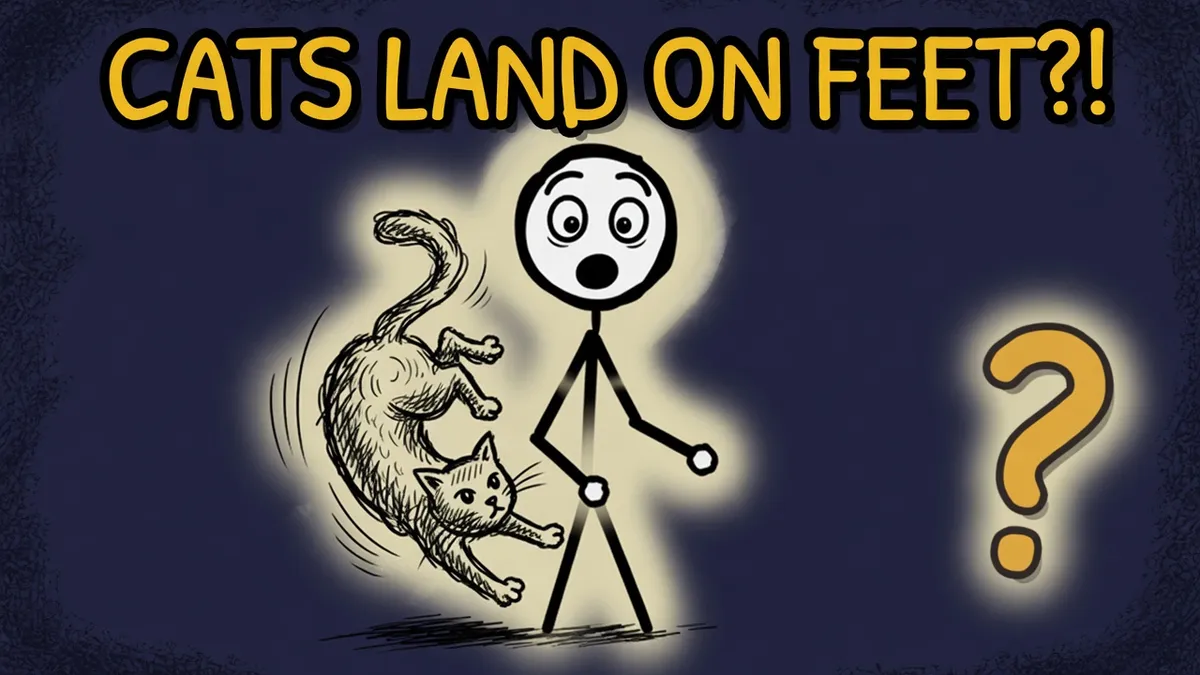
Hold a cat upside down, a short safe drop above a soft cushion, and let go. Before it lands, it will have flipped itself the right way up and touched down on all four feet, calm as anything. Now here's the genuinely puzzling bit: you didn't spin it. It started with no rotation at all. And yet somehow, in mid-air, with nothing to push against, it turned itself completely over. For a moment it looks like the cat is cheating physics. It isn't. The secret is that a cat, unlike a thrown ball, is allowed to change its shape, and that changes everything.
01 · The reflexKnowing which way is down
The whole manoeuvre is called the righting reflex, and the first thing to understand is that it’s a reflex, automatic, not a learned trick. Before a cat can turn upright, it has to know which way up is, and for that it uses the same organ you do: the vestibular system in the inner ear, a fluid-filled set of canals that senses gravity and acceleration. The instant a cat feels itself falling, the inner ear reports which way is down, the eyes confirm it if there’s light, and the reflex fires. The head swivels level first, and then the body follows it round.
02 · The impossible turnSpinning from nothing
Now the physics puzzle. There’s a law called conservation of angular momentum: a spinning thing keeps spinning, and a non-spinning thing can’t just start spinning on its own with no outside push. A cat dropped with zero rotation should, by that logic, stay upside down all the way to the floor. So how does it flip? The answer is a loophole, and it’s a beautiful one. The law says a rigid body can’t rotate itself. But a cat is not rigid. It can bend, and a bending body can reorient itself while its total angular momentum stays exactly zero the whole time. The cat doesn’t break the rule. It wriggles through a gap in it.
03 · Bend and twistTwo cats in one
Here’s the actual move, and it’s ingenious. The cat bends at the waist, effectively splitting itself into two halves that can rotate separately, a front half and a back half. Then it plays with its own inertia. It pulls its front legs in tight, like a spinning skater pulling in their arms, so the front half whips around quickly. Meanwhile it stretches its back legs out, which makes the back half resist turning, so it barely moves. Then the cat swaps: front legs out, back legs in, and now the back half swings round to catch up. Front and back rotate in opposite directions so the totals always cancel to zero, yet the whole cat ends up flipped. It’s less a spin than a very fast, very clever shrug.
People assume the tail is the key, a rudder the cat swishes to turn. It barely matters. Cats with no tail at all, like the Manx breed, right themselves just fine, because the real work is done by the flexible spine and the legs. This whole mystery was actually cracked in 1894 by the French scientist Etienne-Jules Marey, who photographed a falling cat at twelve frames a second. His images proved two things that stunned people at the time: the cat genuinely starts with zero rotation (it isn't secretly pushing off your hands), and air resistance has nothing to do with it. The cat really is spinning itself from nothing, by bending.
04 · The myth in the word 'always'When it fails
Now for the uncomfortable truth buried in the phrase “cats always land on their feet.” They don’t. The flip takes time and space, so a cat needs a minimum height, very roughly a foot, to complete the turn. Fall from lower than that and it can hit the ground still half-twisted. And here’s the part people forget: landing on your feet is not the same as landing safely. Vets have a name for the injuries cats suffer falling from windows and balconies, “high-rise syndrome”, and it’s grim: chest trauma, shattered jaws, broken legs. One study of 132 fallen cats found 90 percent had chest injuries even though most had landed feet-first. The reflex is brilliant. It is not a force field.
05 · The strange high-floor twistTerminal velocity and a caveat
There’s one genuinely weird wrinkle in the vet data, and it needs handling with care. That famous 1987 study noticed something counterintuitive: cats falling from very high, above about seven storeys, sometimes turned up with less severe injuries than cats falling from middling heights. The proposed reason is oddly lovely: after a few storeys a falling cat hits terminal velocity and stops accelerating, at which point it seems to relax and splay out its limbs like a little parachute, spreading the impact. It’s a charming idea, but treat it with real caution. It’s skewed by survivorship bias: cats that die on impact from great heights often never reach a vet to be counted. So please don’t read any of this as “higher is safer.” Falls are dangerous, full stop.
06 · The payoffSo why do cats always land on their feet?
Because they carry an automatic sense of down in their inner ear, and a body flexible enough to exploit a genuine loophole in the laws of motion, bending in the middle and counter-rotating their halves to turn upright from a standing start of zero spin. It’s real, elegant physics, worked out by photographing a falling cat over a century ago, and it’s a reflex so good it looks like magic. But hold onto the caveat, because it matters for real cats and real windows: they land on their feet remarkably well, not perfectly, and never from too low, and landing upright has never once stopped a hard fall from hurting. The cat isn’t unbreakable. It’s just an extraordinarily good gymnast, falling.
Quick questions
Why do cats always land on their feet?
Cats have an inbuilt righting reflex that reorients their body feet-first as they fall. Their inner ear senses which way is down, and their flexible spine and collarbone-free shoulders let them twist round in mid-air. It is automatic and fast, though it is not truly foolproof.
How do cats twist in mid-air without spinning to begin with?
The cat bends at the waist and turns its front and back halves in opposite directions. By tucking its front legs in it spins the front quickly, while extending the rear legs keeps the back nearly still, then it swaps. This lets the whole body flip over while its total angular momentum stays at zero, so no law of physics is broken.
Do cats really always land on their feet?
No, always is a myth. Cats right themselves very reliably from a decent height, but they can still land badly, and even a perfect feet-first landing does not prevent injury from a hard fall. Vets treat cats regularly for fall injuries known as high-rise syndrome.
Can a cat survive a fall from any height?
Not guaranteed. Cats survive many falls that would seriously hurt a human, partly because their terminal velocity is lower (about 60 mph). But high falls still cause chest trauma, broken limbs and facial fractures, and some cats die. A 2025 study of 1,125 fall cases found about 87% survived, meaning roughly one in eight did not.
At what age can kittens land on their feet?
The righting reflex begins to appear at around 3 to 4 weeks of age and is fully developed by roughly 6 to 9 weeks. Very young kittens cannot right themselves reliably, so newborns are far more vulnerable to falls.
Does a cat use its tail to land on its feet?
The tail helps with balance and fine adjustment, but it is not essential. Cats turn mainly by moving their legs and twisting their spine, which is why tailless breeds such as the Manx can still right themselves perfectly well.
Why doesn't the cat righting reflex break the law of conservation of angular momentum?
Because a cat is not a rigid object. A rigid body cannot start spinning in free fall, but a body that changes shape can reorient itself while keeping its total angular momentum at zero. The cat's counter-rotating front and back halves cancel out, so the sum never changes even as the whole cat flips.
What is high-rise syndrome in cats?
It is the pattern of injuries vets see in cats that fall from windows, balconies or roofs. Common injuries include chest trauma, facial and hard-palate fractures, and broken limbs. It is most common in warmer months when windows are left open.
Do cats fall from high floors survive better than from lower floors?
Some veterinary data suggests cats falling from above about seven storeys sometimes had less severe injuries than those from middle heights, possibly because they reach terminal velocity, relax and spread out like a parachute. However this finding is debated and is affected by survivorship bias, since cats killed outright are less likely to reach a vet and be counted. It should not be read as higher is safer.
What is the minimum height a cat needs to land on its feet?
Cats need roughly 30 cm (about 12 inches) of fall to have time to complete the turn. From lower than that they may hit the ground before they can flip, which can cause injury. This figure is an approximation widely repeated across sources.
How do cats know which way is up when they fall?
They use the vestibular apparatus in the inner ear, the same balance organ humans have, together with their eyes when there is enough light. This tells the cat its orientation so the reflex can turn the head level first, with the body then following.
Who first worked out how falling cats turn over?
The French scientist Etienne-Jules Marey settled it in 1894 by photographing a falling cat at about 12 frames per second. His images proved the cat starts with no rotation and does not push off the person dropping it, and that air resistance is not the cause, revealing the true bend-and-twist mechanism.
Our sources 8 checked
// every claim on this page was checked before it went up