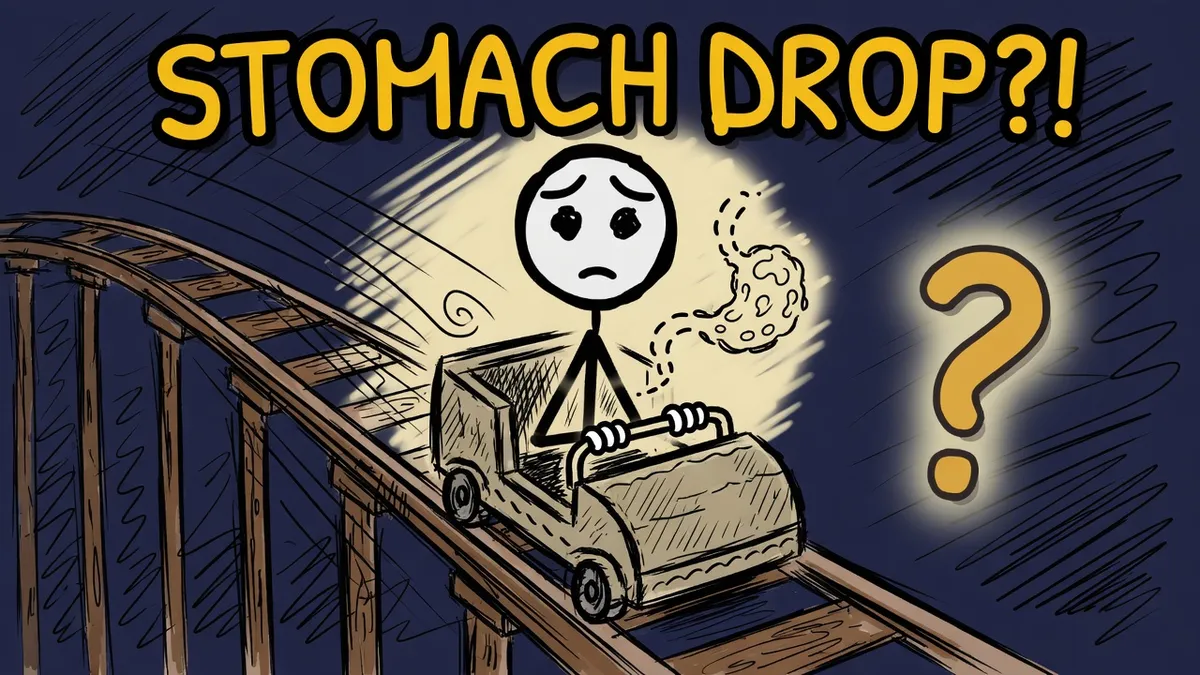
Here is an uncomfortable fact about your own anatomy: your organs are not bolted down. They are slung inside you on sheets and fans of tissue with a little give, held in place mostly by the simple fact that gravity keeps pressing them gently downward. Which is fine, right up until you crest the first big drop on a rollercoaster and gravity, for a second or two, stops doing its job. Then your insides float. And you feel every millimetre of it.
01 · The momentGoing over the top, you and your guts fall together
The whole trick happens right at the crest. As the car tips over the top of the hill and begins to plunge, it starts accelerating downward at close to the acceleration of gravity itself. Here is the key idea: a falling object cannot feel its own weight, because everything about it is falling at the same rate. So as you go over the top, you and your bones and your blood and your organs are all dropping together, and for that moment the normal upward support that holds your insides in place falls toward zero. You are, briefly, in free fall. Astronauts float for the same reason: not because there is no gravity in orbit, but because they are falling continuously. On a coaster you get a second of it. In space you get days.
02 · The organ floatWhy it is your abdomen, not your stomach
So what actually creates the sensation? Your abdominal organs hang from the back wall of your belly by a fan of tissue called the mesentery, threaded with blood vessels and nerves. Normally it holds everything in position against the steady downward pull. Take that pull away, and the organs drift upward a small amount, and that upward drift stretches the mesentery and tugs on the nerves woven through it. Those nerves are not precise, they are the vague, aching, hard-to-locate kind, which is exactly why the feeling is a diffuse swoop across your whole midsection rather than a sharp signal from the stomach in particular. Calling it a “stomach drop” is a small anatomical slander. It is really your entire suspended gut, floating for a heartbeat.
03 · The inner earThe little crystals that scream "we are falling"
Your gut is not the only tattletale. Deep in each inner ear sit the otolith organs, the utricle and saccule, and their whole job is to detect straight-line acceleration and the direction of gravity. They do it with tiny crystals resting on a jelly membrane: when you accelerate, the crystals lag and bend the sensory hairs beneath them, and your brain reads the motion. When you plunge over that crest, the crystals shift and fire off an unambiguous message, “we are dropping,” which your brain would receive even with your eyes shut. This is the same organ that gives you the falling jolt in a fast lift, and the reason you can sense the start of a descent before you can see it.
You can feel the drop before you have dropped at all. At the very top of the lift hill, still crawling upward, plenty of people already get the swoop. That one is not physics. That one is your own brain, running ahead of the ride.
04 · The conflictYour ears say fall, your eyes say lap bar
Your brain does not trust any single sense; it builds your feeling of motion by cross-checking the inner ear, the eyes, and the stretch and pressure sensors all over your body. On a drop, those sources stop agreeing. Your otoliths are shouting that you are plummeting, while your eyes are fixed on a lap bar that is not moving an inch relative to your face. That sensory conflict is part of what makes the moment feel so vivid and strange, and if it drags on (say, reading in a moving car, or a long queasy boat) the same mismatch is what tips people into motion sickness. The drop is a very concentrated, very brief hit of that disagreement, which is a large part of why it is so hard to ignore.
05 · The engineeringAirtime, negative g, and the shape of a hill
None of this is an accident. The swoop is a thing coaster designers manufacture on purpose, and they have a word for it: airtime, those moments of near-weightlessness when you go light in the seat. Positive g presses you down into the seat; negative g lifts you out of it, and the downward-curving parts of the track are engineered to produce it. Gentle “floater” airtime gives you a long, soft lift; sharp “ejector” airtime yanks you up hard and delivers the strongest stomach-drop of all. Designers shape the crest of each hill, its exact curve, as a dial to set how much of this you get. There are limits, though. Strong ejector hills reach somewhere around minus 1 to minus 1.5 g, and they keep it brief on purpose, because sustained negative g starts forcing blood toward your head, which is genuinely dangerous. The swoop is tuned right up to the edge of comfort and then held there for only a heartbeat.
06 · The mind's head startWhy anticipation makes it worse
Then there is the part that is not physics at all. Ask people where they feel the drop most and a surprising number will say the top of the lift hill, before the fall has even begun. That is pure anticipation: your brain knows what is coming, floods you with adrenaline, and starts bracing your body for a plunge that has not physically happened yet. This is why the first ride is always the worst and the tenth is a shrug, and why a nervous first-timer white-knuckling the bar feels the swoop harder than the bored regular next to them. The organs float the same amount for everyone. The dread is bring-your-own.
07 · The payoffThe same feeling, all the way to orbit
So your stomach drops because, for one clean second, you are falling as fast as your own insides, and they float. The mesentery stretches, the inner-ear crystals shift, your eyes and ears fall out of agreement, and your brain, half a step ahead, has already braced for the whole thing. Here is the tidy finish: astronauts get this same feeling not for a second but for days. Continuous free fall means their organs and otoliths stay unweighted, and for the first two to four days in space most feel disoriented and queasy with space adaptation syndrome, until the brain quietly rewrites its rules and the falling feeling simply stops. A rollercoaster, in other words, is a two-second, ground-level taste of what it feels like to leave the planet. You just have to come straight back down.
Quick questions
What actually 'drops' when your stomach drops?
Not your stomach specifically. As the car pitches over the crest and starts to fall, the whole set of abdominal organs is briefly unweighted and floats up a little against the mesentery, the fan of tissue that suspends them from the back of the abdomen. The stretch on that tissue and its nerves is what you feel, which is why the sensation is a diffuse abdominal lurch rather than a pinpoint in the gut.
Is your stomach really moving on a rollercoaster?
Only slightly, but yes. Your organs are not rigidly fixed; they are slung on membranes with some give. When the force holding them down briefly disappears, they shift upward by a small amount relative to the body wall. It does not take much movement to tug on the sensitive tissue and register as that unmistakable falling feeling.
Why does it feel like your stomach drops when you go over a hill?
Because at the crest the car starts accelerating downward at close to the acceleration of gravity, so for a moment you and your organs are in near free fall. The normal upward support on your insides falls toward zero, they float, and the balance organs in your inner ear register the fall. All of that together produces the swoop.
What is 'airtime' on a rollercoaster?
Airtime is the amusement-park word for those moments of near or actual weightlessness when you feel light in the seat or lifted against the restraint. It happens whenever the track curves downward fast enough that the car is briefly falling out from under you. 'Floater' airtime is gentle and sustained; 'ejector' airtime is a sharp, strong yank and produces the most intense stomach-drop.
What is negative g-force?
Positive g pushes you down into your seat; negative g does the opposite, lifting you out of it. A rollercoaster produces negative g on the downward-curving parts of the track. Strong ejector airtime hills can reach roughly minus 1 to minus 1.5 g for a moment. It stays brief on purpose, because sustained negative g forces blood toward the head and becomes dangerous.
Which part of the inner ear senses the drop?
The otolith organs, the utricle and saccule, tucked in each inner ear. They contain tiny crystals sitting on a jelly-like membrane, and they sense linear acceleration and the pull of gravity. When you fall, the crystals shift and signal the change, telling your brain you are dropping even with your eyes closed.
Why does the feeling get stronger when your eyes are conflicting with your body?
Your brain builds its sense of motion from several inputs at once: the inner ear, the eyes, and pressure and stretch sensors in the body. On a drop, your balance organs shout that you are falling while your eyes are locked on the lap bar, which is not moving relative to you. That mismatch heightens the lurch and, if it goes on, is a big part of what causes motion sickness.
Do you get the same feeling in a lift or a plane?
Yes, it is the same mechanism. A lift that starts down quickly, or a plane dropping in turbulence, briefly reduces the support on your organs and gives you a smaller version of the coaster swoop. Any sudden downward acceleration will do it, which is why the 'elevator drop' feeling and the rollercoaster feeling are cousins.
Why do you feel it at the top of the lift hill, before the drop?
That part is not physics, it is anticipation. At the very top, before you have actually started to fall, many people already feel the swoop. That is expectation and a rush of adrenaline priming your body for what it knows is coming. The pre-drop version is your brain, not your organs floating, which is why nervous first-timers often feel it strongest.
Why does the crest of a drop have that particular shape?
Coaster designers shape the top of a hill to control exactly how much airtime you get. A rounded, carefully calculated curve at the crest lets the car fall away from you at close to free-fall for a controlled moment, producing floater or ejector airtime by design. The geometry of that hump is essentially a dial for how strong the stomach-drop will be.
Can the stomach-drop feeling ever be dangerous?
The feeling itself is harmless: it is just your organs shifting a few millimetres and your nerves reporting it. The forces are what designers keep in check. Sustained negative g is limited because it sends blood to the head, and peak positive g is kept to brief bursts, so a properly engineered ride keeps everything inside safe limits. The swoop is intense but not damaging.
Do astronauts feel their stomach drop in space?
In effect, yes, and it does not stop. In orbit, everything is in continuous free fall, so the otolith organs and floating viscera are unweighted the whole time. For the first two to four days most astronauts feel disoriented and queasy, a condition called space adaptation syndrome, until the brain recalibrates and the falling feeling fades.
Why do some people love the stomach-drop and others hate it?
It comes down to how your brain interprets the same signals. The falling sensation is identical, but some people read the adrenaline and the loss of control as thrilling while others read it as alarm. Personality, prior experience and how prone you are to motion sickness all shift where you land, which is why one seat can hold a screamer and a laugher side by side.
Take the quiz on this
A quick 4-question check on what you just read. Get them right to earn XP: no points for just scrolling.
Our sources 8 checked
// every claim on this page was checked before it went up