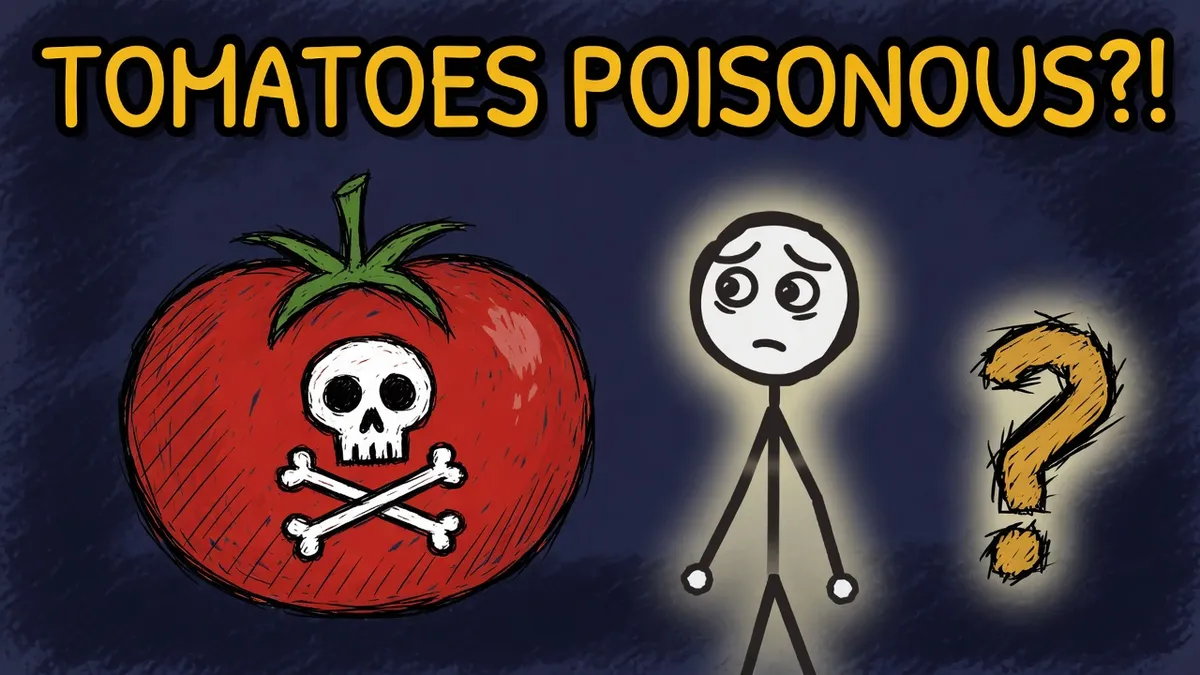
Here is a fruit you have almost certainly eaten this week, and for roughly two centuries a good chunk of Europe regarded it as a plausible way to die. Not disliked. Not merely strange. Suspected of being genuinely lethal. The tomato arrived from the Americas, sat on tables next to things people happily ate, and was quietly filed under "do not risk it." The interesting question isn't just why. It's how much of the fear was ever real, because the story you've heard is a myth wrapped around a myth.
01 · The familyIt keeps very bad company
Start with the one part that’s completely true: the tomato is a nightshade. Botanically, it belongs to the family Solanaceae, and its relatives are a rogues’ gallery of European folklore. Deadly nightshade, the belladonna used to poison and to dilate the eyes of Renaissance women. Mandrake, the shrieking root of witch legend. Henbane. All genuinely toxic, all deeply woven into the continent’s fear of poisonous plants. When a new red fruit showed up wearing the family resemblance, the leaves, the flowers, the whole botanical bearing, herbalists didn’t need to see anyone drop dead. Guilt by association was enough.
02 · The verdictThe herbalists write it down
This wasn’t vague superstition; it got formalised. In 1544 the Italian herbalist Pietro Andrea Mattioli described the tomato and grouped it with the mandrake, one of the family’s most notoriously toxic members. Half a century later, in England, John Gerard’s hugely popular 1597 Herball called the tomato foul-smelling and unfit to eat. Gerard’s word carried weight, and his suspicion stuck to the fruit in Britain and its American colonies for generations. The tomato didn’t just look guilty. It had been convicted in print by the authorities of the day.
03 · The chemistryThe one part that's actually toxic
Now, the tomato isn’t entirely innocent, and this is the part people skip. The plant really does make a poison: a steroidal glycoalkaloid called tomatine, a natural pesticide concentrated in the leaves, the stems, and the green unripe fruit. So the old instinct wasn’t pure fantasy. But two facts defuse it. First, tomatine is far gentler on humans than the alkaloid that gives its cousin the potato a bad name, solanine. Second, the ripe red fruit contains only traces. Food writer Harold McGee, going looking, found scant evidence of tomato toxicity in the medical and veterinary literature at all. You’d have to eat something on the order of a pound of leaves to feel unwell, which is not a thing that happens by accident.
04 · The pewter storyThe tale everyone repeats
Here’s the explanation you’ve almost certainly heard, told with total confidence: wealthy Europeans ate off high-lead pewter plates; the tomato’s unusual acidity leached the lead right out of the metal; and the resulting lead poisoning got blamed on the fruit. It’s a wonderful story. It has a villain (lead), a mechanism (acid), and a twist (the fruit was framed). And you should hold it at arm’s length. The chemistry is real in principle, acid can pull lead from lead-bearing metal, but the historical claim is thinly documented, and it has the suspicious neatness of an explanation reverse-engineered to feel satisfying.
The lead-plate story that "explains" the tomato scare may itself be a modern invention. Chemist Joe Schwarcz of McGill argues the lead actually leached would be trivial, nowhere near enough to make anyone sick, so the tidiest part of the legend is quietly the shakiest.
05 · The hole in the storyHalf of Europe was already eating them
If tomatoes were a poison Europe feared, someone forgot to tell the Italians. Spain and Italy were cooking with the fruit by the mid-1500s, decades before northern Europe unclenched. That single fact quietly wrecks the strong version of the scare. And it gets sharper: Gerard knew. He was aware Italians and Spaniards ate tomatoes without dying, and he called the fruit poisonous anyway. So the fear was never a continent-wide truth about the tomato. It was a regional, bookish suspicion, strongest exactly where people weren’t actually eating them.
06 · The courthouse legendThe hero who probably never existed
Every good myth wants a redemption scene, and the tomato got a famous one. The story goes that in 1820, a gentleman farmer named Robert Gibbon Johnson stood on the courthouse steps in Salem, New Jersey, and ate a whole basket of tomatoes before a horrified crowd who expected him to keel over. He didn’t, and the tomato was saved. It’s a great scene. It’s also unsubstantiated folklore. Johnson was a real man who did grow tomatoes, but no contemporary record of the courthouse stunt exists. The tale was popularised by a local postmaster and first written down around 1940, over a century after the supposed event, then dressed up with invented dialogue in later books.
07 · The payoffA myth wrapped in a myth
So why were tomatoes thought poisonous? Peel it back and there are three honest layers. One is real and chemical: the tomato is a nightshade whose leaves genuinely carry a mild toxin. One is cultural: the great herbalists put their suspicion in print, and print is sticky. And the third is the twist, that much of what we “know” about the fear, the poisoned aristocrats, the two centuries of dread, the brave man on the courthouse steps, is itself myth, sharpened by retelling until it hardened into fact. The tomato was never really out to get anyone. But the story of the tomato that was out to get everyone turned out to be far too good to check.
Quick questions
Were tomatoes ever actually poisonous?
The ripe fruit was never dangerous to eat. What's true is that the tomato is a nightshade, and its leaves and stems contain a mildly toxic alkaloid called tomatine. But the reputation was mostly guilt by botanical association, not real poisonings from the fruit itself.
Why did people think tomatoes were poisonous?
Three things stacked up. First, botanists correctly filed the tomato in the nightshade family, the same family as deadly nightshade and mandrake, so it inherited their sinister reputation. Second, the plant's leaves genuinely are mildly toxic. Third, a much-repeated story blames lead poisoning from pewter plates, though that part is poorly documented.
Is the lead-poisoning pewter plate story true?
Treat it with real caution. The claim is that acidic tomatoes leached lead from aristocrats' pewter plates and the resulting sickness was blamed on the fruit. It's repeated everywhere, but it's thinly sourced, and chemists like McGill's Joe Schwarcz argue the amount of lead leached would be trivial. It reads more like a tidy modern explanation than a documented historical event.
What is tomatine and is it dangerous?
Tomatine is a steroidal glycoalkaloid the tomato plant makes as a natural pesticide. It's concentrated in the leaves, stems and green unripe fruit, and it's considered relatively benign to mammals, much milder than the potato's solanine. Ripe red tomatoes contain only traces, and normal amounts pass through people without notable ill effects.
Can you eat tomato leaves?
In small amounts, probably without harm, but they're bitter and it's not advised. The leaves do contain tomatine and some solanine. To actually make yourself sick, one estimate suggests you'd need to eat something like a pound (about 450 g) of leaves, which nobody does by accident.
Is the tomato really a nightshade?
Yes, literally. It sits in the Solanaceae family with deadly nightshade (belladonna), mandrake, henbane, potatoes, peppers and aubergines. That kinship is exactly why 16th-century herbalists eyed it with suspicion: it kept dangerous company.
Who classified the tomato as poisonous?
The Italian herbalist Pietro Andrea Mattioli described it in 1544 and grouped it with the mandrake, a notoriously toxic nightshade. In England, John Gerard's popular 1597 Herball called it foul-smelling and unfit to eat, and his view held sway in Britain and its colonies for a long time.
Did anyone in Europe eat tomatoes early on?
Yes, and this is the detail that deflates the scare story. Spain and Italy were cooking with tomatoes by the mid-1500s, well before northern Europe came around. Gerard himself knew Italians and Spaniards ate them safely and still called the fruit poisonous, so the 'fear' was never universal.
Who was Robert Gibbon Johnson?
A gentleman farmer from Salem, New Jersey, credited with introducing tomatoes to the area around 1820. He's the star of a famous legend: that he ate a basket of tomatoes on the courthouse steps to prove they were safe. He was a real person, but that dramatic scene is almost certainly invented.
Did a man really eat tomatoes on the courthouse steps to prove they were safe?
Almost certainly not as told. The Robert Gibbon Johnson courthouse story is unsubstantiated folklore. No contemporary record of it exists; it was popularised by a Salem postmaster and first written down around 1940, well over a century after the supposed 1820 event, then dramatised with invented dialogue in later retellings.
Were tomatoes feared for 200 years?
That's the headline you'll see, and it's half true at best. Northern Europe was slow to adopt the tomato, but southern Europe ate it happily the whole time. The neat 'poisonous for two centuries' story is itself a bit of a myth, sharpened and repeated until it sounded like settled fact.
Why is the tomato acidic, and does that matter?
Ripe tomatoes are unusually acidic for a fruit, which is the seed of the pewter-plate theory: acid can leach lead from lead-containing metal. The chemistry is real in principle, but whether it ever caused meaningful poisoning attributed to tomatoes is not well documented, so the acidity is better treated as a plausible ingredient in a story than as proof.
Are any parts of the tomato plant still considered toxic today?
The green leaves, stems and vines contain the most alkaloids and are the parts to avoid eating in quantity. The ripe fruit is entirely safe. Even unripe green tomatoes, often fried, are eaten routinely with no ill effect, because the tomatine levels involved are low.
What finally made tomatoes popular?
Time, cooking, and southern Europe leading by example. As tomatoes became central to Italian and Spanish food and spread through cookbooks and gardens, the old herbalists' warnings simply lost their grip. By the 19th century the fruit was mainstream, and the fear survives now mostly as a good story.
Take the quiz on this
A quick 4-question check on what you just read. Get them right to earn XP: no points for just scrolling.
Our sources 9 checked
// every claim on this page was checked before it went up