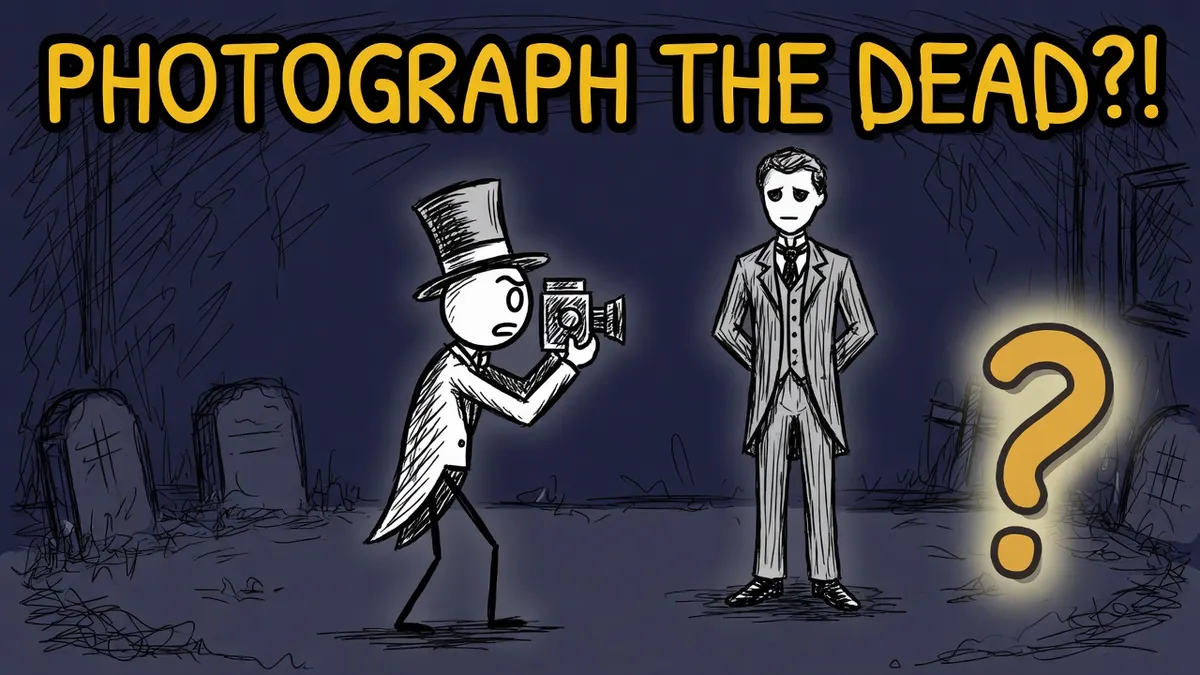
Start with the part that gets misunderstood, because almost everything you have heard about this is wrong, and the truth is gentler than the myth. A Victorian family loses a child. They have no photograph of that child, because photographs are expensive and rare and life has been short. So they do the only thing left to them: they call a photographer to make one picture, after death, to keep. Not out of morbidity. Out of the plain human need to have something to hold on to. This is a story about grief, and about a technology arriving at exactly the wrong, and right, moment.
01 · The arrivalA new machine that could keep a face
In August of 1839, in Paris, the daguerreotype was announced to the world. For the first time in human history, an ordinary person could have their exact likeness captured, not painted by an artist over days at great cost, but fixed by light onto a silvered plate. The French government bought the process and gave it away freely, and photography spread across the world within months.
But “possible” is not the same as “cheap.” Each daguerreotype was a single one-off image on a plate of silvered copper, made by a professional, and it cost real money. For most working families it was something you did perhaps once in a lifetime, if at all. Which means that for a great many Victorians, no photograph of them existed. There simply had never been a reason, or the money, to make one.
02 · The arithmetic of griefWhy the picture was so often the only one
Now lay that against the other great fact of the age: Victorian children died in numbers that are hard to sit with. The figures vary by place, by decade, and by how poor the neighbourhood was, but around 1840 in England, very roughly a third of children did not live to see their fifth birthday, and something like one baby in six died before its first. Estimates differ, and the worst slums were far grimmer than the leafy suburbs, but the shape of it is not in doubt: death came early, and it came for the young.
Put the two facts together and the whole practice explains itself. A photograph was rare and dear. A child’s life could be terribly brief. So the moment a child died was, for many families, the last possible chance to have any image of them at all. The post-mortem portrait was frequently the first and only photograph that would ever exist of that person. That is the real reason. Not a taste for the macabre: a race against having nothing.
03 · How the pictures were madePosed as if sleeping
Genuine post-mortem portraits are, on the whole, quiet things. The person is usually shown lying down as though asleep, in bed or sometimes in the coffin, eyes closed, at peace. Very often a child is held in a mother’s or father’s arms, or laid among flowers. The Victorians did not, by and large, try to disguise death. They photographed it plainly and tenderly, the way you might photograph someone dozing.
Where retouchers did intervene, it was to soften. A little rosy tint might be brushed onto the cheeks to counter the pallor. Occasionally, on the finished print, an artist would paint open eyes onto the closed lids, so the keepsake looked a fraction more like the living person the family remembered. Small mercies, applied by hand, to make a hard thing easier to hold.
Nearly everything creepy you have seen about this, the "hidden stands that held dead bodies standing upright", is a modern myth. And the object at the centre of it proves the exact opposite of what the myth claims.
04 · The mythThe corpse that did not stand up
Here is the story that spreads: that Victorians used concealed metal armatures, “posing stands”, to prop their dead upright and photograph them standing among the living, eyes eerily open. It is all over the internet, attached to hundreds of unsettling images. And it is, as far as the evidence goes, false.
Posing stands were real. But they were headrests for the living. A living sitter had to hold still through a long exposure, and a stand behind the body, with a gentle brace at the back of the head, helped steady them. Crucially, these things were slight, roughly the strength of a modern microphone stand. They could not begin to bear the dead weight of a human body. A corpse cannot balance, cannot be held up by a light metal rod, and in rigor cannot be posed at all. So the logic flips completely: if you see a stand behind a person in a Victorian photograph, that is strong evidence the person was alive. The stand is not proof of death. It is proof of life.
05 · Why the fakes went viralMost 'dead' people online are alive
So where do all those “standing corpse” images come from? Mostly from mislabelling. Photo historians and collectors who actually study this material, among them Jack Mord’s Thanatos Archive, one of the largest collections of genuine post-mortem and mourning photography, have shown repeatedly that the great majority of viral “post-mortem” pictures show ordinary living people. The stiff pose, the neutral face, the faint stand in the background: to modern eyes it all reads as death, but it is simply what a normal portrait looked like when you had to hold still.
Two related myths fall at the same time. The first is that unsmiling faces mean corpses. They do not. People kept a neutral expression partly because long exposures made a held smile a nightmare, and partly because a serious face was the fashion. The second is that exposures took so long only the dead could sit still. Also untrue for most of the era. The first daguerreotypes of 1839 did need minutes, but by the early 1840s it was under a minute, and by the late 1840s and 1850s a portrait took just a few seconds. Plenty of living, breathing, blinking people held still perfectly well.
06 · The wider cultureA whole society dressed in black
Post-mortem photography did not happen in isolation. It sat inside a Victorian culture that kept the dead unusually close, and much of that culture flowed from the top. When Prince Albert died in 1861, Queen Victoria put on black and, famously, never took it off again, wearing mourning for the remaining forty years of her life. Her grief set the tone for a nation.
Ordinary mourning became a set of elaborate, staged rules, especially for widows, who were expected to pass through years of “deep mourning” and then “half-mourning”, each with its own dress. And people wore their grief literally. Mourning jewellery was made from black Whitby jet, and, most touchingly, from the actual hair of the person who had died, woven into intricate patterns and set under glass in lockets, brooches and rings. Demand for human hair grew large enough that England imported it in quantity. A photograph of the dead was one keepsake among many in a society that refused, quite deliberately, to let go.
07 · The twist we don't admitWe never actually stopped
It is comfortable to file all of this under “things strange people did long ago.” But here is the part that should stop you. We still photograph the dead. We simply moved it to the hospital and stopped talking about it.
When a baby is stillborn, or dies soon after birth, many hospitals now quietly offer the parents bereavement photography. A charity called Now I Lay Me Down to Sleep, founded in 2005, runs a network of over 1,700 volunteer photographers who come to the hospital, free of charge, to make gentle portraits of a baby the parents will otherwise never get to picture. Often the family holds the child. Often it is done in soft black and white. And the reason is word for word the Victorian reason: it may be the only photograph of that person that will ever exist.
08 · The payoffSo why did they photograph the dead?
Because a photograph was rare, and life was short, and love needs something to hold. Strip away the invented armatures and the eerie captions and the myth of the standing corpse, and what is left is almost unbearably ordinary: parents who had lost a child, and one chance to keep a picture of them. They posed the child as if sleeping, tinted the cheeks so it hurt a little less, and kept the plate for the rest of their lives.
We look at those images now and feel a shiver, and we should probably ask why. The Victorians were not being ghoulish. They were doing the most human thing there is, in the only way then available to them. And when a nurse today hands a grieving mother a single black-and-white photograph of the baby she never got to bring home, we are doing the exact same thing. We just don’t call it what it is.
Quick questions
Why did Victorians photograph dead relatives?
Chiefly because it was often the only chance. A photograph was expensive and taken rarely, and death, especially of children, came early and often. A post-mortem portrait might be the single image a family ever had of that person, so it was made out of love and remembrance, not ghoulishness.
When was the daguerreotype invented?
The daguerreotype process, the first practical photograph, was announced publicly in Paris on 19 August 1839. The French government bought the rights and released the method to the world, which is why photography spread so fast (with one quirk: it was patented separately in England and Wales).
Did Victorians really prop up corpses to stand them up for photos?
Almost certainly not, and this is the big myth. The claim that hidden metal 'posing stands' held dead bodies upright is false. Those stands were headrests for living sitters, designed to steady a living head during a long exposure. They were far too flimsy to bear a body's dead weight. As archivists put it: if you see a stand behind the person, that is strong evidence the person was alive.
So why do so many 'standing corpse' photos exist online?
Because most of them are mislabelled. Photo historians and collectors, including the Thanatos Archive, have shown that the vast majority of viral 'post-mortem' images actually show living people, sometimes steadied by a posing stand, which is precisely the detail that proves they were alive.
How could you tell someone in the photo was actually dead?
Genuine post-mortem images usually make no attempt to hide it. The person is typically shown lying down as if asleep, often in bed or in a coffin, sometimes held in a parent's arms. Real death portraits tend to read as peaceful repose, not as someone standing around looking oddly stiff.
Did they really paint eyes onto the photos?
Sometimes, yes. To soften the image, retouchers might tint the cheeks with a rosy blush or paint open eyes onto the closed lids of the print. It was an attempt to make the keepsake gentler to look at, closer to how the person looked in life.
Why are the people in old photos never smiling?
Mostly because early exposures were long, and holding a smile for many seconds is hard, so a neutral face was easier to keep still. It was NOT, as legend has it, because half of them were dead. The unsmiling Victorian is a matter of technology and fashion, not a room full of corpses.
How long did an exposure actually take?
It shrank fast. The very first daguerreotypes in 1839 needed minutes of stillness. By the early 1840s that was down to under a minute, and by the late 1840s and 1850s a portrait could be made in just a few seconds. So the 'they had to be dead to hold still' idea does not hold up for most of the era.
How expensive was a Victorian photograph?
Early on, quite expensive. A daguerreotype was a one-off image on a silvered copper plate and cost more than most working families could spend casually, which is exactly why many people were photographed only once, if ever. Cheaper formats later in the century made portraits far more common.
What was Victorian mourning culture like?
Elaborate and highly formal, and much of it took its cue from the Queen. After Prince Albert died in 1861, Queen Victoria wore black for the rest of her life. Widows were expected to mourn for years in stages, from full black to 'half-mourning', with strict rules about dress.
What is mourning jewellery?
Jewellery worn to remember the dead. The Victorians made lockets, brooches and rings from black Whitby jet, and famously wove the actual hair of a lost loved one into keepsakes under glass. Demand for hair was so large that England imported it by the tonne.
Do people still photograph the dead today?
Yes, and for the very same reason. Hospitals and charities offer bereavement photography for stillborn and dying babies, so that grieving parents have a photograph of a child they will otherwise never get to picture. One charity, Now I Lay Me Down to Sleep, runs a network of over a thousand volunteer photographers who do it free of charge.
Was post-mortem photography considered creepy at the time?
No. To the Victorians it was tender and ordinary, a natural extension of sitting for a portrait and of a wider culture that kept the dead close. The unease is largely modern: we became squeamish about death, and then reinterpreted their keepsakes as macabre.
Why does this topic feel so unsettling now?
Partly the myths, and partly us. Sensational 'standing corpse' stories spread far faster than the quiet truth, and we live at a greater distance from death than they did. Seen plainly, most of these images are just a family holding on to the only picture they had.
Take the quiz on this
A quick 4-question check on what you just read. Get them right to earn XP: no points for just scrolling.
Our sources 11 checked
// every claim on this page was checked before it went up