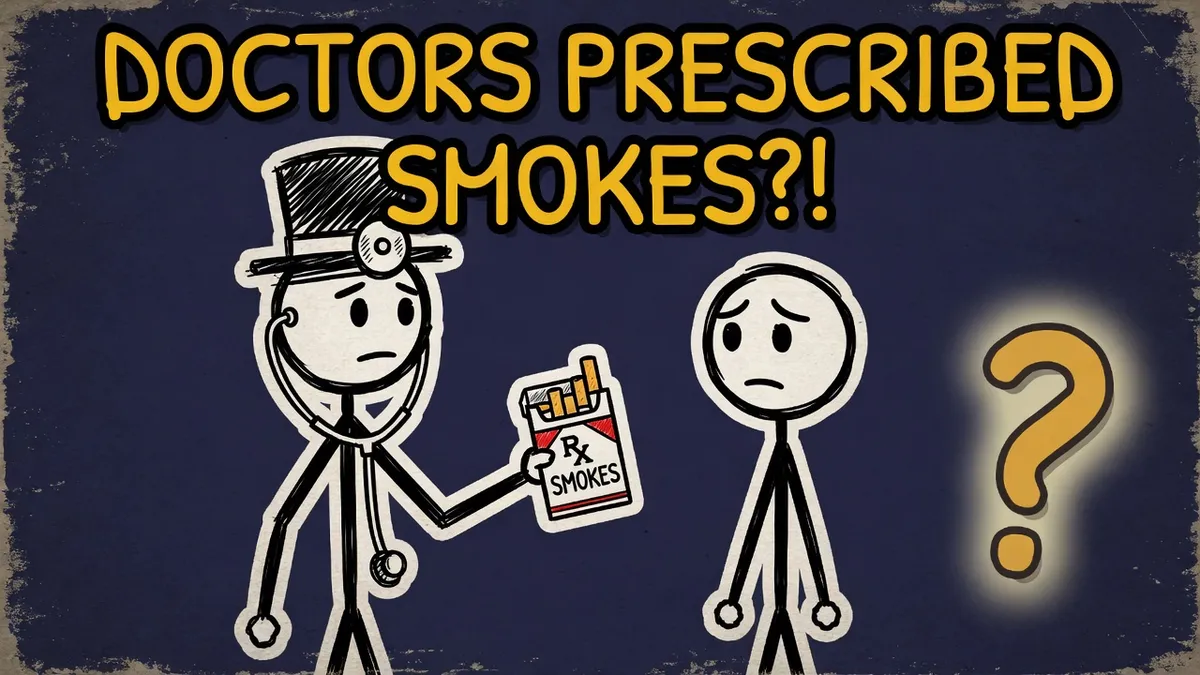
Picture a cigarette advertisement from the middle of the last century and there is a decent chance a doctor is in it. White coat, steady gaze, a Camel between two fingers, quietly assuring you that the smart, medical choice is also the pleasant one. It looks absurd now. At the time it looked like reassurance. And when that reassurance stopped working, when actual science arrived and pointed the other way, the tobacco industry did something far more clever and far more lasting than lie. It went into the business of selling doubt.
01 · The pitchThe man in the white coat
For roughly two decades, from the 1930s into the 1950s, American cigarette brands borrowed the most trusted figure they could find: the physician. Ads showed doctors mid-examination, quoted their supposed brand preferences, and reassured readers that a given cigarette was easy on the throat. This was not a considered medical position. It was a marketing device, and a shrewd one, because a doctor’s endorsement does a specific job: it converts a worry into a permission. If the profession that worries about your health smokes this brand, the reasoning goes, how bad can it be? It helped, too, that smoking was genuinely everywhere in this era, doctors included, so a physician with a cigarette looked ordinary, not scandalous.
02 · The surveyMore doctors smoke Camels (allegedly)
The most famous example is R.J. Reynolds’ campaign for Camel, which ran as the brand’s mainstay from about 1946 to 1952 under the slogan “More Doctors Smoke Camels Than Any Other Cigarette.” It even appeared inside medical journals. The line rested on an impressive-sounding figure: a survey of 113,597 physicians. The number is real. The method behind it is the interesting part. The polling, run through Reynolds’ advertising agency, frequently worked like this: a representative would hand a doctor a free carton of Camels, and then, with the gift still warm, ask which brand he smoked. A great many named the one they had just been given. The methodology was never properly published, which is its own kind of tell.
03 · The evidence turns1950, and the numbers stop being friendly
Then the science caught up, and it did so on two continents at once. In 1950, in the United States, Ernst Wynder and Evarts Graham published a study in the Journal of the American Medical Association. The same year in Britain, Richard Doll and Austin Bradford Hill published in the British Medical Journal, comparing lung-cancer patients with matched controls and finding that heavy smokers were on the order of 25 times more likely to develop the disease. A case-control study can be argued with, so Doll and Hill went further. In 1951 they began following a large group of British doctors forward in time, watching who smoked and who fell ill. When those prospective results came in around 1954, pointing the same way, the link became very difficult to wave off. The friendly face in the advertisements now had a serious problem.
04 · The PlazaA meeting, and a decision
In December 1953, the heads of the major tobacco companies gathered at the Plaza Hotel in New York. They brought in John W. Hill, of the public relations firm Hill & Knowlton, and the question on the table was blunt: what do you do when the science is turning against your product? Hill’s answer was not to fight the evidence head-on. It was to fund research, project openness, and let the resulting appearance of ongoing inquiry keep the matter looking unresolved. Out of that meeting came the Tobacco Industry Research Committee, and, on 4 January 1954, a full-page advertisement in hundreds of American newspapers titled “A Frank Statement to Cigarette Smokers.” It reached tens of millions of readers, promised the industry took their health seriously, and pledged independent research into the question. It was, read one way, a model of corporate responsibility. Read another way, it was the opening move of a very long game.
05 · The strategyDon't deny it, unsettle it
Here is the genuinely important shift, the one worth slowing down for. The industry did not, on the whole, stand up and declare that cigarettes were safe. That would have been a losing fight, and an expensive one, because proving a product harmless against a rising tide of evidence is close to impossible. What it did instead was quieter: it worked to keep the question open. It funded studies that offered other explanations, it amplified the honest caveats that exist in any young science, and it repeated, patiently, that the matter was not settled. You do not have to win a debate to benefit from it looking like a debate. Every year the science stayed “controversial” was another year of sales, and another year without regulation.
They never had to prove smoking was safe. They only had to keep it looking like the jury was still out. And that, it turns out, is a much cheaper thing to buy.
06 · Doubt is our productThe quiet part, written down
For years this was an inference from behaviour. Then the documents surfaced. An internal memo, generally known as the “Smoking and Health Proposal” and attributed to Brown & Williamson, dated 1969, states the strategy with a candour that is almost startling: “Doubt is our product since it is the best means of competing with the ‘body of fact’ that exists in the mind of the general public.” The line goes on to explain that doubt is also the best way to establish a controversy in the first place. It is not a smoking gun so much as a strategy memo, laying out in plain terms that the product being managed was not tobacco. It was public uncertainty.
07 · The legacyA tactic that outlived the cigarette
The government did, eventually, say it plainly. On 11 January 1964, US Surgeon General Luther Terry released a report concluding that cigarette smoking causes lung cancer in men and is a serious hazard to health. Warning labels and decades of policy followed. But by then the more durable invention was already loose in the world. In their 2010 book Merchants of Doubt, historians Naomi Oreskes and Erik Conway trace how a small group of figures took the tobacco template, the funded contrarian study, the demand for impossible certainty, the insistence that the science was not settled, and reused it against other findings: acid rain, the hole in the ozone layer, and later climate change. The tactic worked precisely because it hides where it is hardest to see, inside the real, honest uncertainty that all science carries. So the answer to why doctors once recommended cigarettes is really two answers. For a while, it sold cigarettes. And when it stopped selling cigarettes, the industry discovered something more valuable than any endorsement: that you can defend almost anything, for a very long time, simply by keeping the question open.
Quick questions
Did doctors really recommend cigarettes?
In advertising, yes. From the 1930s into the 1950s, cigarette brands used physicians as a badge of safety, showing doctors in white coats and quoting brand-preference surveys. It was a marketing device meant to borrow the doctor's authority, not a considered medical recommendation. Individual doctors also smoked heavily at the time, which made the imagery feel ordinary rather than shocking.
What was the More Doctors Smoke Camels campaign?
It was R.J. Reynolds' long-running advertising campaign for Camel cigarettes, running roughly from 1946 to 1952, with the slogan More Doctors Smoke Camels Than Any Other Cigarette. It leaned on a claimed survey of 113,597 physicians and ran everywhere, including inside medical journals like the Journal of the American Medical Association.
How was the doctor survey rigged?
The polling, done through Reynolds' ad agency, frequently involved handing doctors a free carton of Camels and then asking what brand they smoked. Unsurprisingly, a lot of them named the brand they had just been given. The methodology was never properly published, so the impressive-sounding number rested on a stacked question.
When did science prove smoking causes cancer?
The turning point was 1950. In the United States, Wynder and Graham published a study in JAMA, and in Britain, Richard Doll and Austin Bradford Hill published in the British Medical Journal, both linking smoking to lung cancer. Doll and Hill then followed a large group of British doctors over time and reported confirming, forward-looking results in 1954. That prospective design made the link very hard to dismiss.
What was A Frank Statement to Cigarette Smokers?
It was a full-page advertisement the tobacco industry ran in hundreds of US newspapers on 4 January 1954, reaching tens of millions of readers. It promised the public that the industry took the health question seriously and would fund independent research. In practice it launched the Tobacco Industry Research Committee, whose real job was to keep the science looking unsettled.
What does 'manufacturing doubt' mean?
It means a strategy of not trying to disprove an inconvenient finding, but instead emphasising uncertainty, funding alternative explanations, and repeating that 'the science isn't settled.' You don't have to win the argument. You only have to keep it looking like an open argument, which is enough to delay regulation and reassure customers.
What was the 'Doubt is our product' memo?
It is a line from an internal tobacco-industry document, generally known as the Smoking and Health Proposal, attributed to Brown and Williamson and dated 1969. It reads: Doubt is our product since it is the best means of competing with the 'body of fact' that exists in the mind of the general public. The document became public later through litigation and disclosure.
Why didn't the industry just argue smoking was safe?
Because that was a losing bet and an expensive one. Proving a product safe against mounting evidence is very hard. Keeping a question open is far easier: you fund a few contrarian studies, amplify genuine scientific caveats, and let normal uncertainty do the work. Doubt was simply the cheaper thing to buy.
What did the 1964 Surgeon General's report say?
On 11 January 1964, US Surgeon General Luther Terry released a landmark report concluding that cigarette smoking is a cause of lung cancer in men and a serious health hazard. It was the moment the US government formally stated the link, and it triggered warning labels and decades of policy that followed.
What is Merchants of Doubt about?
It is a 2010 book by historians Naomi Oreskes and Erik Conway arguing that a small group of people took the tobacco industry's doubt-making playbook and reused it against other findings, including acid rain, the ozone hole, and climate change. Its point is that the tactic outlived the original product.
Did doctors smoke a lot back then?
Yes. Smoking was extremely common across society in the mid-20th century, doctors included, which is part of why the imagery in the ads did not look strange at the time. Doll and Hill's decision to study British doctors specifically was clever partly because so many of them smoked and they were easy to follow up on.
Is this the same tactic used in other debates today?
The tactic, manufacturing the appearance of scientific controversy, is well documented as having been reused, most notably around climate change, and historians trace a direct line back to the tobacco template. That does not mean every scientific disagreement is manufactured. Real uncertainty exists too, which is exactly why the tactic works: it hides inside the normal, honest caveats of science.
When did doctors stop appearing in cigarette ads?
The overt physician-endorsement style faded through the 1950s as the health evidence mounted and became harder to stand next to. The American Medical Association stopped accepting cigarette advertising in its journal in the early 1950s, and by the 1960s the doctor-in-a-white-coat pitch had largely disappeared from tobacco marketing.
Why does this story still matter?
Because it is the origin of a technique, not just a period of bad advertising. The tobacco fight established that you can defend an indefensible product for decades simply by keeping the underlying science looking contested. Recognising that move is useful well beyond cigarettes.
Take the quiz on this
A quick 4-question check on what you just read. Get them right to earn XP: no points for just scrolling.
Our sources 10 checked
// every claim on this page was checked before it went up