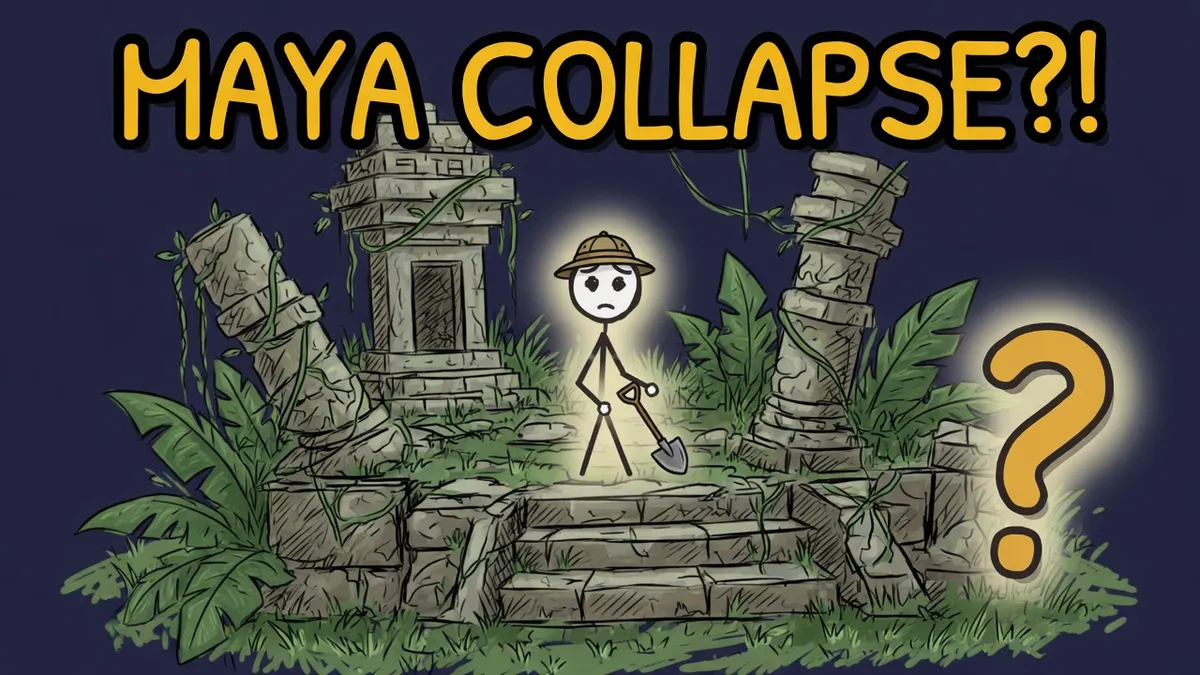
Deep in the jungles of Central America stand the ruins of a lost world: towering stone pyramids, sprawling plazas, cities that once held tens of thousands of people, now swallowed by rainforest. The great Maya cities were abandoned over a thousand years ago, and the popular story is irresistibly spooky, that an advanced civilisation simply vanished from the face of the Earth. It's a wonderful mystery. It also happens to be wrong on the most important point, and the real answer is written, of all places, in the mud at the bottom of a lake.
01 · The mythThey never actually disappeared
Let’s clear up the biggest misconception first, because everything depends on it. The Maya did not vanish. They are not a lost people. More than seven million Maya are alive today, living across Mexico, Guatemala, Belize and Honduras, speaking over thirty Maya languages, keeping traditions that stretch back thousands of years. So when historians talk about “the Maya collapse,” they don’t mean a people who disappeared. They mean something more specific and more interesting: a particular event, in a particular place, when the great cities of one region were abandoned and their way of life came apart.
02 · What actually collapsedThe cities went quiet
The event is called the Classic Maya collapse, and it happened roughly between 800 and 900 AD in the southern lowlands, the jungle heartland of cities like Tikal, Copan and Palenque. Archaeologists can date it with eerie precision because of two clues the Maya left behind. First, they were obsessive record-keepers, carving dates and histories onto stone monuments, and then, city by city, those carvings simply stop. Second, the enormous construction projects, the pyramids and palaces, cease. The cities didn’t explode or burn. They fell silent. The people drifted away, the jungle moved in, and a civilisation’s greatest cities were left to the vines.
03 · The mud that told the truthA drought you can measure
For decades, why this happened was genuinely mysterious. Then scientists found the answer in lake sediment. Layers of mud at the bottom of Maya-region lakes preserve a chemical record of ancient rainfall, and in 2018 a Cambridge team read that record with new precision. Their verdict was stark: during the collapse, the region was hit by a catastrophic drought, with annual rainfall dropping by an estimated 41 to 54 percent, and by up to 70 percent at its worst. This wasn’t a dry spell. It was a decades-long megadrought, striking exactly when and where the great cities failed. For a civilisation built on rain-fed farming in a seasonal jungle, that is a death sentence.
Here's the uncomfortable part: the Maya may have helped dig their own drought. Modern surveys reveal they cleared far more forest than anyone realised, to make farmland and to burn lime for all that dazzling white plaster on their pyramids. NASA modelling suggests that stripping the forest actually reduced local rainfall and worsened the drought. In other words, the environmental catastrophe wasn't purely bad luck from the sky. A thriving, growing civilisation cut down the trees, and the sky answered by holding back the rain. Neither the natural drought nor the deforestation alone would likely have been fatal. Together, they were.
04 · The other pressuresToo many people, too much war
Drought was the great driver, but it landed on a society already under strain. By the 8th century, the southern cities were crowded, their populations pressing hard against the land’s ability to feed them. And they were at war. The Maya city-states were not one peaceful empire but rival kingdoms locked in escalating conflict, above all the long, bitter rivalry between the superpowers of Tikal and Calakmul. Constant warfare wrecked trade, shattered alliances, and pulled farmers off the fields. So when the rains failed, the cities weren’t a resilient society weathering a bad patch. They were an overstretched, war-torn world, and the drought was the shove that toppled them.
05 · The half that survivedWhy the story isn't a tragedy
And yet even the “collapse” was not the end. While the southern cities emptied, something remarkable was happening to the north. In the Yucatan, the great city of Chichen Itza was rising, becoming the dominant power of its region during the very same period the southern cities fell. The centre of the Maya world didn’t disappear; it moved. The collapse was regional and staggered, not a single apocalypse, more like a slow shifting of power across a landscape than the death of a people. Which is exactly why the “vanished civilisation” framing misleads: the Maya didn’t end. They adapted, relocated, and carried on, as their descendants still do today.
06 · The payoffSo why did the Maya civilization collapse?
Because a crowded, war-weary world, farming a jungle it had partly deforested, was struck by one of the worst droughts in its history, a drought we can now measure to the percentage point. The great southern cities, dependent on rain that stopped coming, could not hold together, and their people left. That’s the real story, and it’s more sobering than any tale of a vanishing race, because it’s a story about a successful society overreaching its environment until the climate turned against it. The Maya didn’t disappear. Their cities were abandoned, their monuments fell silent, and their descendants are still here to tell you so. The mystery was never where they went. It was why the rain stopped, and now, thanks to the mud at the bottom of a lake, we finally know.
Quick questions
Why did the Maya civilization collapse?
There is no single cause. Most scholars point to a combination of severe multi-decade drought, deforestation and soil exhaustion, overpopulation, and escalating warfare between city-states. These stresses interacted, and the leading driver is now thought to be a quantified megadrought that struck the southern lowlands around 800 to 900 AD.
Did the Maya disappear?
No. This is the biggest myth about the Maya. Their great southern cities were abandoned and their political system collapsed, but the people did not vanish. More than seven million Maya live today across Mexico and Central America.
Are there still Maya people today?
Yes. Over seven million Maya live in their ancestral homelands and around the world, speaking more than 30 living Maya languages including K'iche', Yucatec, Kaqchikel and Mam. They maintain rich cultural, spiritual and artistic traditions stretching back millennia.
Did drought cause the Maya collapse?
Drought is the leading cause, though rarely considered the only one. A 2018 study in Science, led by Cambridge researchers, measured rainfall falling by roughly 41 to 54% during the collapse, with peaks up to 70%. Most experts see drought as the trigger that combined with deforestation, overpopulation and warfare.
When did the Maya civilization collapse?
The Classic Maya collapse happened roughly between 800 and 900 AD, during the Terminal Classic period (about 800 to 1000 CE). This is when southern lowland cities were abandoned and monument-building stopped.
Did the Maya destroy their own environment?
Partly, yes. Surveys show the Maya cleared vast areas of forest for farming and building. This degraded soils and, according to NASA modelling, may have worsened drought by changing local rainfall. Human deforestation and natural drought together appear to have been far more damaging than either alone.
Which Maya cities were abandoned?
The great southern lowland centres, including Tikal, Copan, Palenque and Calakmul, declined during the 8th and 9th centuries and were largely abandoned by around 900 AD. Northern cities such as Chichen Itza were not abandoned and actually rose to power afterwards.
Did all the Maya cities collapse at once?
No. The collapse was concentrated in the southern lowlands and unfolded over roughly a century, city by city. In the northern Yucatan, Chichen Itza and other centres flourished during the same period, so the decline was regional and staggered, not a single sudden event.
What role did warfare play in the Maya collapse?
Warfare between rival city-states escalated sharply in the 8th century, especially the long rivalry between Tikal and Calakmul. Constant conflict disrupted trade, alliances and farming labour, weakening cities already under environmental stress. It is seen as one contributing factor among several.
Did the Spanish cause the Maya collapse?
No. The Classic Maya collapse happened around 800 to 900 AD, roughly 600 years before the Spanish arrived in the 1500s. The Maya were still living in independent communities and northern cities when Europeans came. The Spanish conquest was a separate, much later event.
What is the biggest myth about the Maya collapse?
That the Maya mysteriously vanished. In reality it was the political system and the southern cities that collapsed, not the people. Millions of Maya live today, so the true question is why those particular cities were abandoned, not where a whole civilisation went.
Is the mystery of the Maya collapse solved?
Largely, but not completely. The drought is now well quantified thanks to lake-sediment studies, and researchers broadly agree on a mix of drought, deforestation, overpopulation and warfare. Debate continues over how much weight each factor carries and how gradual the transition really was.
Our sources 7 checked
// every claim on this page was checked before it went up