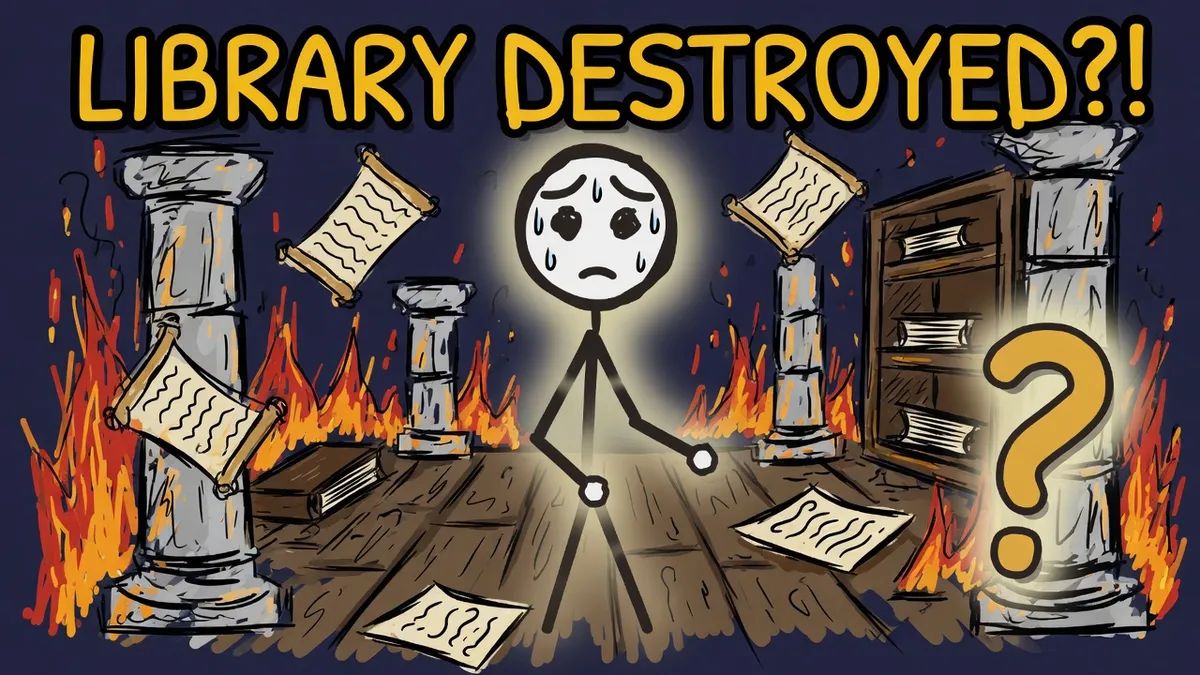
Picture the scene everyone imagines: a single terrible night, flames climbing the shelves of the greatest library in the ancient world, centuries of irreplaceable knowledge curling into ash, a whole civilisation set back a thousand years. It is a wonderful story. It is also, almost certainly, not what happened. The Library of Alexandria did not die in one dramatic blaze, whatever the films suggest. Its end was slower, sadder, and far more unsettling than any fire, because it is the kind of ending that could happen to us.
01 · The institutionNot a library, a research machine
To understand its death, you have to know what it actually was. Founded under the Ptolemaic pharaohs in the 3rd century BC, the Library was one wing of a larger institution called the Mouseion, a “shrine of the Muses,” and the root of our word museum. It was less a public lending library than a state-funded think tank: resident scholars, lecture halls, dining rooms, and a vast collection of papyrus scrolls gathered from across the known world. This was where Eratosthenes measured the size of the Earth and Callimachus built one of history’s first library catalogues. It ran on royal money and brilliant people. Remember those two ingredients, because losing them is the whole story.
02 · Caesar's fireThe famous blaze that didn't finish the job
The most famous villain is Julius Caesar. In 48 BC, tangled in a civil war and holed up in Alexandria on Cleopatra’s side, he set fire to enemy ships in the harbour. The flames spread ashore, and some library holdings burned. This much is real. But it was accidental and partial, a side effect of a battle, not a deliberate act of destruction. And the clinching detail is simple: the Library kept going. Scholars and writers reference the Mouseion for centuries afterward. Whatever Caesar’s fire took, it did not take the Library. The great blaze that “ended” it demonstrably didn’t.
03 · The real killerBudget cuts and banished scholars
The true decline was mundane, and it began earlier than the fire. Around 145 BC, the pharaoh Ptolemy VIII purged Alexandria’s intellectuals, and the head librarian, Aristarchus of Samothrace, fled into exile along with many of the scholars. The institution lost its people. Then, under Roman rule, it lost its patron: the emperors largely ignored it, and the steady royal funding that had built the collection dried up. And here is the part nobody dramatises. Papyrus rots. A scroll left alone crumbles within a century or two. A library that size survived only by constantly, expensively recopying itself, which takes money and scholars, the exact two things Alexandria was losing. Stop paying, and the collection quietly dissolves on its shelves.
The two "destructions" we're taught to blame may be the emptiest of all. When Christians tore down the Serapeum, a daughter library, in 391 AD, the eyewitness accounts of that event don't mention a single book being burned. And the beloved tale of a Muslim caliph torching the scrolls to heat the city's bathwater in 642 AD? It first appears roughly 600 years after the fact, in a 13th-century source, and historians widely treat it as pure legend. Both famous "murders" were probably committed against a corpse that had already gone cold.
04 · The missing booksWhat we lost, and what we didn't
So what actually vanished? Honestly, we cannot fully say, and that uncertainty is its own kind of loss: plays, histories and treatises by authors whose names survive but whose works do not. But the popular idea that all ancient knowledge lived in Alexandria and died with it is overblown. Many important texts existed in copies scattered across the Mediterranean, in Rome, Athens, Pergamon and beyond. The Library’s fall was a wound, not a decapitation. Even the scroll counts we throw around, 400,000, 700,000, are guesses that serious historians call outlandish; more careful estimates land closer to 100,000, and even that is a shrug dressed as a number.
05 · The slow deathHow a wonder of the world just fades out
Add it all up and a pattern emerges that has nothing to do with torches. War damage under the emperor Aurelian in the 270s AD flattened the palace quarter where the main Library stood. Funding was gone. The scholars were scattered. The copying had stopped. Long before any mob or army arrived, the greatest collection in the world had already been starved to death in slow motion, a scroll at a time, as the papyrus crumbled and no one was left, or paid, to remake it. The dramatic endings we remember are just the tidy full stops history prefers to the truth.
06 · The payoffSo why was the Library of Alexandria destroyed?
Because a civilisation stopped paying attention. Not one fire, not one villain, but a long, ordinary sequence of budget cuts, exiled experts, political indifference and the relentless rot of papyrus that no one recopied. That is what makes it haunting rather than merely tragic. We imagine knowledge is lost in catastrophes, dramatic, sudden, blameable. Alexandria says otherwise. Sometimes the greatest library in the world doesn’t burn. It just quietly falls off the budget, and one generation at a time, forgets to keep it alive.
Quick questions
Who destroyed the Library of Alexandria?
No single person did. Historians now believe the Library declined gradually over several centuries due to lost funding, political purges, war damage and neglect. The famous culprits (Caesar, a Christian mob, a Muslim caliph) each played at most a partial role, and some of those stories are legend rather than fact.
Did Julius Caesar burn the Library of Alexandria?
Not deliberately, and not completely. In 48 BC Caesar set fire to enemy ships in Alexandria's harbour during a civil war, and the flames spread ashore and damaged some holdings. Ancient writers disagree wildly on how much was lost, but the Library clearly survived, as it is referred to for centuries afterward.
How many books were in the Library of Alexandria?
Nobody actually knows, and the estimates are hotly contested. Popular figures range from 400,000 to 700,000 scrolls, while conservative scholars suggest as few as 40,000. Remember too that scrolls are not the same as books: a single work often filled many scrolls, so the raw counts can be misleading.
What knowledge was lost with the Library of Alexandria?
We cannot fully know, which is part of the tragedy. Lost works likely included Greek plays, histories and scientific treatises by authors whose names survive but whose writings do not. However, much of what people imagine was uniquely lost also existed in copies elsewhere, so the idea that all ancient knowledge vanished in one night is overstated.
Does the Library of Alexandria still exist?
The ancient Library is long gone and no ruins of it have been definitively identified. A modern successor, the Bibliotheca Alexandrina, opened in 2002 near the presumed original site as a tribute and a working research library. It is a homage, not a continuation of the ancient collection.
When was the Library of Alexandria destroyed?
There is no single destruction date, which is exactly the point. Damage and decline stretched from Caesar's fire in 48 BC, through Aurelian's war in the 270s AD, to the Serapeum's fall in 391 AD. Most historians think the great Library had effectively ceased to exist well before the Arab conquest of 642 AD.
Did the Muslims burn the Library of Alexandria?
Almost certainly not. The story that Amr ibn al-As burned the books on Caliph Umar's orders first appears about 600 years after the supposed event, in 13th-century sources, and is widely dismissed by modern historians as legend. The Library was very probably gone long before 642 AD in any case.
Was the Library destroyed by Christians in 391 AD?
Christians did destroy the Serapeum temple in 391 AD, under a decree of Emperor Theodosius I and Patriarch Theophilus. However, contemporary accounts of that event do not mention burning a library or scrolls, so how much of the collection, if any, was still there is uncertain. It is one contributing episode, not the whole story.
What was the Library of Alexandria actually for?
It was part of the Mouseion, a state-funded research institution in Ptolemaic Egypt, roughly a cross between a university, a research institute and a royal archive. Scholars lived, studied and worked there, collecting and copying scrolls from across the known world. It was more a hub for elite research than a public lending library.
Who were the famous scholars of the Library of Alexandria?
Figures associated with Alexandria include Eratosthenes, who estimated the Earth's circumference and served as head librarian, and Callimachus, who compiled an early catalogue called the Pinakes. Euclid, the father of geometry, worked in Alexandria, and Aristarchus of Samothrace was a renowned head librarian and textual scholar.
Why did the Library of Alexandria really decline?
The unglamorous answer is money and neglect. Papyrus scrolls decay and must be constantly recopied, which needs steady funding and resident scholars. When royal patronage faded, scholars were purged or drifted away, and later rulers largely ignored the institution, the copying stopped and the collection slowly crumbled.
Could the Library of Alexandria have survived?
In principle, yes, and that is what makes its loss so sobering. It was not doomed by one unstoppable catastrophe but by a series of avoidable choices: budget cuts, political purges and simple indifference. It stands as a lasting warning that knowledge can be lost not only to fire, but to neglect.
Our sources 8 checked
// every claim on this page was checked before it went up