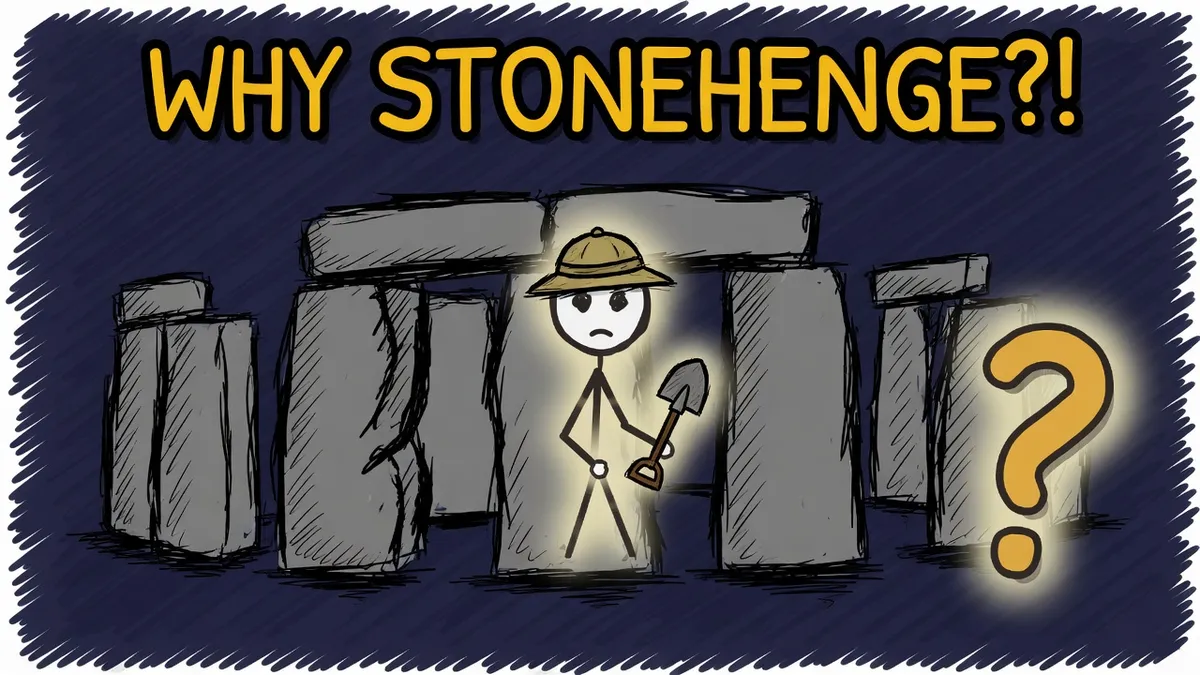
For 4,500 years it has stood on a plain in Wiltshire: a ring of impossible stones, some the weight of three cars, hauled into place by people with no wheels, no metal tools and no writing. We call it Stonehenge, and almost everyone assumes it was built for one grand reason, a temple, a calendar, a tomb. The truth is stranger and more human than any single answer. Stonehenge was not built for a purpose. It was built, and rebuilt, and reimagined, for over a thousand years, by generation after generation who each made it mean something new.
01 · The honest answerNobody actually knows
Let’s start where the archaeologists start: with humility. Stonehenge was in use for more than 1,500 years, roughly a hundred generations. That is longer than the gap between us and the Roman Empire. A monument revered for that long could not possibly have meant one fixed thing to all those people. Asking “why was Stonehenge built” is a bit like asking why a cathedral exists after a thousand years of weddings, funerals, coronations and quiet prayer. The right answer isn’t a single purpose. It’s a layered story, and the stones themselves are the only witnesses left.
02 · The sunA machine for catching the solstice
Here is the one thing almost beyond doubt, because it is literally built into the rock. Stonehenge’s main axis is aligned on the solstices. At the summer solstice, the sun rises over the outlying Heel Stone and throws its first light into the heart of the circle. Six months later, at the winter solstice, the sun sets along the very same line in the opposite direction. This is not a coincidence you can argue away; the builders oriented the entire monument to it. Many archaeologists now suspect the midwinter sunset mattered most, tied to feasting in the dark heart of the year. Whatever else it was, Stonehenge was a machine for holding the turning sun.
03 · The deadBritain's great stone cemetery
Long before the famous stones went up, Stonehenge was something quieter and darker: a graveyard. In its earliest phase, from around 3000 BC, people dug a ring of 56 pits, the Aubrey Holes, and buried cremated remains in and around them. Archaeologist Mike Parker Pearson’s team estimates up to around 250 people were laid to rest here, making it one of the largest cremation cemeteries in Neolithic Britain. Parker Pearson reads the whole landscape as a “domain of the dead” in permanent stone, deliberately paired with a timber settlement two miles away, the “land of the living,” the two linked by the River Avon. Stone for the eternal dead, wood for the temporary living.
In August 2024, scientists tested the six-tonne Altar Stone lying at the centre of Stonehenge, long assumed to be Welsh. Its mineral chemistry matched not Wales, but the far northeast of Scotland, at least 750 km away. Somehow, Neolithic people moved a five-metre slab most of the length of Britain, probably partly by sea, centuries before the wheel was in use here. The centrepiece of England's greatest monument is a stone from the top of Scotland.
04 · The stonesHauled from three corners of an island
That Scottish slab is the showstopper, but the whole monument is a feat of impossible logistics. The giant sarsens, the uprights and lintels, weigh around 25 tonnes each and came from West Woods, about 25 km away. The smaller bluestones were dragged roughly 250 km from the Preseli Hills of Wales, their exact quarries now pinpointed. And the Altar Stone came from Scotland. Think about what that means: this was not local people stacking local rocks. It was a deliberate gathering of stones from across an entire island, each with its own journey, brought together in one place on purpose.
05 · The peopleA monument that may have built a nation
Which leads to the most human theory of all. Why haul stones the length of Britain when there were perfectly good rocks nearby? Because the journey was the point. Parker Pearson argues the great building phase around 2500 BC was an act of unification, thousands of people from different regions labouring together, their stones standing side by side as symbols of once-separate communities becoming one. Others, like Tim Darvill and Geoff Wainwright, think the well-travelled bluestones were prized for healing powers, making Stonehenge a kind of prehistoric Lourdes. Both are interpretations, not proven fact. But both point the same way: Stonehenge was a place people came to, from far off, together.
06 · The payoffSo why was Stonehenge built?
Because it was never one thing. It was a solar temple that caught the solstice, a cemetery that held the ancestors, perhaps a place of healing, and very likely a great act of gathering that helped weld scattered peoples into something larger. Each generation for over a thousand years inherited it, altered it, and poured its own meaning into the stones. That is the real wonder of Stonehenge, and the reason no single explanation will ever be enough. It isn’t a monument with a purpose. It’s a monument with a biography, written across fifteen hundred years by people who dragged stones from the ends of their world just to stand together in one place and watch the sun come up.
Quick questions
Who built Stonehenge?
Stonehenge was built by Neolithic and early Bronze Age people of Britain, starting around 3000 BC. They were farming communities using antler picks, stone tools, timber and rope, not any single named leader. It was a huge communal effort thought to have drawn in hundreds, possibly thousands, of people over many generations.
How old is Stonehenge?
The first earthwork monument dates to about 3000 BC, roughly 5,000 years ago. The famous standing stones were raised around 2500 BC, making them about 4,500 years old, roughly the same age as the Great Pyramid of Giza. The site was then used and altered for over 1,500 years.
Where did the Stonehenge stones come from?
The stones came from strikingly different places. The large sarsens came from West Woods, about 25 km north near Marlborough. The smaller bluestones came from the Preseli Hills in Wales, about 250 km away. The Altar Stone, remarkably, came from northeast Scotland, at least 750 km away.
Was Stonehenge built by the Druids?
No, this is a popular myth. Stonehenge was built more than 2,000 years before the Iron Age Druids existed, so they could not have constructed it. The link comes from 17th and 18th century antiquarians who wrongly connected the two, and modern Druid groups have since adopted the site.
How were the stones moved?
Most archaeologists think people hauled them using timber sledges, wooden A-frames and ropes made of plant fibre, with the long-distance stones probably moved partly by sea and river. Moving 25-tonne sarsens overland was a massive coordinated effort. A minority theory suggests ice carried the Welsh stones part-way, but this is not widely accepted.
Is Stonehenge aligned with the sun?
Yes. Its main axis is deliberately aligned on the solstices. At the summer solstice the sun rises over the Heel Stone and shines into the centre; at the winter solstice the sun sets along the opposite direction of the same axis. This solar alignment is one of the few things about its purpose that is beyond real doubt.
Why was Stonehenge really built?
There is no single agreed answer. The strongest ideas are that it was a solar temple, a cremation cemetery and monument to the ancestors, possibly a place of healing, and possibly a symbol of unity. Because it was used for over 1,500 years, it most likely served several of these purposes at different times.
Is Stonehenge a burial site?
Yes, at least in its early phase. For several centuries after about 3000 BC it was one of the largest cremation cemeteries in Neolithic Britain, holding the burnt remains of up to around 250 people. Many were buried in and around the ring of pits called the Aubrey Holes.
What are the bluestones and why do they matter?
Bluestones are the smaller stones at Stonehenge, weighing 2 to 5 tonnes, brought about 250 km from the Preseli Hills in Wales. Their extraordinary journey is central to several theories, including the idea that they were valued for healing powers. Their exact Welsh quarries have now been identified by archaeologists.
Did the Altar Stone really come from Scotland?
Yes, according to a 2024 study published in Nature. Chemical and mineral analysis matched it to the Orcadian Basin of northeast Scotland, at least 750 km away, overturning the long-held belief it was Welsh. It implies a remarkable level of long-distance contact and coordination across Neolithic Britain.
How long did it take to build Stonehenge?
It was not built in one go. Construction and alteration spanned more than 1,500 years, roughly 100 generations, from about 3000 BC to around 1600 BC. The single most dramatic phase, raising the great sarsens and bluestones, happened around 2500 BC.
Can you go inside the stones at Stonehenge?
The standard visit, managed by English Heritage, keeps you on a path around the circle rather than among the stones. Special access into the centre can be booked at certain quiet times, and thousands are allowed among the stones for the managed solstice celebrations in summer and winter.
Our sources 8 checked
// every claim on this page was checked before it went up