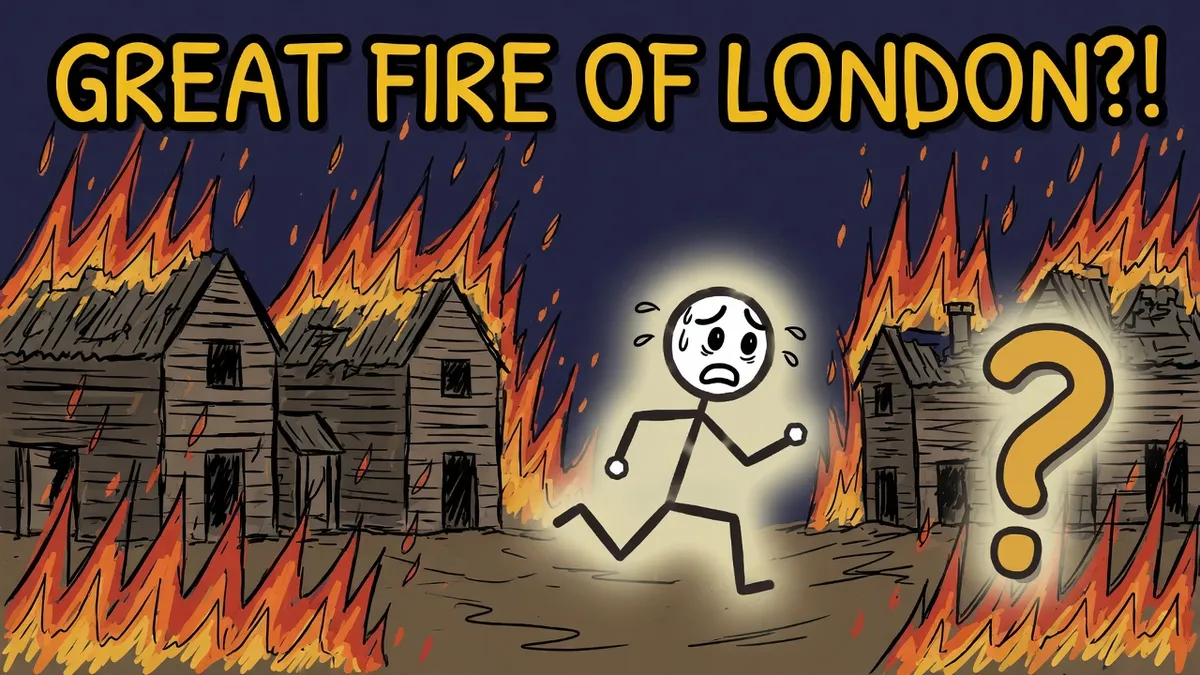
In the small hours of 2 September 1666, a fire started in a bakery on a narrow London street called Pudding Lane. It was, at first, an entirely ordinary fire, the kind that broke out in the timber city all the time. The Lord Mayor was woken, took one look, and reportedly sneered that "a woman might piss it out" before going back to bed. Four days later, most of London was ash: 13,000 houses gone, old St Paul's Cathedral a smoking ruin, a hundred thousand people homeless. So how did one bakery fire become the greatest disaster in the city's history? The answer is a checklist of everything a city can do wrong.
01 · The tinderbox cityBuilt to burn
London in 1666 was, in effect, a giant pile of firewood. The houses were timber-framed and often coated in pitch to weatherproof them, which is to say coated in fuel. Worse was how they were arranged. Upper floors were built to jut out over the street below, a style called jettying, so that as buildings rose, their top storeys leaned closer and closer together until they nearly touched the house opposite. The streets were dark canyons of overhanging wood. A fire didn’t need to cross a street; it could simply reach across it. The city wasn’t just flammable. It was practically designed to pass flames from house to house.
02 · The perfect summerDry wood and a driving wind
Then the weather stacked the deck. The summer of 1666 had been long, hot and dry, baking every timber beam and thatched roof into perfect kindling. And on the night the fire started, a strong wind was blowing from the east. That wind did two things: it fanned the flames to a ferocious heat, and it drove them steadily westward, deeper into the packed heart of the City, faster than anyone could hope to respond. Fire in dry timber is bad enough. Fire in dry timber with a gale behind it is unstoppable, and for four days the wind simply refused to drop.
03 · The riverside fuel dumpBarrels of tar and brandy
Of all the places for a wind-driven fire to head, it found the worst. Down by the Thames, the wharves and warehouses were packed with the goods of a trading empire, and an alarming amount of it was flammable: pitch, tar, oil, coal, rope, hemp, and barrels of spirits and brandy. When the flames reached these riverside stores, they didn’t just spread, they exploded into new intensity, each warehouse a bomb of concentrated fuel. This is what tipped an ordinary blaze into something monstrous. The fire grew so hot it began generating its own weather, sucking in air to feed itself, a self-sustaining firestorm that no bucket chain on Earth could touch.
The maddening part is that London knew exactly how to stop a fire like this: pull down a row of houses ahead of the flames to create a firebreak, a gap with nothing to burn. In the crucial first hours, that would have worked. But the man with the authority to order it, Lord Mayor Thomas Bloodworth, refused, fretting about who would pay to rebuild the rented houses, and dismissing the danger with his infamous line about a woman putting it out. By the time demolitions were finally ordered, the wind had turned the fire into a firestorm that leapt the firebreaks anyway. The single decision that could have saved London was the one nobody made in time.
04 · The scapegoatA confession that made no sense
As the city burned, panic curdled into paranoia. This was wartime, with anti-Catholic and anti-foreign feeling running high, and people wanted a villain, not an accident. They found one in Robert Hubert, a French watchmaker who, under the strange pressure of the moment, confessed to deliberately starting the fire. His confession was riddled with impossibilities; he described details that were simply wrong, and evidence suggests he wasn’t even in London when the fire began. It didn’t matter. A frightened city needed someone to blame, and Hubert was hanged for a crime that was almost certainly just a baker forgetting to damp down his oven.
05 · The myth of the cleansing fireDid it end the plague?
There’s a comforting story that the Great Fire had a silver lining: that it burned out the rats and cleansed the city of the Great Plague that had ravaged it the year before. It’s a neat tale, and it’s mostly not true. Plague deaths were already falling before the fire ever started, people kept dying of plague after it, and crucially the fire never reached the poor, crowded outer parishes like Whitechapel and Southwark where the plague hit hardest. The disease faded for its own reasons, likely the cold winter and shifting conditions, not because of the flames. The fire destroyed London. It didn’t save it.
06 · The payoffSo why did the Great Fire spread so fast?
Because almost nothing about that week was bad luck alone. A city built of overhanging timber and pitch, dried to tinder by a long hot summer, met a strong east wind, a riverside packed with tar and brandy, and a Lord Mayor who wouldn’t order the one thing that could have stopped it. Each factor was dangerous; together they were catastrophic. Out of the ashes came a new London, rebuilt in brick and stone under fire-safety rules that still echo today, and the Monument near Pudding Lane still marks where it all began. The Great Fire spread so fast for the oldest reason in the book: a small problem, ignored a few hours too long, in a place that was ready to burn.
Quick questions
How did the Great Fire of London start?
It began in the early hours of 2 September 1666 in Thomas Farriner's bakery on Pudding Lane, most likely from an oven or hearth that was not fully put out. Sparks caught the timber building alight and the fire spread from there. Farriner escaped, but his maid died in the blaze.
How long did the Great Fire of London last?
The fire burned for around four days, from Sunday 2 September to Wednesday 6 September 1666. It was finally brought under control once the strong east wind dropped and large firebreaks, including demolitions with gunpowder, took effect.
Why did the fire spread so quickly?
London was packed with timber houses coated in flammable pitch, built so close their jettied upper floors nearly touched over narrow streets. A long dry summer had left everything tinder-dry, a strong east wind drove the flames, riverside warehouses full of oil, pitch and brandy fed them, and the Lord Mayor's delay in ordering firebreaks let the fire take hold.
How many people died in the Great Fire of London?
Officially only a handful of deaths were recorded, traditionally cited as around six, sometimes fewer than ten. However, many historians think the real toll was higher, because the intense heat could destroy remains and the deaths of poorer Londoners often went unrecorded.
How much of London was destroyed?
The fire destroyed roughly 13,200 houses and 87 parish churches, along with old St Paul's Cathedral and many public buildings. Most of the medieval City within the walls was left in ruins, and around 100,000 people were made homeless.
Did the Great Fire of London end the plague?
This is a popular myth but is contested and probably overstated. Plague deaths were already falling before the fire, people kept dying of plague afterwards, and the fire did not reach the worst-hit outer parishes such as Whitechapel and Southwark. The preceding cold winter and other factors are now seen as more important.
Who was blamed for the Great Fire of London?
Amid anti-Catholic and anti-foreign panic, a French watchmaker named Robert Hubert falsely confessed to starting the fire deliberately and was hanged at Tyburn on 28 September 1666. He is now regarded as innocent, and evidence suggests he may not even have been in London when the fire began.
Where did the Great Fire of London start?
It started on Pudding Lane in the City of London, a narrow street near the river, in the bakery run by Thomas Farriner. The Monument, designed by Christopher Wren and Robert Hooke, stands near the spot to commemorate the fire.
Who was the Lord Mayor during the Great Fire?
Sir Thomas Bloodworth was Lord Mayor. He is remembered for underestimating the fire, reportedly saying a woman could put it out, and for delaying the demolition of buildings to create firebreaks, which many believe let the fire spread much further.
How was the Great Fire of London finally stopped?
The fire was brought under control when the strong east wind eased and large firebreaks were created, partly by blowing up buildings with gunpowder to deny the flames fuel. By 6 September 1666 the fire had burned out or been contained.
Did the King help fight the Great Fire?
Yes. King Charles II and his brother James, Duke of York, took an active role, ordering the demolition of buildings to create firebreaks and helping to organise firefighting and relief for the homeless. Contemporary accounts describe the King directing efforts in person.
What changed in London after the Great Fire?
London was rebuilt largely in brick and stone rather than timber, under new building rules meant to reduce fire risk. Sir Christopher Wren rebuilt St Paul's Cathedral and many City churches, and the Monument was erected near Pudding Lane to remember the disaster.
Our sources 8 checked
// every claim on this page was checked before it went up