The Great Pyramid of Giza is made of millions of stone blocks, some weighing several tonnes, stacked with such precision that it stood as the tallest structure on Earth for nearly four thousand years. Faced with that, a lot of people quietly conclude it can't have been built by ordinary humans with ropes and copper tools. Aliens, then, or some lost super-civilisation. But every time archaeologists dig at Giza, they find the same answer, and it's more impressive than any spaceship: an astonishingly well-run human workforce, a clever trick with wet sand, and ramps.
01 · Who built themPaid workers, not slaves
Start by clearing away the whip. The image of enslaved masses dying under the lash to raise the pyramids is Hollywood, not history. Archaeologists have excavated the workers’ towns beside the Giza pyramids and found bakeries, breweries, housing and the bones of a well-fed, organised labour force, rotating crews of skilled workers and ordinary Egyptians who were housed, provisioned and paid. Those who died on the job were even buried in tombs near the pyramids they built, an honour no slave society would bother to give. The pyramids were a national project staffed by proud workers, not a prison yard.
02 · The wet-sand trickPhysics they shouldn't have known
The obvious problem is moving stones that weigh as much as a car, or several. The Egyptians dragged them on wooden sledges, and here’s the genius part: they poured water on the sand in front of the sledge. Damp sand, at just the right wetness, packs firm and flat instead of bunching into a pile ahead of the runners, which slashes the friction and the number of haulers needed. Modern physicists tested this and found the right amount of water roughly halves the pulling force. And on an ancient Egyptian wall, there’s a painting of a worker doing exactly this: pouring water before a sledge dragging a colossal statue. They knew the trick millennia before anyone could explain it.
03 · Going upThe ramp question
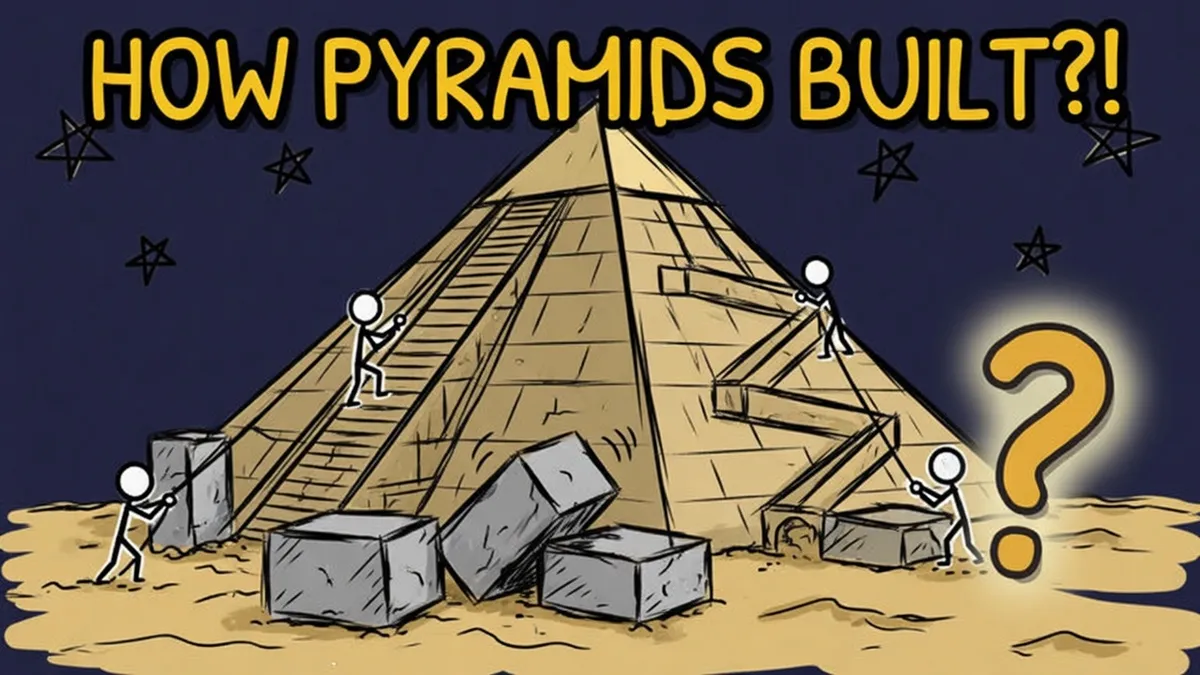
Dragging a block along the ground is one thing; getting it a hundred metres into the air is another. The answer is ramps, built of earth, rubble and brick against the rising pyramid so blocks could be hauled up and set in place. What’s still argued is the shape. A single long straight ramp? A ramp zig-zagging up one face? One spiralling around the outside? Each idea works on paper but stumbles somewhere, especially on a nagging puzzle: if there were giant external ramps, where did all that material go, and why so little trace? The ramp debate is one of the most active questions in Egyptology precisely because the pyramids kept their method to themselves.
Do the arithmetic and the real marvel appears. To finish the Great Pyramid in about twenty years, the builders had to quarry, move and place a multi-tonne block on average every few minutes, for two decades straight. The hard part was never lifting one stone. It was choreographing millions of them, without a break, for a generation.
04 · The newest ideaRamps hidden in the pyramid
That brutal pace is driving the latest research. A recent model proposes an “integrated edge-ramp” system: instead of one huge ramp outside, several ramps built into the faces of the pyramid itself, spiralling upward, many of them near the wide base and fewer as it tapers toward the top. Its author argues this could raise blocks fast enough to finish in well under twenty years, and, intriguingly, that the ramp paths line up with mysterious voids detected inside the Great Pyramid by modern scanning. It may or may not be the final answer, but it shows the question is being cracked with data, not fantasy.
05 · Not aliensWhy the myth won't die
So why does “aliens built the pyramids” persist against all this evidence? Because the scale is genuinely hard to picture, and people mistake “hard to imagine” for “impossible for humans.” But the discomfort is emotional, not factual. The record is full of human fingerprints: quarries scarred by tools, half-finished blocks abandoned mid-cut, the workers’ towns, the tombs, the water-pourer on the wall. Every excavation adds more proof of skilled Egyptian hands. Crediting aliens doesn’t solve a mystery; it robs a real civilisation of one of the greatest feats of organisation our species has ever pulled off.
06 · The payoffSo how were the pyramids built?
By people, brilliantly. Organised, paid Egyptian crews quarried and dragged millions of stone blocks on sledges, slicked the sand with water to cheat friction, and hauled them up ramps against the growing pyramid, placing a block every few minutes for twenty years. The exact ramps are still being worked out, but the essentials are settled and they’re human through and through. The pyramids aren’t evidence that someone else visited Earth. They’re evidence of what Earth’s own people can do when they organise around a single, impossible-looking goal and simply refuse to stop.
Quick questions
How were the pyramids actually built?
By large, organised teams of Egyptian workers using ramps, wooden sledges and clever, simple physics, over many years. They quarried and shaped enormous stone blocks, dragged them on sledges (often over sand wetted to reduce friction), and hauled them up ramps built against the growing pyramid to set each block in place. The core of the achievement wasn't secret technology; it was extraordinary organisation, engineering knowledge and sheer coordinated effort.
Were the pyramids built by slaves?
The evidence says no, this is a persistent myth. Archaeologists have excavated the workers' settlements near the Giza pyramids, including bakeries, breweries and housing, and found signs of a paid, fed, organised workforce rather than enslaved masses. Skilled labourers and rotating crews of ordinary Egyptians did the work, were housed and provisioned, and those who died on the job were even buried in tombs near the pyramids, honours a slave society wouldn't grant.
How did they move such heavy stones?
Mainly by dragging them on wooden sledges, with a brilliant trick to make it easier: pouring water on the sand in front of the sledge. Wetting the sand to just the right dampness makes it far firmer and less prone to piling up ahead of the sledge, sharply reducing the friction and the number of people needed to pull. There's even an ancient Egyptian wall painting showing a worker pouring water in front of a sledge hauling a huge statue.
Does wet sand really make dragging easier?
Yes, and it's been tested. Physicists have shown that adding the right amount of water to sand roughly halves the force needed to drag a heavy sledge across it. Dry sand bunches up into a pile in front of the sledge, which you then have to keep pushing through; slightly damp sand sticks together and stays flat and firm. The Egyptians appear to have known this practical fact thousands of years before physics could explain why it works.
How did they get the blocks so high up?
With ramps, though the exact design is still debated. As the pyramid rose, workers built ramps of earth, rubble and brick to drag blocks upward and into position. Proposed designs include a single long straight ramp, ramps that zig-zagged up one face, and ramps that spiralled around the outside. Each has strengths and problems, especially explaining why so few ramp remains survive, which is why the ramp question is one of the liveliest in the field.
How long did it take to build the Great Pyramid?
Roughly two decades, during the reign of the pharaoh Khufu (around 2600 BCE). That timescale is staggering when you do the maths: to finish in about 20 years, the builders would have had to quarry, move and place a block on average every few minutes, all day, for years on end. That relentless pace is exactly why organisation and logistics mattered so much, and why modern researchers focus on which building methods could actually keep up.
What are the newest theories about how they were built?
Recent research has focused on ramp designs that could explain the astonishing pace. One 2025-era model proposes an 'integrated edge-ramp' system, where multiple ramps are built into the faces of the pyramid itself and spiral upward, starting with many ramps near the base and reducing to fewer as the pyramid narrows. Its authors argue this could complete the Great Pyramid in well under twenty years and even matches internal voids detected by modern scanning.
Did aliens or a lost civilisation build the pyramids?
No. There is no credible evidence for either, and abundant evidence for human construction: quarries with tool marks, unfinished blocks, workers' towns, tombs, records and the ramps and sledges themselves. The 'aliens built the pyramids' idea persists mostly because the scale is so hard to imagine, but that scale is a testament to human organisation, not a puzzle requiring outsiders. Attributing it to aliens actually erases the real, extraordinary achievement of the Egyptians.
Why does the alien myth persist?
Because the pyramids are so vast and old that it feels impossible for people with simple tools to have built them, and that gap invites fantastical explanations. But 'impossible' here really means 'hard to picture', not 'beyond human ability'. The discomfort is emotional, not evidential. Every time archaeologists dig, they find more proof of a skilled human workforce, and the alien story survives on awe and unfamiliarity rather than on any actual mystery in the record.
How many workers did it take to build the Great Pyramid?
Estimates vary, but modern scholarship suggests a workforce in the low tens of thousands, not the hundreds of thousands once imagined. A core of skilled craftsmen worked year round, supported by larger rotating crews of labourers who came in shifts, possibly during seasons when farming paused. The excavated workers' towns at Giza were sizeable but not enormous, which fits an organised force of perhaps 20,000 to 30,000 people rather than a limitless army.
What tools did the Egyptians use to cut the stone?
Mostly copper chisels and saws, stone hammers and pounders, and wooden wedges, all worked by hand. For the softer limestone that makes up the bulk of the pyramid, copper tools and abrasive sand were enough to cut and dress the blocks. Harder stones such as the granite used in interior chambers were shaped with even harder pounding stones like dolerite, plus sand as a grinding abrasive. It was slow, patient labour rather than any lost high technology.
How did they cut the blocks so precisely?
Through careful measuring, skilled stoneworking and constant checking, not secret machinery. Egyptian masons used simple but reliable tools: plumb lines, set squares, levelling instruments and measuring rods, to keep faces flat and joints tight. Much of the precise fitting happened on site, where blocks were trimmed and adjusted against their neighbours. The results look almost impossibly exact, but they were achieved by experienced craftsmen taking great care, one block at a time.
Is the Great Pyramid aligned with the stars?
It is aligned with remarkable accuracy to the cardinal directions of north, south, east and west, which the Egyptians likely achieved by observing the stars or the Sun. The sides face true north within a tiny fraction of a degree, a feat of careful astronomical observation. Some researchers note rough alignments with certain stars too, though claims of elaborate hidden star maps go well beyond the evidence. The solid fact is the precise cardinal orientation, itself an impressive piece of practical astronomy.
Our sources 6 checked
// every claim on this page was checked before it went up