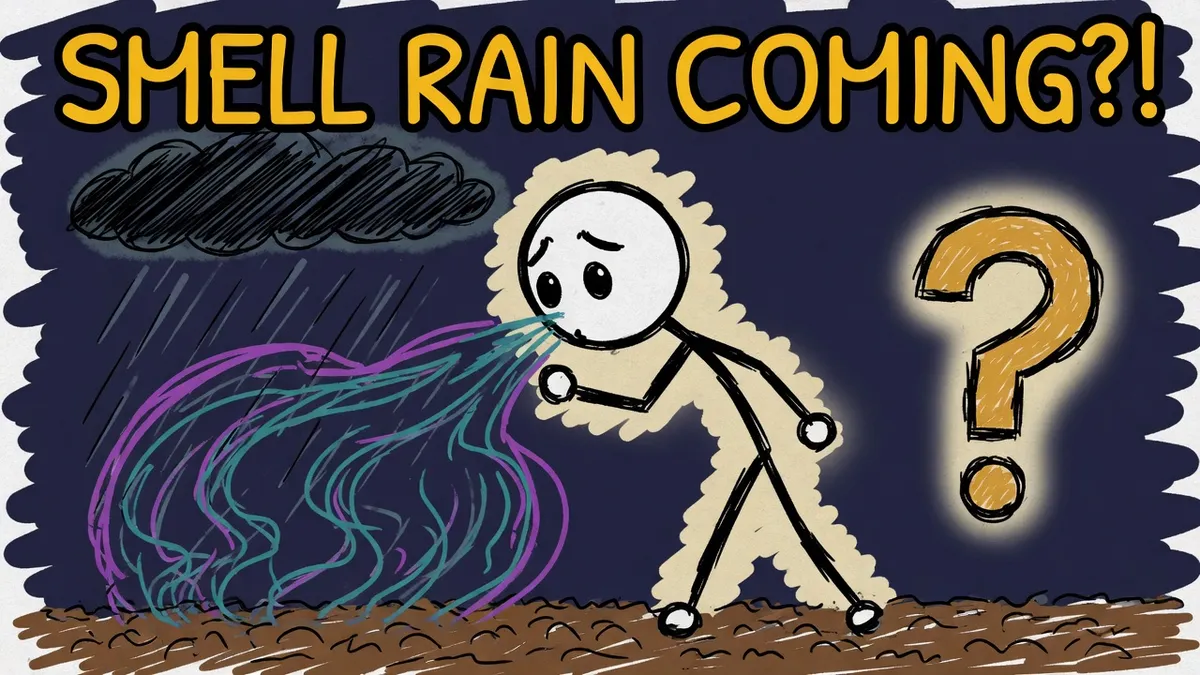
You walk outside, take a breath, and something in you goes quiet and certain: rain is coming. No forecast, no radar, just a smell in the air. It feels almost like a sixth sense, some old animal instinct for weather. It isn't. What you are actually doing is detecting a molecule made by bacteria living in the dirt, at a concentration so faint it borders on the ridiculous. You are smelling the soil, and you are one of the best geosmin detectors on the planet.
01 · The wordA smell so specific it got its own name
For most of history, the smell of rain was just the smell of rain. Then, in 1964, two Australian scientists, Isabel Joy Bear and Richard Thomas, published a paper in the journal Nature giving it a proper name: petrichor. They built the word out of Greek: petra, meaning stone, and ichor, the ethereal fluid that was said to flow in the veins of the gods. The essence that seeps from stone when the rain comes. It is, frankly, one of the more beautiful things ever named in a scientific journal.
But naming a smell is easy. Bear and Thomas did something harder: they worked out what it actually was. And the answer turned out to be less romantic and far stranger than “the smell of rain.”
02 · The oilsWhat petrichor actually is
Here is the part most people get wrong. Petrichor is not the smell of water, and it is not made by the rain. The rain just releases it. During long dry spells, plants shed oily compounds that slowly build up, soaking into rocks and dry soil like a stain. Bear and Thomas managed to distil this oil out of soil and vegetation that had been left exposed to the air but kept away from rain. It sits there, accumulating, waiting. Then the first drops arrive, wet the surface, and lift that stored-up cocktail into the air all at once.
That is why the first rain after a drought smells so much stronger than a shower during a wet week: the ground has had time to load up. But the plant oils are only half the story. The note that really defines the smell, the deep, dark, unmistakable smell of earth itself, comes from something alive.
03 · The bacteriaYou are smelling Streptomyces
That earthy heart of petrichor is a single compound: geosmin, which literally means “earth smell.” And geosmin is not made by the soil. It is made by bacteria living in it, chiefly a genus called Streptomyces, the same busy, common soil microbes we get many of our antibiotics from. As they grow and form spores, they pump out geosmin. So when you inhale that gorgeous post-rain scent and feel connected to the deep, ancient earth, what you are literally smelling is bacterial metabolism. The planet’s oldest air freshener, run by microbes.
04 · The noseAbsurdly, impossibly sensitive
Now here is where it gets genuinely hard to believe. Your ability to smell geosmin is not just good, it is off the charts. Most estimates put the human detection threshold somewhere around 5 parts per trillion, one of the lowest thresholds for any smell we know of. That is a few molecules lost in an ocean of air. You will often see this dramatised as “humans can smell rain better than sharks can smell blood,” a claim that we are something like 200,000 times more sensitive to geosmin than a shark is to blood in water.
It is a great line, and the rough numbers do line up. But be a little careful with it: it compares two completely different molecules in two completely different media, air against water, and it comes from popular science rather than any head-to-head experiment. So enjoy it as a vivid way to picture how sharp your nose really is, not as a hard scientific fact. The underlying truth stands regardless: for this one smell, you are a superb instrument.
05 · The deliveryHow the smell leaps off the ground
So the geosmin is sitting in the soil. How does it get up into your nose? For a long time nobody had actually seen it happen. Then in 2015, two MIT researchers, Youngsoo Joung and Cullen Buie, pointed a high-speed camera at raindrops landing on soil and caught the mechanism in the act.
When a drop hits a porous surface, it briefly traps tiny bubbles of air underneath itself. Those bubbles shoot up through the drop and burst at the top, exactly like the fizz rising in a glass of champagne. Each bursting bubble flings out a fine mist of aerosols, and those aerosols carry geosmin and soil particles up into the breeze. A cloud of scent, launched by a mechanism you would never guess was there. Stranger still, they found that gentle and moderate rain throws up the most aerosols, while a heavy downpour actually releases fewer. The soft rain is the fragrant one.
The smell you get before the rain arrives is not petrichor at all. It is a completely different chemical, made by lightning, and it reaches you by hitching a ride on the storm's own wind.
06 · The pre-storm smellOzone, made by lightning
This solves a puzzle you have probably felt but never questioned: how can you smell rain coming, before a single drop has fallen? Petrichor cannot explain it, because petrichor needs the ground to be wet first. The answer is a second, separate smell: ozone.
Up in a thunderstorm, lightning bolts are violent enough to rip oxygen molecules (and nitrogen) clean apart. The loose atoms recombine into ozone, O3, which carries that sharp, clean, faintly metallic tang you notice in the air before a storm. Then the storm does the delivering: its powerful downdrafts drag air from high up back down to ground level, carrying the ozone with it, right to your nose, minutes before the rain. So the smell of an “oncoming” storm is real, and it is genuinely arriving ahead of the weather. Ozone announces the storm; petrichor confirms it has landed.
07 · The same molecule, everywhereWhy beetroot tastes of soil
Once you know geosmin, you start meeting it in odd places. It is the reason beetroot tastes so distinctly of earth, that “just pulled from the ground” flavour some people adore and others can’t stand. It is also, less happily, why a glass of tap water or a bottle of wine can occasionally taste musty and muddy: a trace of geosmin from bacteria or algae, at a level your painfully sensitive nose refuses to ignore.
One quick myth to clear up, because these two constantly get confused: geosmin is not what makes a wine “corked.” That classic musty cork fault is a different compound entirely, TCA (2,4,6-trichloroanisole). Both smell dank, but they are separate culprits. Same lesson, though: this is a molecule you are wired to notice at the faintest whisper, for better and for worse.
08 · The payoffSo why are we so good at this?
Which leaves the real question. Why would evolution build a human nose that can catch a few molecules of bacterial by-product? The tidy story goes like this: being able to smell water, or damp fertile soil, from a long way off would have been priceless to our ancestors, and especially to anything trying to survive in dry country. So we were tuned to it. It is a lovely idea, and it may well be true, but it is genuinely hard to prove, so it is best held as a good hypothesis rather than a settled fact.
There is one more twist, though, and it flips the whole thing around. For years, geosmin looked like a pointless leak, a smell the bacteria happened to give off for no reason. Then a 2020 study found that little six-legged soil creatures called springtails are drawn to geosmin, come to feast on the Streptomyces, and in the process carry the bacteria’s spores away and spread them far and wide. Which means the smell may not be a leak at all. It may be an advertisement: the bacteria putting out a scent to summon a delivery service. So the next time you catch that first breath of rain and feel something ancient stir, savour the full absurdity of it. You are eavesdropping on a bacterium, hollering into the dark for a ride, in a language your nose was somehow built to understand.
The animated version
Same answer, told as a little animated story with the strange little stickman acting it out. Dry, quick, and, obviously, correct.
Quick questions
What is the smell of rain actually called?
The earthy smell that rises after rain hits dry ground is called petrichor. The word was coined in 1964 by two Australian researchers, Isabel Joy Bear and Richard Thomas, from the Greek petra (stone) and ichor (the fluid that ran in the veins of the gods). The distinct sharp smell that can arrive before the rain is a separate thing: ozone.
What is petrichor made of?
Two main ingredients. First, plant oils that build up on rocks and soil during dry spells and get released when the ground is wetted, which is what Bear and Thomas actually distilled and named in 1964. Second, and more famously, geosmin, an earthy-smelling molecule produced by soil bacteria. When rain lands, both get flung into the air together.
What is geosmin?
Geosmin is the molecule behind that classic 'damp earth' smell. It is made mostly by Streptomyces, common soil bacteria, as they grow and form spores. It is also produced by some other microbes and by certain algae. It is the single most important note in petrichor, and the human nose is absurdly tuned to it.
How sensitive are humans to geosmin?
Extraordinarily. Most sources put the human detection threshold somewhere around 5 parts per trillion (with estimates ranging up to roughly 10 to 15). That is a handful of molecules in a vast sea of air, and it makes geosmin one of the most detectable substances known to our sense of smell. It is the reason a single sniff can tell you rain is coming.
Is it true humans smell rain better than sharks smell blood?
You will see this claim everywhere, that we are '200,000 times more sensitive' to geosmin than sharks are to blood. The rough arithmetic does line up (geosmin at about 5 parts per trillion versus blood at roughly one part per million), but it is an apples-to-oranges comparison: different molecules, in different media (air versus water), and the numbers come from popular science rather than a head-to-head study. Treat it as a fun illustration of how good our noses are, not a hard fact.
Why can you smell rain BEFORE it arrives?
That is usually ozone, not petrichor. During a thunderstorm, lightning splits oxygen (and nitrogen) molecules apart, and they recombine into ozone (O3), which has a sharp, clean, almost metallic smell. The storm's own downdrafts then carry that ozone down from higher up to ground level, so it can reach your nose ahead of the rain itself. Petrichor, by contrast, only appears once drops actually hit the ground.
How does the smell get from the ground into the air?
In 2015, MIT researchers Youngsoo Joung and Cullen Buie filmed raindrops in ultra slow motion and caught the mechanism. When a drop hits a porous surface, it traps tiny air bubbles underneath. Those bubbles shoot up through the drop and burst at the top, like the fizz in a glass of champagne, flinging a fine spray of aerosols (carrying geosmin and soil particles) into the air. Curiously, light and moderate rain make the most aerosols; a heavy downpour makes fewer.
Why does the smell seem stronger after a dry spell?
Because the ingredients have had time to accumulate. During a long dry period, plant oils build up on rocks and soil, and soil bacteria keep producing geosmin with nothing to wash it away. The first rain after a drought hits a fully loaded surface and releases the whole store at once, which is why that first shower smells so intensely earthy.
Is geosmin the same as the smell of fresh-cut grass?
No, they are different molecules doing different jobs. Fresh-cut grass is 'green leaf volatiles', a plant's wound response, and its signature is a compound called cis-3-hexenal. Petrichor is bacterial geosmin plus plant oils, released by water rather than by cutting. Both share the same twist, though: our noses are staggeringly sensitive to both, picking them up at tiny concentrations.
Why does beetroot taste earthy?
Geosmin again. The same molecule that makes rain smell of earth is present in beetroot, which is why it has that distinctive 'just dug up' flavour. Some people love it and others find it off-putting, and that split comes partly down to how strongly your nose responds to geosmin. It is also why a squeeze of lemon helps: acid breaks geosmin down and mellows the earthiness.
Does geosmin ruin water and wine?
It can. Because we detect it at a few parts per trillion, even a trace of geosmin (from bacteria or algae) makes tap water taste musty and 'muddy', and it can give wine an earthy, beetroot-like off-note. Worth clearing up a common mix-up: the classic 'corked' wine fault is a different compound, TCA (2,4,6-trichloroanisole), not geosmin, even though both smell musty.
Why can dogs and other animals sense rain coming too?
They are reading the same clues, often better than we are: the ozone drifting ahead of a storm, the surge of geosmin and petrichor as humidity rises and the first drops fall, plus a drop in air pressure and shifts in wind and sound they can feel. Animals do not have a magic sixth sense for weather; they simply have sharper access to the very signals we are only half aware of.
Did the smell of rain help our ancestors survive?
That is the popular story: being able to smell water from far off would have helped early humans (and desert animals) find it, so evolution tuned us to geosmin. It is plausible and appealing, but genuinely hard to prove, so treat it as a good hypothesis rather than an established fact. What we can say for sure is that we are remarkably good at detecting it.
Why do the bacteria make geosmin at all?
For a long time this was a mystery: geosmin looked like a pointless by-product. Then a 2020 study found that tiny soil creatures called springtails are attracted to geosmin and eat the bacteria, and in doing so they spread the bacteria's spores around. So the smell may be an advertisement, the bacteria calling for a delivery service, rather than something merely leaking out.
Take the quiz on this
A quick 4-question check on what you just read. Get them right to earn XP: no points for just scrolling.
Our sources 10 checked
// every claim on this page was checked before it went up