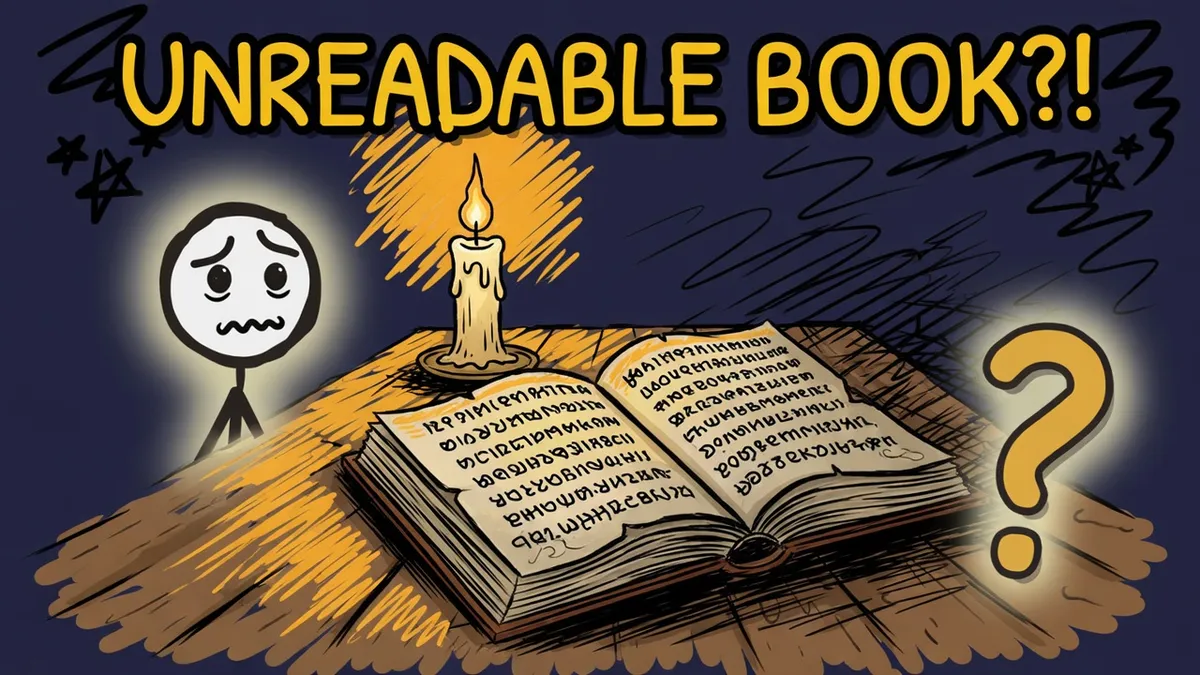
Sitting in a climate-controlled vault at Yale University is a small, unremarkable-looking book about 600 years old. Turn its pages and you find drawings of plants that don't exist, star charts labelled in an alphabet no one recognises, and strange scenes of tiny naked women bathing in pools of green liquid connected by tubes. And running through all of it, page after page, is dense, flowing handwriting in a language that has never been read. Not by amateurs, not by professors, not by the professional codebreakers who cracked wartime military ciphers. For over a century, the Voynich manuscript has held onto its secret, and the strangest thing about it is that it looks like it genuinely has one.
01 · The book itselfWhat we actually know
Let’s start with the solid facts, because they’re strange enough. The manuscript is a hand-written book of around 240 pages, held at Yale’s Beinecke Library, where it’s soberly catalogued as MS 408. It’s named not after whoever wrote it, whom we have no clue about, but after Wilfrid Voynich, a book dealer who bought it in 1912 and brought it to the world’s attention. The text is nicknamed “Voynichese”, and it is completely undeciphered. That’s the whole, frustrating, verified core of it: a real book, in a real script, that absolutely nobody can read.
02 · The ageGenuinely, provably old
The first thing you’d suspect is a hoax, some Victorian forger’s elaborate joke. That theory ran into a wall in 2009, when a team at the University of Arizona radiocarbon-dated the parchment. The result was unambiguous: the animal skin the book is written on dates to the early 15th century, roughly 1404 to 1438. The inks and pigments are consistent with that era too. This matters enormously, because you cannot fake it. A modern forger can invent a weird script, but they cannot conjure up a large stock of genuine 600-year-old blank parchment to write it on. Whatever the Voynich manuscript is, it is authentically medieval. It has been keeping its secret since before Gutenberg printed his Bible.
03 · The drawingsImpossible plants and green baths
If the text tells us nothing, surely the pictures should help? They don’t, and that’s part of the eeriness. The illustrations fall into clear sections, each maddeningly almost-familiar. There’s a botanical section full of detailed plants, not one of which can be confidently matched to a real species. There’s an astronomical section of suns, moons, stars and zodiac symbols. There’s a bizarre “biological” section of dozens of tiny nude women wading in green fluids, joined by networks of tubes and vessels. And there’s a pharmaceutical section of jars and roots, like a recipe book. It looks exactly like a medieval herbal or medical text, the right shape, the right themes, and yet the contents match nothing on Earth. It’s familiarity with all the meaning drained out.
04 · A century of failureThe codebreakers who lost
You might think a determined expert could crack it, and many have tried. The Voynich manuscript has been attacked for a hundred years by amateurs, academics, and some of the finest cryptographers alive, including professionals who broke real military codes. Every one of them has failed. And with grim regularity, every few years, someone announces they’ve finally solved it, a lost language, a clever cipher, an anagram scheme, and every single time, on closer inspection, the “solution” collapses. The most famous recent example, a 2019 claim that it was written in a lost “proto-Romance” language, was dismissed by scholars as, in one medievalist’s words, self-fulfilling nonsense, and the author’s own university quietly withdrew its support. The book has a perfect record. It has beaten everyone.
Here's what makes it genuinely unsettling rather than just obscure. When mathematicians analyse the text statistically, it doesn't behave like random gibberish. It follows the same deep patterns real languages follow, most famously Zipf's law: a few words appear constantly, most appear rarely, in exactly the smooth mathematical curve you see in genuine writing. Convincing language-like statistics are very hard to fake by hand, especially in the 1400s. So we're left with an impossible-feeling contradiction: a genuinely 600-year-old book, written in a text that looks like it means something, that no human being has ever managed to read. The structure whispers that there's a message in there. And it has never let anyone hear it.
05 · The theoriesLanguage, cipher, or beautiful nonsense
So what is Voynichese? Nobody knows, but the serious guesses fall into a few camps. It could be a genuine unknown or ciphered language, a real tongue written in an invented alphabet, or a coded version of a known one. It could be a constructed or shorthand language the author made up. Or, the deflating possibility, it could be elaborate nonsense, meaningless text designed to look valuable, perhaps to sell to a wealthy collector. The researcher Gordon Rugg even showed you could generate convincing gibberish by hand using a simple word-fragment table and a sliding mask. But the language-like statistics push back against pure nonsense, and Rugg’s specific method uses a tool that may postdate the manuscript. Every theory has a hole. That’s why we still don’t have an answer.
06 · The payoffSo what is the Voynich manuscript?
It is a genuinely medieval book, around 600 years old, filled with an unreadable script and illustrations of a world that never existed, that has resisted every expert who ever came for it. And the reason it grips people isn’t just that it’s undeciphered; plenty of texts are. It’s the contradiction at its heart. The parchment is real, so it’s not a modern trick. The statistics look like a real language, so it may not be nonsense. And yet, after a hundred years and the best codebreakers on the planet, not one word has ever been read. It sits in its vault at Yale, patient and silent, either the most sophisticated hoax in history or a message from the 1400s that we simply have not been clever enough to hear. Nobody can tell you which. That’s the whole, maddening point.
The animated version
Same answer, told as a little animated story with the strange little stickman acting it out. Dry, quick, and, obviously, correct.
Quick questions
What is the Voynich manuscript?
The Voynich manuscript is an illustrated handwritten book, around 240 pages long, written in an unknown script and language that has never been decoded. It contains sections of botanical, astronomical, biological and pharmaceutical drawings alongside dense, unreadable text. It is held at Yale University's Beinecke Rare Book and Manuscript Library as MS 408.
How old is the Voynich manuscript?
Radiocarbon dating of its parchment, carried out by a University of Arizona team, places it in the early 15th century, roughly between 1404 and 1438. Analysis of the ink and pigments is consistent with that period. That makes the physical book about 600 years old.
Has the Voynich manuscript been decoded?
No. Despite more than a century of attempts by amateurs, academics and professional cryptographers, no proposed reading has been accepted by experts. Many 'solved' headlines have appeared over the years, but each has been rejected on closer scrutiny. It remains one of the world's most famous undeciphered texts.
What language is the Voynich manuscript written in?
No one knows. The text, nicknamed Voynichese, does not match any known language or alphabet. Statistical studies show it behaves in some ways like a real language, following patterns such as Zipf's law, but whether it encodes genuine meaning, an unknown tongue, a cipher, or nothing at all is still unresolved.
Who wrote the Voynich manuscript?
The author is unknown. It is named not after its writer but after Wilfrid Voynich, the book dealer who bought it in 1912. Various historical figures have been proposed as authors over the years, but none has been confirmed, and the identity of the scribe or scribes remains a mystery.
Is the Voynich manuscript a hoax?
Possibly, but it is not a modern forgery, because the parchment genuinely dates to the early 15th century. One theory, put forward by researcher Gordon Rugg, is that the text is meaningless nonsense produced to look valuable. That idea is debated and unproven, and the language-like statistical structure of the text is often cited as an argument against pure gibberish.
Where is the Voynich manuscript now?
It is kept at the Beinecke Rare Book and Manuscript Library at Yale University in New Haven, Connecticut, catalogued as MS 408. Yale preserves it under controlled conditions and has published high-resolution scans, so anyone can view the pages online without handling the fragile original.
Why can't anyone read the Voynich manuscript?
The script does not correspond to any known writing system, there is no bilingual key like a Rosetta Stone, and the underlying language, if there is one, is unidentified. The text also has unusual features, such as very repetitive word patterns, that frustrate standard code-breaking. This combination has defeated even expert cryptographers.
What do the pictures in the Voynich manuscript show?
The drawings fall into sections: plants that cannot be matched to real species, star charts and zodiac symbols, strange scenes of small nude female figures bathing in green fluids linked by tubes, circular cosmological diagrams, and jars of herbs and roots. Many resemble the layout of medieval herbals and medical texts, but their exact meaning is unclear.
Did codebreakers ever try to crack it?
Yes. The manuscript has drawn attention from serious cryptographers, including professionals who worked on military codes in the 20th century. None succeeded in producing an accepted decipherment. Modern computational and statistical analysis has continued the effort, mapping the text's structure without unlocking its meaning.
Was the Voynich manuscript solved in 2019?
No. In 2019 Gerard Cheshire claimed it was written in a lost 'proto-Romance' language, and the story spread widely. Experts in Romance languages and medieval manuscripts rejected the work as inconsistent and self-fulfilling, and the University of Bristol withdrew its promotion of the claim. It was not a genuine solution.
Why is the Voynich manuscript so mysterious?
It combines several puzzles at once: a genuinely old book, an unknown script, illustrations that resemble familiar medieval themes yet match nothing real, and a text that looks statistically like a language but cannot be read. The fact that it is old and structured, rather than an obvious modern fake, is exactly what keeps the mystery alive.
Our sources 7 checked
// every claim on this page was checked before it went up