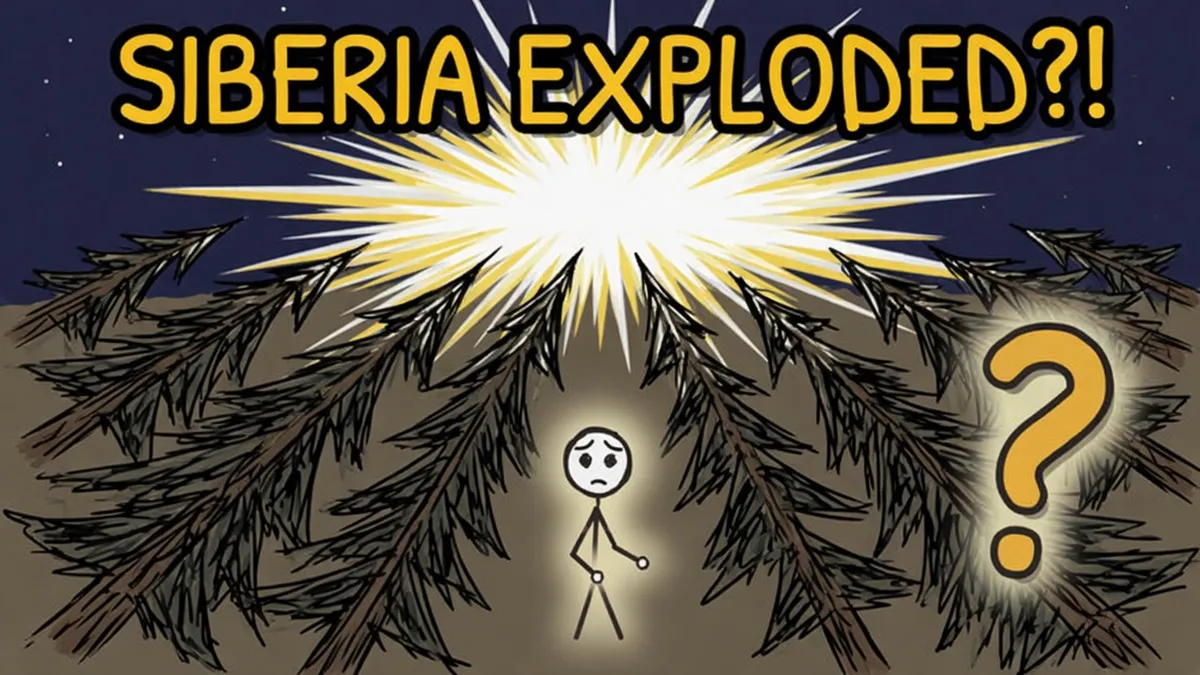
Just after seven in the morning on 30 June 1908, the sky over a remote stretch of Siberian forest split open. A fireball brighter than the sun streaked overhead, and then came an explosion so vast it flattened 80 million trees across an area the size of a large city, knocked a man clean off his porch 60 kilometres away, and lit up the night skies of Europe so brightly that people could read outdoors at midnight. It had the force of a large nuclear bomb, decades before nuclear bombs existed. And when scientists finally reached the epicentre to find the crater such a blast must have left, they found something that made no sense: nothing.
01 · The blastA nuclear bomb before the bomb
The scale of the Tunguska event is hard to overstate. It remains, to this day, the largest impact event in recorded human history. The explosion released an estimated 10 to 15 megatons of energy, which is to say hundreds of times more powerful than the bomb that destroyed Hiroshima. It levelled roughly 2,000 square kilometres of forest, laying the trees down flat in a vast radial pattern like matchsticks swept by a giant hand. The only reason it isn’t remembered as one of history’s great catastrophes is pure luck of geography: it happened over one of the emptiest places on Earth, and killed, as far as we know, almost no one.
02 · The missing craterThe clue that was an absence
Here is the puzzle that defined Tunguska for decades. It took years before a scientific expedition, led by Leonid Kulik, finally reached the remote site in 1927, nearly twenty years after the event. Kulik expected to find a colossal impact crater, the obvious signature of whatever had struck the Earth. He found flattened forest radiating outward for miles. He found, eerily, a patch of trees at the very centre still standing upright but stripped of their branches. What he did not find, anywhere, was a crater. He searched for years, even draining a bog he suspected was the impact pit, only to find an ordinary tree stump at the bottom. Something had exploded with the power of a nuclear bomb and left no hole. How?
The missing crater isn't a mystery. It's the single biggest clue, and it points straight to the answer: an airburst. The object, a stony asteroid roughly the size of an office building, never reached the ground. As it plunged through the atmosphere at cosmic speed, the mounting pressure and heat tore it apart, and it detonated several kilometres up in the sky, releasing all its energy as a downward shockwave. That's why the central trees were left standing but stripped: the blast came from directly overhead, snapping off branches while leaving trunks upright. And it's why there's no crater: the thing that exploded was largely vaporised in mid-air. There was never a solid object to hit the ground. The absence of a crater isn't the mystery. It's the fingerprint.
03 · Asteroid or cometThe remaining debate
So the “what” is settled: an airburst. The lingering scientific argument is over exactly what exploded, a rocky asteroid or a fragment of a comet. Both fit the broad picture, and both would airburst the same way. A 2001 modelling study leaned strongly toward an asteroid, putting the odds at around 83 percent asteroidal versus 17 percent cometary, and most researchers today favour a stony asteroid from the asteroid belt. But a comet fragment, essentially a dirty snowball, hasn’t been ruled out, and would helpfully explain why so little debris was ever found (it would mostly be ice, which vanishes). This is a genuine, narrow scientific debate, not a mystery. Nobody doubts it was a natural object. They just aren’t certain which kind.
04 · The fringe theoriesAntimatter, black holes, and Tesla
A blast this big, this strange, and this crater-less was always going to attract wilder ideas, and Tunguska has collected a menagerie of them. Over the years people have proposed that it was a lump of antimatter annihilating in the atmosphere, a tiny black hole passing through the Earth, a crashed alien spacecraft, or even a death-ray experiment gone wrong by the inventor Nikola Tesla. They’re fun, and they’re all unsupported by a shred of evidence. The reason scientists don’t reach for them is simple: they don’t need to. The ordinary airburst of a natural object explains every single observation, the flattened forest, the standing central trees, the missing crater, the glowing skies. When the boring answer explains everything, the exciting answers are just noise.
05 · The reason it mattersIt can happen again
Tunguska is not just a historical curiosity, and this is the part that should make you sit up. Objects of that size, a few tens of metres across, strike the Earth every few centuries or so. We got lucky in 1908 because it hit empty forest; a Tunguska over a major city would be a catastrophe. And it’s not theoretical. In 2013, a much smaller asteroid airburst over Chelyabinsk, Russia, in broad daylight, caught on hundreds of dashcams, its shockwave blowing out windows and injuring over a thousand people. It was a live, filmed miniature of Tunguska. That’s precisely why space agencies now scan the skies for near-Earth asteroids: not because the mystery is unsolved, but because it’s solved, and it told us this will happen again.
06 · The payoffSo what caused the Tunguska event?
A rock the size of a building, screaming in from space, that exploded in the sky before it ever touched the ground. That airburst delivered the punch of a large nuclear weapon to a Siberian forest, flattened it for thousands of square kilometres, and then left almost no trace, because the culprit had turned itself to vapour on the way down. The absent crater that baffled everyone for decades turned out to be the answer hiding in plain sight. And the real lesson of Tunguska isn’t spooky at all; it’s practical. The sky occasionally throws a building-sized rock at us, and in 1908 it happened to land in the middle of nowhere. The only genuine mystery left is where, and when, the next one lands.
The animated version
Same answer, told as a little animated story with the strange little stickman acting it out. Dry, quick, and, obviously, correct.
Quick questions
What was the Tunguska event?
The Tunguska event was a massive explosion that occurred on 30 June 1908 over a remote part of Siberia, near the Podkamennaya Tunguska River. It flattened roughly 2,000 square km of forest and is the largest impact event in recorded history. Almost no people were harmed because the area was so remote.
What caused the Tunguska event?
The scientific consensus is that a stony asteroid, or possibly a comet fragment, entered the atmosphere and exploded several kilometres above the ground in an airburst. The object was torn apart by heat and aerodynamic pressure, releasing its energy as a devastating shockwave. It did not strike the ground intact.
Why is there no crater from the Tunguska event?
Because the object exploded in mid-air rather than hitting the surface. The blast happened at an altitude of roughly 5 to 10 km, and the body was largely vaporised, so there was no solid mass left to punch a crater. This puzzled the 1927 Kulik expedition, which found flattened trees but no impact pit.
How big was the Tunguska explosion?
Estimates centre on roughly 10 to 15 megatons of TNT, with a broader scholarly range of about 3 to 30 megatons. Even the lower estimates are hundreds of times more powerful than the Hiroshima atomic bomb. It flattened an area of forest comparable in size to a large city.
Was the Tunguska event a meteor or a comet?
This is still debated. Most scientists favour a stony asteroid, and a 2001 study estimated roughly an 83% probability of an asteroidal origin. A comet fragment has not been fully ruled out, so the exact nature of the object remains an open question.
Did anyone die in the Tunguska event?
There are no firmly confirmed human deaths, largely because the region was extremely remote and sparsely populated. Some accounts mention up to a few possible deaths, but none are confirmed. Reindeer herds were killed and local Evenki people were knocked down and injured.
Could a Tunguska event happen again?
Yes. Objects of this size strike Earth on average every few centuries to a millennium, and most of the planet's surface is ocean or unpopulated land. The 2013 Chelyabinsk airburst over Russia was a smaller, directly observed example, which is why space agencies now actively track near-Earth asteroids.
How big was the Tunguska asteroid?
Modern modelling suggests the object was roughly 50 to 60 metres across, with a scholarly range of about 50 to 80 metres, roughly the size of a large building. Despite its modest size, its enormous speed gave it the energy of a large nuclear weapon.
Where did the Tunguska event happen?
It happened in central Siberia, Russia, over the basin of the Podkamennaya Tunguska River, in a densely forested and very remote region. The nearest settlement of note was the Vanavara trading post, around 65 km from the epicentre.
How did scientists figure out it was an airburst?
The 1927 expedition led by Leonid Kulik found trees flattened outward from a central point, with some trees left standing upright at the very centre, and no crater at all. This radial pattern and the missing crater matched a mid-air explosion directly overhead, which the airburst model later explained precisely.
Was the Tunguska event caused by aliens, a black hole, or Tesla?
No. Over the years people have suggested antimatter, a passing mini black hole, and even a Nikola Tesla experiment, but none of these ideas are supported by any evidence. The natural airburst of an asteroid or comet fragment explains all the observations, and it is the explanation accepted by scientists.
Is Lake Cheko the Tunguska crater?
Probably not, though it is debated. In 2007 an Italian team proposed the small, funnel-shaped Lake Cheko as a crater from a surviving fragment, but later research, including 2017 sediment dating, suggests the lake is older than 1908. Most scientists remain unconvinced, and no confirmed crater from the event has ever been found.
Our sources 8 checked
// every claim on this page was checked before it went up