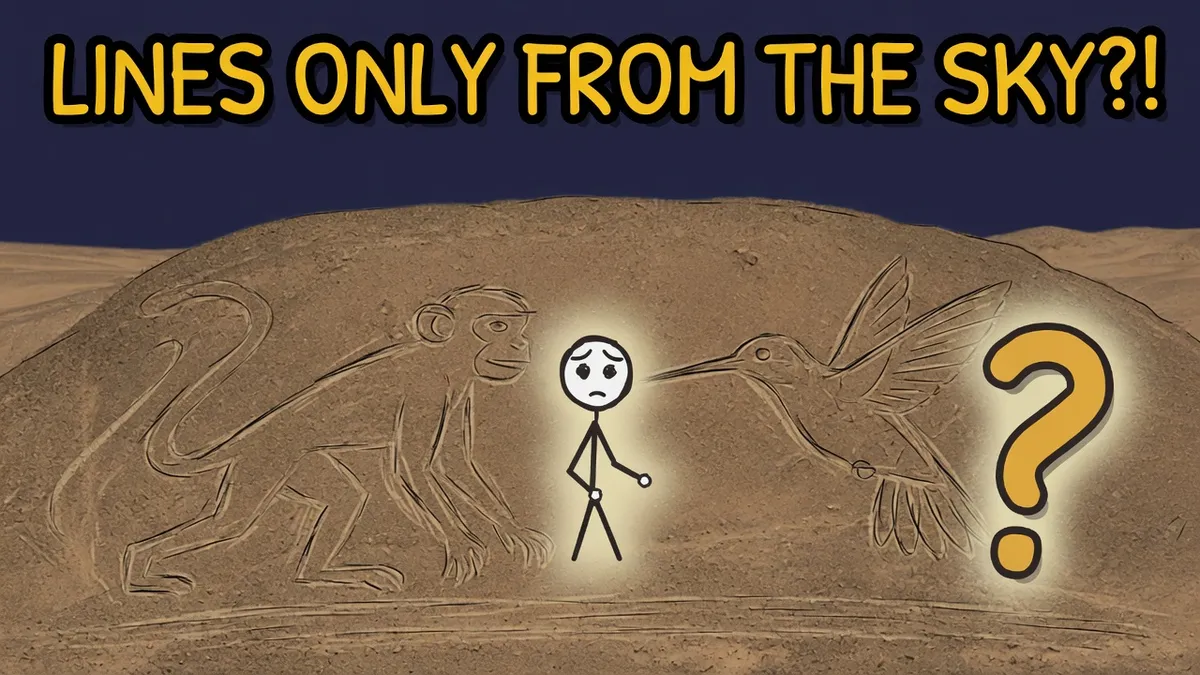
Scratched into a bone-dry plateau in southern Peru are drawings so vast you cannot take them in from the ground: a hummingbird the length of a football pitch, a monkey with a curling tail, a spider, a condor, straight lines running arrow-true for kilometres. They are around 2,000 years old, and for decades a seductive story has clung to them: that they can only be seen from the sky, so they must have been made for, or by, visitors from above. It is a wonderful tale. It is also completely backwards, and the real story is better.
01 · What they actually areDrawings the size of a landscape
The Nazca Lines are geoglyphs, designs drawn directly onto the earth on a giant scale. There are hundreds of them across the Nazca pampa: long straight lines, geometric shapes like trapezoids and spirals, and the famous figures, the hummingbird, the monkey, the spider, the condor, a pelican, a tree, even a waving humanoid nicknamed the “astronaut” (which fuels the alien story, though it’s just a stylised figure). The largest reach up to around 370 metres. In 1994 the whole complex was made a UNESCO World Heritage Site. This is not a handful of doodles. It is an entire landscape turned into a canvas.
02 · Who drew themA known people, not a lost mystery
Despite the mystique, we know who made them. They were created by the Nazca culture, with earlier work by the Paracas before them, Andean desert peoples who lived along Peru’s south coast roughly between 500 BC and 500 AD. These weren’t a vanished super-civilisation; archaeologists trace them through their pottery, textiles and settlements scattered across the same region. The lines are hard to date directly, since you can’t carbon-date a scrape in the ground, so their age is pinned down from organic material and pottery found alongside them. The makers had names, homes, crafts and gods. We just don’t have their written records, because they left none.
03 · How they did itScraping the desert's skin
The technique is beautifully simple, which is part of why it survived. The surface of the pampa is covered in dark, reddish stones, coated over millennia by a thin iron-oxide “desert varnish.” Just beneath lies pale, yellow-grey ground. To draw, the Nazca simply removed the dark stones along a line, exposing the light earth underneath in high contrast. Most figures are a single cleared outline, often one continuous line, laid out with nothing more than wooden stakes and cord, probably scaled up from small models. No lasers, no aliens, no lost technology. Just people, patiently uncovering the pale skin of the desert.
04 · Why they lastedThe most patient place on Earth
Here’s the quiet miracle: these are shallow scratches, and yet they’ve endured for two millennia. The reason isn’t mysterious, it’s meteorological. The Nazca pampa is one of the driest, stillest places on the planet, with almost no rain and very little wind to disturb the ground. Nothing washes the lines away, nothing blows sand across them, nothing grows over them. In almost any other landscape they’d have vanished within a generation. Here, the climate acts like a preservative, holding a 2,000-year-old drawing as if it were made last week. The lines didn’t survive because they were magic. They survived because nothing ever happens to that ground.
The whole "only visible from the sky" premise is wrong, and the evidence flips the alien story on its head. Many figures can be seen from the surrounding foothills, and crucially, they were made to be walked. Most are a single unbroken line you can trace on foot like a procession. And in 2024, an AI survey by Japan's Yamagata University and IBM found hundreds of smaller figures placed deliberately beside old trails, at human eye level, like roadside signs for people passing by. The Nazca didn't need to fly to see their art. The art was the walk. The one thing the ancient-astronaut theory insists they couldn't do without aircraft is the exact thing they designed the lines for.
05 · Why they made themA prayer for water, written on the ground
So if not for aliens, why go to all this effort? The honest answer is that no single purpose is proven, but the leading idea is deeply human. This is one of the most arid places on Earth, and to the Nazca, water was survival. Many archaeologists believe the lines were ritual pathways, walked in ceremonies to petition the gods for rain and fertility, with the animal figures, spiders, birds, plants, standing as symbols of water and life. Straight lines may point toward water sources or sacred mountains. The 2024 discoveries of trailside figures strengthen this picture of the pampa as a vast ceremonial space you moved through. The Nazca Lines may be, in essence, an enormous prayer for rain, drawn into the driest ground on Earth.
06 · The payoffSo what are the Nazca Lines?
They are the ritual landscape of a real, known, ingenious desert people, hundreds of giant figures scraped into the earth around 2,000 years ago, made not to be admired from the heavens but to be walked across the ground, most likely in ceremonies begging a merciless desert for water. They survived because the climate never lets anything change, and we are, astonishingly, still finding new ones, with modern AI now uncovering in months what once took decades. The alien story sells the Nazca short. The truth is stranger and far more moving: ordinary human beings, with cord and stakes and enormous patience, drew a message to their gods so large it could only be understood on foot, and so faithful to its desert that it’s still there, waiting, two thousand years later.
The animated version
Same answer, told as a little animated story with the strange little stickman acting it out. Dry, quick, and, obviously, correct.
Quick questions
What are the Nazca Lines?
The Nazca Lines are hundreds of huge designs, called geoglyphs, etched into a desert plateau in southern Peru. They range from long straight lines and geometric shapes to figures of animals and plants such as a hummingbird, monkey, spider and condor. They were made by ancient Andean cultures over 1,500 years ago and are a UNESCO World Heritage Site.
Who made the Nazca Lines?
They were made mainly by the Nazca culture, with some earlier work by the Paracas culture. These were skilled desert-dwelling Andean peoples, not a lost or mysterious civilisation. Archaeologists identify them from the pottery, textiles and settlements found across the same region.
How old are the Nazca Lines?
Most were made between roughly 500 BC and 500 AD, so the oldest are around 2,500 years old and the main Nazca phase runs from about 200 BC to 500 AD. Exact dates for individual figures are uncertain because the cleared lines cannot be carbon-dated directly. Researchers date them indirectly using pottery and organic material found alongside them.
How were the Nazca Lines made?
The builders removed the top layer of dark, iron-oxide-coated surface stones to expose the pale, lighter-coloured ground underneath. This created a high-contrast outline, usually just a narrow cleared border rather than a filled-in shape. They likely used simple tools such as wooden stakes and lengths of cord, and probably scaled up from smaller models.
Why were the Nazca Lines made?
No single purpose is proven, but most archaeologists think they were ritual and religious. The leading idea links them to water and fertility: in an extreme desert, the lines may have been walked in ceremonies to petition gods for rain and good harvests. Other figures may have been offerings addressed to sky or mountain deities.
Can you only see the Nazca Lines from the air?
No, and this is a common myth. Many can be seen from the surrounding foothills, and the figures were designed to be walked along and experienced at ground level, not viewed from above. Aircraft simply make them easier to photograph in full; they were never needed to make or use them.
Were the Nazca Lines made by aliens?
No. There is no credible evidence for extraterrestrial involvement, and the aliens idea rests on the false claim that the lines can only be seen from the sky. The people who made them are known, and their tools and technique have been reproduced by experiment. The real story, of a desert culture creating ritual landscapes, is more impressive than the myth.
Where are the Nazca Lines located?
They lie on the arid Nazca pampa in the Ica region of southern Peru, between the towns of Nazca and Palpa, a few hundred kilometres south of Lima. The surrounding coastal desert is one of the driest places on Earth. Related geoglyphs also appear in the nearby Palpa valley.
How many Nazca Lines are there?
Hundreds, and the count keeps rising. Around 358 figurative geoglyphs were known by 2022, but AI-assisted surveys have since found hundreds more, nearly doubling the figurative total. Counting all lines and shapes as well as figures, the totals run into many hundreds and continue to grow.
Why have the Nazca Lines survived so long?
Because of the exceptionally dry, windless and stable climate of the pampa. With almost no rain or wind to disturb the surface, the shallow cleared lines have barely eroded in around 2,000 years. Their survival is down to geography and climate, not any special or supernatural quality.
How were new Nazca Lines discovered using AI?
In 2024, a team from Japan's Yamagata University and IBM Research trained artificial intelligence on thousands of aerial images to flag spots most likely to hold hidden glyphs, then checked them in the field. This found about 303 new figures in roughly six months, work that would previously have taken decades.
What do the newest AI-found glyphs tell us about their purpose?
The newly found relief-type glyphs are smaller and sit close to old walking trails, showing humans, domesticated animals and severed heads. Researchers interpret these as near-path markers meant to be seen by people walking by, almost like roadside signs. This supports the view that the geoglyphs were made to be travelled and experienced on the ground.
Our sources 7 checked
// every claim on this page was checked before it went up