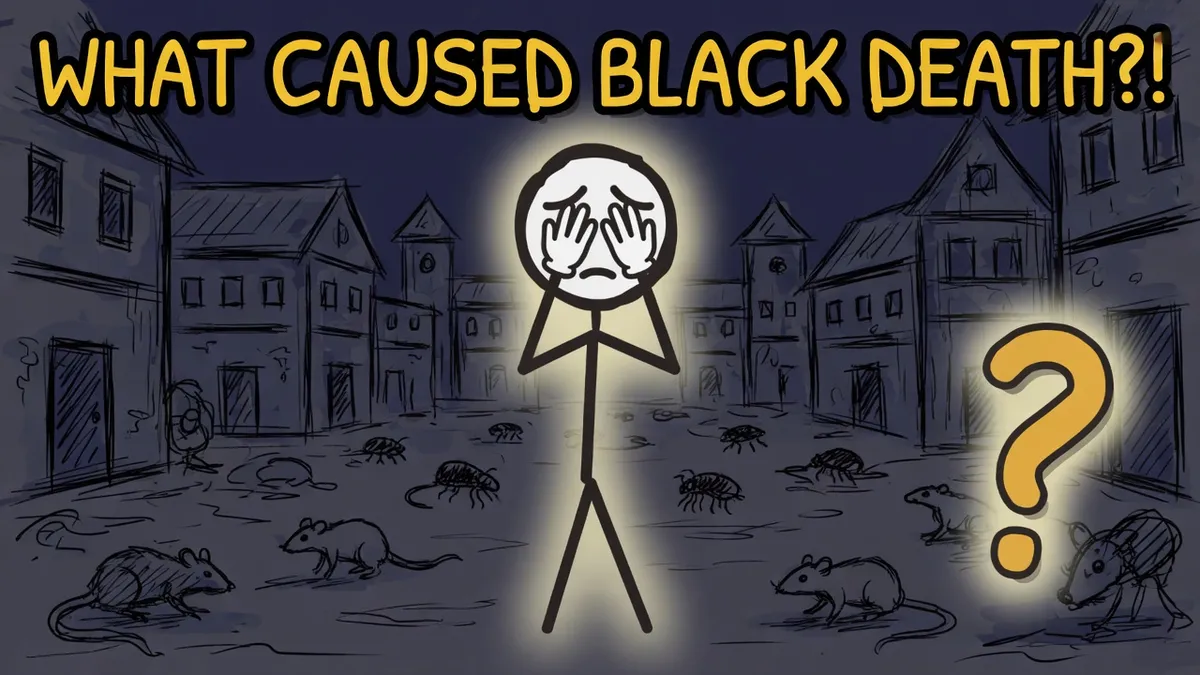
In the space of about five years, something swept across Europe and killed between a third and a half of everyone alive. Whole villages emptied. Cities lost so many people the survivors could not bury them fast enough. And the most terrifying part was that nobody had the faintest idea what it was. They blamed bad air, sinful living, the alignment of the planets, the wrath of God. They were all wrong. The Black Death was caused by something far smaller than any of those, a single species of bacterium, and we can now trace almost the exact moment and place it began.
01 · The culpritA bacterium hiding in the teeth of the dead
For centuries, historians argued about what the Black Death actually was. That argument is now over, settled by the dead themselves. Scientists extracted ancient DNA from the teeth of people buried in medieval plague pits, and found the fingerprint of a single bacterium: Yersinia pestis. This is the germ that causes plague. It lives naturally in wild rodents, hitching between them on the backs of fleas, and every so often it spills over into humans with catastrophic results. The medieval mind reached for demons and comets. The real killer was a microbe you could not have seen if you were staring right at it.
02 · The birthplaceA graveyard by a lake in 1338
Here is where the story turns genuinely astonishing. In 2022, researchers combined two clues: DNA from bodies in a cemetery near Lake Issyk-Kul in Kyrgyzstan, and the tombstones marking those same graves. The stones, carved in Syriac, named the dead and recorded that they died of “pestilence” in 1338 to 1339, nearly a decade before the plague reached Europe. And the strain of Y. pestis in their bodies sat exactly at the root of a huge genetic explosion of plague variants, an event scientists call the “big bang.” In other words, this lakeside community was patient zero. A pandemic that reshaped the world was traced to a graveyard by a lake.
03 · The spreadFleas, rats, ships, and lungs
From that Central Asian source, the plague travelled the arteries of the medieval world: trade routes. The bacterium moved with infected rodents and their fleas, then leapt onto Genoese merchant ships that carried it across the Mediterranean, reaching Sicily, Italy and the rest of Europe from 1347. But fleas and rats alone don’t explain how fast it burned through towns. Plague takes three forms, and the deadliest, the pneumonic form, infects the lungs and spreads straight from person to person on a cough, no flea required. Once it reached the lungs, the Black Death could travel as fast as breath.
We tend to picture the guilty party as the rat. But a 2018 study modelling the actual death curves found the medieval spread fit human parasites, our own fleas and body lice, better than a rat-borne model. If that's right, the plague didn't mainly ride into your home on a rat. It rode in on the people around you, and on the lice in your own clothes. The enemy wasn't just in the streets. It was on your skin.
04 · The perfect stormWhy it killed on such a scale
Why did one bacterium manage to kill up to half of Europe? Because it landed in a world with no defences whatsoever. Nobody had prior immunity to this strain. Nobody knew that germs existed, so every response, from prayer to bloodletting to burning “bad air,” was useless or worse. There were no antibiotics and would not be for six hundred years. And medieval towns were dense, filthy and shared with rats, fleas and lice, an almost perfect habitat for the disease. Put a novel, airborne-capable killer into that world and the result was the deadliest pandemic in recorded history.
05 · The survivorIt never actually left
Here’s the fact that unsettles people most: Yersinia pestis did not go extinct when the Black Death faded. It is still out there, still living in wild rodents, still infecting people. Every year around the world there are roughly 1,000 to 2,000 human cases of plague, including about seven a year in the United States, mostly in rural New Mexico and Arizona. The difference is not the germ. The germ is essentially the same monster that emptied medieval Europe. The difference is that today, caught early, it is cured with a course of ordinary antibiotics. The gap between apocalypse and a treatable illness turned out to be a few days and the right pills.
06 · The payoffSo what caused the Black Death?
A single bacterium, Yersinia pestis, born in a rodent population in Central Asia, carried west by fleas, rats, ships and quite possibly our own body lice, striking a world with no immunity, no medicine and no idea what was killing it. That is the whole grim engine of the worst catastrophe in human history. And the strangest part is how close it still is. The same germ that traced its origin to a lakeside grave in 1338 is alive today, circulating quietly in wild animals, held in check not by luck or distance but by a bottle of antibiotics. The Black Death was never really vanquished. We just, finally, learned its name.
Quick questions
What caused the Black Death?
The Black Death was caused by the bacterium Yersinia pestis. Ancient DNA taken from the teeth of plague victims has directly confirmed the bacterium in medieval remains, ending long-running speculation about what the disease was. It normally lives in wild rodents and is carried by fleas.
How many people died in the Black Death?
Estimates suggest the 1347 to 1352 peak killed roughly one third to one half of Europe's population, on the order of 25 to 50 million people in Europe alone, with tens of millions more across Asia and North Africa. These figures are estimates rather than exact counts. It is still considered the deadliest pandemic in recorded history.
Where did the Black Death start?
A 2022 study in Nature traced the source strain to the region around Lake Issyk-Kul in modern Kyrgyzstan, in Central Asia. Tombstones there record a spike in deaths from pestilence in 1338 to 1339, several years before plague reached Europe. This overturned the older assumption that it began in China.
How did the Black Death spread?
It spread through the rodent-and-flea cycle and then along human trade and shipping routes. Fleas carried the bacterium from infected rodents to people, and the disease moved west from the Crimea across the Mediterranean on merchant ships. The pneumonic form could also pass directly between people through the air, which helped it move fast.
Did the Black Death come from rats?
Rats and their fleas are the classic explanation, but this is debated. A 2018 study modelling mortality data found the medieval spread fit human fleas and body lice better than a rat-borne model. So rats were part of the wider picture, but human parasites may have driven much of the rapid person-to-person spread.
Does the Black Death still exist?
Yes. The same bacterium, Yersinia pestis, still causes plague today. About 1,000 to 2,000 cases are reported worldwide each year, with around seven a year in the United States, mostly in rural areas of New Mexico and Arizona. It is nothing like the medieval scale.
Can the Black Death be cured today?
Yes, if it is caught early. Plague is treated with common antibiotics such as gentamicin and fluoroquinolones, and early treatment is usually effective. The danger now is delay, because untreated plague, especially the pneumonic form, can still be fatal.
What are the three forms of plague?
Bubonic plague is the commonest form, caught from a flea bite, and produces swollen lymph nodes called buboes. Septicaemic plague is a bloodstream infection with very high fatality. Pneumonic plague affects the lungs and is the only form that spreads directly from person to person through coughed droplets.
What were the symptoms of the Black Death?
The bubonic form caused fever, chills, weakness and painful swollen lymph nodes called buboes, often in the groin, armpits or neck. The septicaemic form flooded the bloodstream, and the pneumonic form attacked the lungs. Untreated, all three could be rapidly fatal.
How was the Black Death finally stopped?
The medieval outbreak was never cured. It burned through populations and eased as the most vulnerable died and communities used crude measures like quarantine. There was no medical treatment at the time. Only in the twentieth century, with antibiotics, did plague become reliably treatable.
Why was the Black Death so deadly?
People had no immunity to the strain, no understanding that germs cause disease, and no effective treatment. Crowded, unsanitary towns full of fleas, lice and rodents let it spread easily, and the airborne pneumonic form made it move faster than people could respond. Together these factors produced catastrophic death rates.
How did the Black Death change society?
With so many workers dead, surviving labourers could demand better pay and conditions, which many historians argue helped weaken serfdom and feudal labour ties in parts of Europe. It also reshaped religion, art and attitudes to death. In that sense the pandemic was a turning point, not just a disaster.
Our sources 7 checked
// every claim on this page was checked before it went up