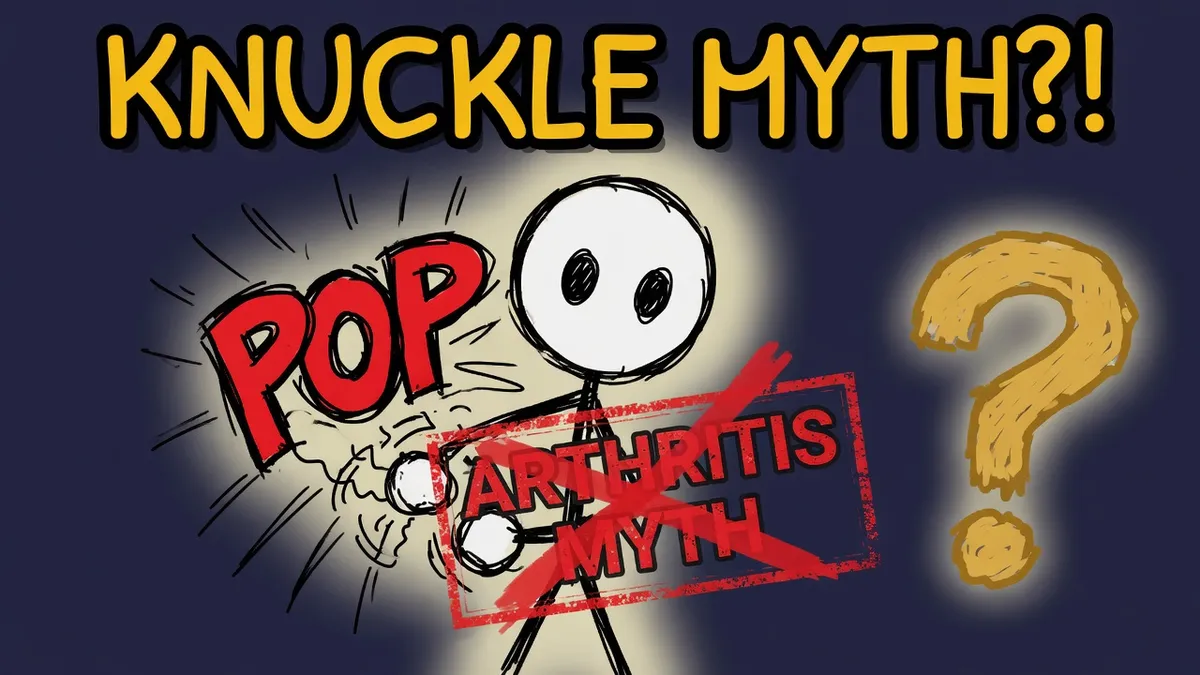
Somewhere, right now, someone is cracking their knuckles, and someone else is wincing and saying "you'll get arthritis doing that." It's one of the most universal warnings there is, passed down from parents and teachers with total confidence. And it is wrong. Not "probably wrong" or "unproven", genuinely, thoroughly disproven, by controlled studies of hundreds of people and, most gloriously, by one stubborn doctor who spent sixty years running the experiment on his own two hands. Your knuckles are safe. Your mum, on this one, was mistaken.
01 · What the pop actually isA bubble, not a grind
To see why the myth can’t be true, you have to know what that satisfying crack actually is, and it’s not what people imagine. It is not bone scraping on bone, or cartilage wearing away. Each of your knuckles is a joint wrapped in a sealed capsule filled with a lubricating liquid called synovial fluid. When you pull the joint apart, you stretch that capsule and the pressure inside suddenly drops, which lets a gas bubble rapidly form in the fluid and collapse. That collapse is the pop. It’s a fluid-and-gas event, closer to the fizz of opening a bottle than to any kind of damage. And here’s the key point: there is simply no mechanism by which a gas bubble popping in your joint fluid could grind your joint down into arthritis. The myth fails before it even starts.
02 · The studiesHundreds of hands, no link
You don’t have to argue from mechanism, though, because researchers have gone and counted. In 1990, a study looked at 300 people, comparing habitual knuckle-crackers against non-crackers, and found no higher rate of hand arthritis in the crackers. In 2011, a larger and more rigorous study went further, calculating each person’s lifetime “crack-years” of cumulative cracking and checking their hand X-rays, and again found no significant association with osteoarthritis at any joint. Major medical institutions have since closed the case: Harvard Health says cracking “probably won’t raise your risk for arthritis,” and Johns Hopkins states flatly there’s no evidence it causes damage like arthritis. The verdict is about as settled as medical verdicts get.
The single best piece of evidence isn't a big clinical trial. It's one man and a grudge against a myth. Dr Donald Unger's mother told him, as a boy, that cracking his knuckles would give him arthritis. So he decided to test it, on himself, for the rest of his life. For over sixty years, he cracked the knuckles of his left hand at least twice every single day, an estimated 36,500 cracks, while never once cracking his right hand, keeping it as a pristine control. After six decades: no arthritis in either hand, and no difference between them. In 2009 he won the Ig Nobel Prize in Medicine for it, and signed off with the immortal line, addressed to his mother, asking what else she might have been wrong about.
03 · The grain of truthGrip, swelling, and a caveat
To be scrupulously fair, there is one loose thread, and honesty means flagging it. That 1990 study of 300 people did report that the habitual crackers tended to have slightly more hand swelling and somewhat weaker grip. That sounds alarming until you look closer. First, weaker grip is not arthritis, they’re completely different things. Second, the crackers in that study also did more manual labour, smoked more and drank more, any of which could explain the difference. And third, the larger 2011 study specifically did not find reduced grip strength. So this is a shaky, confounded, unreplicated finding about grip, not evidence for the arthritis claim everyone actually worries about. Treat it as a curiosity, not a warning.
04 · When cracking can genuinely hurtThe rare exceptions
“Harmless” isn’t quite the same as “impossible to hurt yourself with,” so here’s the sensible fine print. There are a handful of published cases of people injuring a finger while forcing a particularly aggressive crack, straining a ligament or the like. And cracking a joint that’s already damaged by existing arthritis could aggravate it. But these are edge cases about how you crack, not evidence that ordinary cracking of a healthy hand causes disease. For the vast majority of people, gently popping your knuckles is doing nothing worse than annoying the person next to you.
05 · What about necks and backs?Same fizz, more caution
People crack more than knuckles, so it’s worth a word on the rest. Cracking your neck or back works on the same basic principle, a gas pop in a joint’s fluid, and occasional self-cracking is generally low-risk. The difference is location: your neck and spine sit right next to major nerves and blood vessels, so forceful, repeated twisting, especially when someone else yanks your neck, carries more real risk than popping a finger. If your neck or back cracking is constant, painful, or comes with other symptoms, that’s worth getting checked. But a healthy finger joint? Pop away.
06 · The payoffSo does cracking your knuckles cause arthritis?
No. The pop is just a gas bubble collapsing in your joint’s own lubricating fluid, a harmless fizz, with no mechanism to grind anything down. Study after study of hundreds of people finds no link to arthritis, and one determined doctor proved it on his own hands over sixty years and won a science prize for the trouble. The habit might irritate the people around you, and if you truly wrench at it you could tweak a finger, but the disease your relatives keep threatening you with simply isn’t coming from this. So the next time someone tells you you’ll ruin your joints, you can crack a knuckle, smile, and tell them about the man who tested it for six decades, one hand at a time, and won an award for proving them wrong.
Quick questions
Does cracking your knuckles cause arthritis?
No. Study after study, including a 60-year self-experiment and controlled studies of hundreds of people, has found no link between knuckle-cracking and hand arthritis. The pop is gas in the joint fluid, not damage to the joint.
Is cracking your knuckles bad for you?
For most people it is harmless. The main documented downsides in older research were possible hand swelling and slightly weaker grip, and those findings are contested and not the same as arthritis. It is mostly an annoying habit rather than a dangerous one.
What actually happens when you crack your knuckles?
You pull the joint apart, which stretches the capsule around it and lowers the pressure inside. A gas bubble forms in the synovial fluid and collapses, and that collapse makes the pop. No bone is grinding and no cartilage is being worn away.
Can knuckle cracking cause any harm?
Rarely, and only mildly. There are a small number of published reports of people injuring a finger while forcing a crack, and cracking a joint already damaged by arthritis could in theory aggravate it. For a healthy hand, routine cracking has not been shown to cause lasting harm.
Why do knuckles crack louder over time?
There is no solid evidence that a person's knuckles genuinely get louder over the years. Loudness varies with the joint, how much you stretch it, and how big the gas bubble is. Perceived changes are usually down to technique and attention rather than the joint deteriorating.
Does cracking your neck or back cause problems?
The basic mechanism is the same gas-bubble pop, and occasional self-cracking is generally low risk. The caution is that the neck and spine sit near major nerves and blood vessels, so aggressive or forceful twisting, especially by another person, carries more risk than cracking a finger. If neck or back cracking is frequent, painful or paired with other symptoms, see a professional.
Who is Dr Donald Unger and what did he prove?
He was a doctor who cracked only his left knuckles, at least twice a day, for over 60 years while leaving his right hand alone as a control. He found no arthritis in either hand and no difference between them, and won the 2009 Ig Nobel Prize in Medicine for it. It remains the most famous single demonstration that the myth is wrong.
How many times did Donald Unger crack his knuckles?
By his own estimate, at least 36,500 times on his left hand over the six decades of the experiment. Despite that, examination showed no arthritis and no difference from his uncracked right hand.
What causes the popping sound in a joint?
It is gas rapidly forming and collapsing inside the synovial fluid when you stretch the joint and drop the pressure inside its capsule. It is a fluid-and-gas event, which is why you usually cannot re-crack the same knuckle immediately; the gas needs time to redissolve.
Does cracking your knuckles weaken your grip?
One 1990 study of 300 people reported that habitual crackers had somewhat weaker grip and more hand swelling. But those crackers also did more manual labour and other habits, and a larger 2011 study did not find reduced grip. So the grip claim is weak and contested, not established fact.
Can I stop my knuckles from cracking?
Yes. Knuckle-cracking is a habit, not a compulsion for most people, and simply becoming aware of it and keeping your hands busy tends to reduce it. Since there is no proven health benefit to cracking, stopping costs you nothing except the satisfying pop.
Is it true a doctor won a science prize for this?
Yes. Dr Donald Unger won the 2009 Ig Nobel Prize in Medicine, a real, tongue-in-cheek award, for his 60-year one-hand experiment. The Ig Nobels honour research that makes people laugh, then think.
Our sources 7 checked
// every claim on this page was checked before it went up