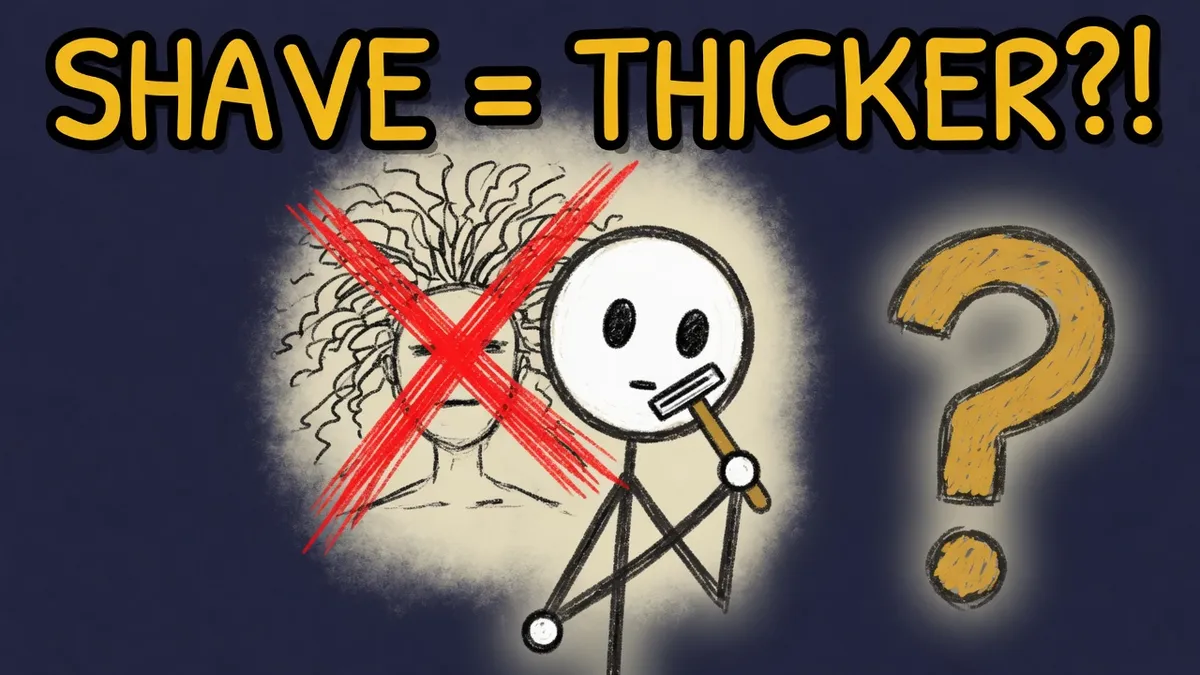
It's one of those facts everyone just knows. Shave your legs, your face, your arms, and the hair comes back thicker, darker, coarser, a little more each time, until you've apparently made a rod for your own back. Parents warn teenagers about it. It feels obviously true, because you can literally feel the stubble. And it is, from top to bottom, a myth, one that controlled scientific experiments have been quietly demolishing since 1928. The strange part isn't that people believe it. It's how cleverly your own skin tricks you into believing it.
01 · The one fact that settles itThe razor can't reach
Here’s the whole argument in a single sentence: a razor cuts hair at the surface, and everything that decides how a hair grows happens below the surface. Each hair is produced by a follicle, a tiny factory rooted in the skin, and that follicle alone determines the hair’s thickness, its colour, its texture, and how fast it grows. The part you shave, the visible shaft, is already dead. Cutting a dead strand at skin level has no possible way to send a message down into the living follicle telling it to change its output. It would be like trimming a plant’s leaves and expecting the roots to grow differently. The blade simply never touches the thing that matters.
02 · The illusion, part oneA blunt tip feels like a thick hair
So why does regrowth feel so convincingly coarse? Picture an uncut hair. It grows from the follicle and tapers, over its length, to a fine, soft point, like the tip of a paintbrush. That delicate tip is what you normally feel, and it feels soft. Now shave it. The razor slices straight across the middle of the shaft, leaving a blunt, flat end. When that regrows as stubble, you’re no longer feeling a fine taper, you’re feeling the full, flat width of a cut shaft. It feels stiff, prickly, and coarser. But the hair is exactly as thick as it always was. You’ve just changed the shape of its tip from a point to a stump.
03 · The illusion, part twoDark stubble against pale skin
The “darker” half of the myth has its own innocent explanation. Short regrowth stubble sits right against the skin, high-contrast and highly visible, so it simply looks more obvious than fine hair lying flat and long. And there’s a second effect: a hair that’s been growing for months or years has been gradually lightened by sunlight, chemicals and everyday wear. Fresh regrowth hasn’t had that exposure yet, so at first it can look very slightly darker, its original, un-faded colour. Both effects are about visibility and freshness, not about the follicle suddenly pumping out more pigment. Let it grow out, and it fades right back to normal.
The clincher is what happens with the opposite methods. Waxing and plucking don't cut the hair, they rip the whole thing out from the root, so the regrowth comes back with its natural fine, tapered tip intact, no blunt stubble at all. And sure enough, hair removed that way does not produce the coarse stubbly feeling that shaving does. That's the smoking gun. If shaving genuinely thickened hair, waxing would too, but it doesn't, because the whole effect was never about growth. It was always, only, about the shape of the cut. Same follicle, same hair, different tip.
04 · The experimentsA century of one-leg tests
You don’t have to take the anatomy on faith, because people have literally tested it. Back in 1928, the anatomist Mildred Trotter ran controlled beard-shaving studies and found no change in growth rate, coarseness or colour. Then in 1970, researchers ran the definitive version: they had men shave one leg every week for months while leaving the other leg completely alone as a control. Then they measured. The result was total: no difference in the width of the hairs, no difference in how much hair grew, no difference in growth rate, between the shaved leg and the untouched one. The British Medical Journal has since listed the whole belief among the medical myths that even doctors sometimes fall for.
05 · Why we all fall for itBlame puberty's timing
If it’s so thoroughly disproven, why does everyone believe it? Partly the illusions above, and partly a cruel coincidence of timing. Most people start shaving in their teens, during puberty, which is exactly when body and facial hair is naturally getting thicker, darker and more plentiful anyway, driven by hormones. So a teenager shaves for the first time, watches their hair genuinely thicken over the following years, and draws the obvious-but-wrong conclusion. The hair was always going to come in like that. Shaving just happened to be standing next to the crime scene, and got blamed for something puberty did.
06 · The payoffSo does shaving make hair grow back thicker?
No, not thicker, not darker, not coarser, not faster. Not in any real, measurable way. Shaving is a purely cosmetic act on the dead part of a hair, and the living follicle that actually controls everything never even notices. What changes is entirely in your perception: a blunt cut tip that feels stubbly, short dark regrowth that stands out against the skin, and a teenage timeline that lines up with puberty. Strip those three illusions away and the truth is almost boring: the hair comes back exactly as it was. So shave, or don’t, for whatever reason you like. Just know that the razor has no power whatsoever over what grows back. It never did.
Quick questions
Does shaving make hair grow back thicker?
No. This is a well-studied myth. Shaving only cuts the hair at the skin's surface and never touches the follicle below, which is the only thing that controls thickness. The regrowth feels coarser only because the cut leaves a blunt tip instead of the hair's natural fine point.
Does shaving make hair grow faster?
No. Controlled studies, including a classic 1970 trial in the Journal of Investigative Dermatology, measured shaved versus unshaved skin and found no difference in growth rate. Your growth speed is set by genetics and hormones, not by how often you shave.
Does shaving make hair darker?
No, the follicle produces the same pigment as before. Fresh stubble can look a little darker at first because it contrasts sharply against the skin and has not yet been lightened by the sun and everyday exposure. Once it grows out, it looks the same as it always did.
Why does hair feel coarser after shaving?
Because a razor cuts straight across the shaft, leaving a blunt, flat tip. An uncut hair tapers to a soft, fine point, so the blunt regrowth feels stiffer and stubblier by comparison. You are feeling the shape of the cut, not a genuinely thicker hair.
Does waxing make hair thinner over time?
It might, for some people, but it is not guaranteed and not permanent. Repeatedly pulling hair from the root can gradually weaken some follicles, producing finer regrowth. This differs from shaving, which does not affect the follicle at all. The evidence here is mostly clinical experience rather than strong controlled trials.
Does shaving affect the hair follicle?
No. A razor works only on the dead hair shaft above the skin. The follicle, which determines colour, thickness and growth rate, sits below the surface and is completely untouched by shaving.
Will shaving my face make my beard grow in fuller?
No. A 1928 controlled beard study and later research found shaving does not increase beard density or speed. Beards fill in with age and hormones during and after puberty, which is why the timing often gets mistaken for a shaving effect.
Does shaving my legs or arms make the hair grow back thicker?
No. The 1970 leg-shaving study is the direct test: one leg shaved weekly, the other left alone, and no difference in hair width, weight or growth rate. The stubble simply feels coarser because of the blunt cut tip.
If shaving does not thicken hair, why does it look that way?
Three things combine: the blunt cut end feels and looks coarser than a natural tapered tip, short dark stubble contrasts against the skin, and people often start shaving during puberty when hair is naturally thickening anyway. None of these involve any real change to the hair the follicle produces.
Does plucking or tweezing make hair grow back thicker?
No. Like waxing, plucking removes the whole hair from the root, so regrowth comes back with a natural tapered tip rather than blunt stubble. Repeated plucking can actually damage a follicle over time, if anything reducing growth rather than increasing it.
Can shaving change my hair colour?
No. Colour comes from pigment made inside the follicle, which shaving never reaches. New regrowth can appear marginally darker only because it has not yet been faded by sunlight and daily wear, an appearance effect that disappears as the hair lengthens.
Is there any way shaving changes how hair grows at all?
No, not the growth itself. The only real changes are cosmetic and temporary: the blunt cut tip feels stubbly and the short regrowth is more visible. Thickness, colour, growth rate and follicle behaviour all stay exactly the same.
Our sources 7 checked
// every claim on this page was checked before it went up