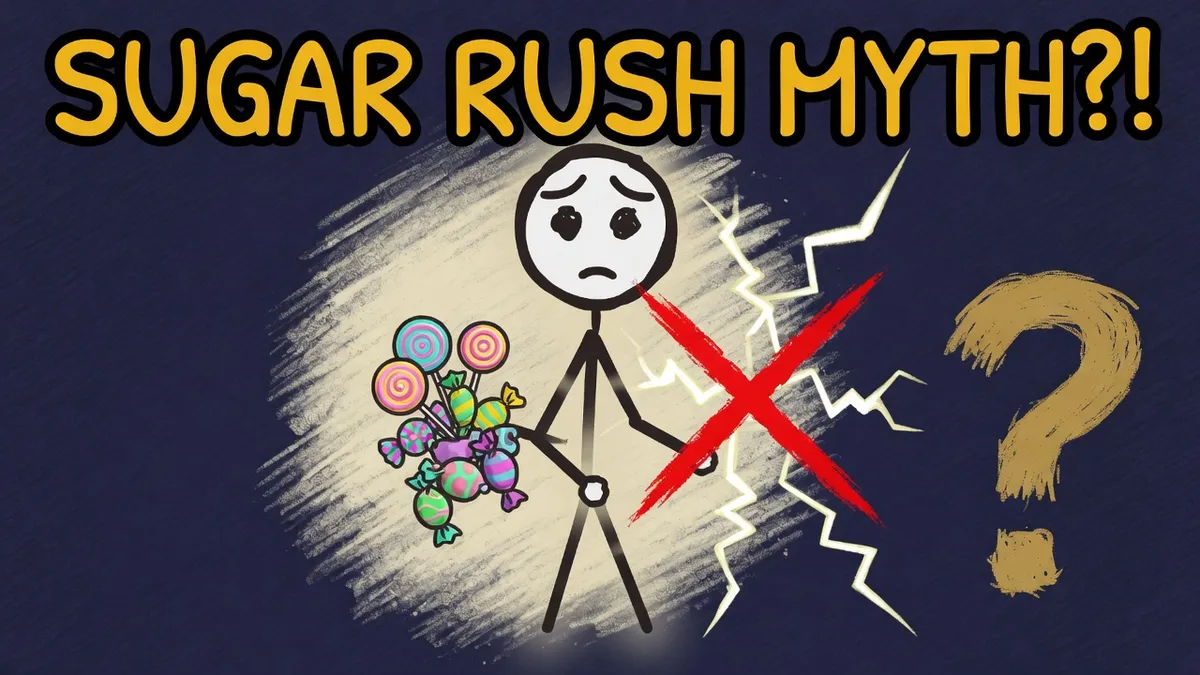
Every parent has watched it happen. The birthday cake is served, and within twenty minutes the children are ricocheting off the walls, shrieking, spinning, utterly feral. The culprit seems obvious: the sugar. It has become one of the most rock-solid beliefs in all of parenting, so obvious it barely feels like a claim at all. And yet when scientists actually put it to the test, in study after careful study, they found something genuinely surprising: sugar does nothing. The hyperactivity is real. The cause is not the cake. And the proof of that is one of the sneakiest experiments in psychology.
01 · What the studies foundA great big nothing
This myth has been tested more thoroughly than almost any other piece of folk nutrition, and the results are strikingly consistent. In 1994, researchers ran a rigorous double-blind trial: children were put on different diets, some loaded with sugar, some sweetened with a sugar-free substitute, and neither the kids, the parents, nor the researchers knew which was which. They measured behaviour and thinking exhaustively. The result: no difference. The following year, a meta-analysis in the journal JAMA pooled 23 such controlled studies and reached the same flat conclusion: sugar has no effect on children’s behaviour or cognition. And crucially, this held even for the children whose own parents were certain they were “sugar sensitive.”
02 · The real culpritBlame the party, not the cake
So if it isn’t the sugar, why do kids so reliably go bananas after sweets? Look at where children eat the most sugar. Birthday parties. Halloween. Christmas. Celebrations, days out, sleepovers. And what do all of those have in common, besides cake? They are loud, crowded, unstructured, wildly overstimulating environments, exactly the conditions that send any child into orbit, sugar or no sugar. The hyperactivity is genuinely there. It’s just being produced by the occasion, not the glucose. Strip away the sugar and keep the chaotic party, and you still get feral children. Strip away the party and just feed a child sugar quietly at home, and, as the trials show, you get nothing. We’ve been blaming the cake for what the party was doing all along.
Here's the study that cracks the whole thing open. Researchers took a group of boys whose mothers described them as "sugar sensitive," and gave every single boy a placebo, no sugar at all. But they told half the mothers that their son had just been given a big dose of sugar. Then they watched. The mothers who believed their sons were sugared up rated them as significantly more hyperactive, and on video they hovered closer, criticised more, and watched their sons more anxiously than the other mothers. The boys had eaten no sugar whatsoever. The entire "hyperactivity" existed in the parents' heads. Tell a parent sugar was given, and they will see wildness that isn't there, and start policing behaviour that hasn't changed. The effect was never in the child's blood. It was in the grown-up's expectation.
03 · Why the belief is so stickyConfirmation bias does the rest
Once you believe sugar makes kids hyper, your own mind quietly rigs the evidence. It’s called confirmation bias. Every time a child bounces off the walls after a biscuit, you notice, and file it as proof. But all the times a child eats sweets and stays perfectly calm? Those don’t register; they don’t fit the story, so they slip past unremembered. So a parent can spend years “observing” the sugar effect and feel utterly certain of it, while actually just collecting the hits and ignoring the misses. Add the party-timing coincidence on top, and you have a belief that feels overwhelmingly confirmed by daily experience, even though controlled experiments, where nobody knows who got the sugar, find nothing at all.
04 · But should you still limit sugar?Yes, for other reasons
None of this is a licence to let children live on sweets, so let’s be clear and balanced. Sugar being innocent of hyperactivity does not make it healthy. There are excellent, well-evidenced reasons to keep children’s added sugar moderate: tooth decay, healthy weight, and general nutrition all argue for limits, and dietitians rightly recommend them. The point of this myth-bust isn’t “feed them all the cake you like.” It’s narrower and more useful than that: cutting sugar is a good idea for your child’s teeth and body, but don’t expect it to calm a hyper child down, because the link you’re counting on was never real. Limit sugar, just for the right reasons.
05 · Why it matters to get this rightChasing the wrong cause
It might seem harmless to blame the cake, but believing the myth has a small cost: it points parents at the wrong lever. If your child is bouncing off the walls, hunting for the sugar means you might miss what’s actually driving it, over-tiredness, over-excitement, hunger, a chaotic environment, or simply the thrilling madness of a party. Those are the real, addressable causes, and they get overlooked when “it’s the sugar” is the automatic answer. Understanding that behaviour comes from the situation, not the snack, is genuinely more useful for a frazzled parent than clinging to a cake-shaped villain that the science has cleared.
06 · The payoffSo does sugar make children hyperactive?
No. Controlled, blinded studies are about as unanimous as science gets: sugar has no measurable effect on children’s behaviour or attention, not even in kids labelled sugar-sensitive, not even in kids with ADHD. The wildness at the party is real, but the party is causing it, and the belief that sugar is to blame turns out to live largely in the observer, so strongly that you can conjure “hyperactivity” in a parent’s eyes just by telling them sugar was served. So keep an eye on your child’s sugar for their teeth and their health, by all means. Just retire the idea that a slice of cake flips a switch in their brain. The switch was always the occasion. The cake was just there, taking the blame.
Quick questions
Does sugar make kids hyperactive?
No. Controlled double-blind studies have consistently found no link between sugar and hyperactivity in children. A 1995 meta-analysis in JAMA pooled 23 such studies and found sugar had no effect on behaviour or thinking. The energy you see at parties comes from the occasion, not the cake.
Does sugar cause hyperactivity?
No. Decades of research, including at least 12 randomised double-blind trials reviewed in the BMJ in 2008, have failed to find any causal link between sugar and hyperactive behaviour. Even studies of children believed to be sugar sensitive found no difference between sugar and placebo.
Why do kids seem hyper after sweets?
Because sweets usually turn up in exciting places: parties, holidays, celebrations and days out. Those settings are unstructured, social and stimulating, which naturally winds children up. Parents see the sugar and the excitement together and blame the sugar, when it is really the party doing the work.
Does sugar affect children with ADHD?
Studies that focused specifically on children with ADHD found no evidence that sugar worsens their behaviour or attention. The 2008 BMJ review noted this held even in ADHD-focused trials. Sugar is not a recognised cause or trigger of ADHD symptoms.
Is a sugar rush real?
Not in the way most people mean. Controlled research does not support a behavioural 'sugar rush' in children. Any burst of alertness people report is largely an expectation effect: believing sugar energises you can make you feel more alert even when the drink was sugar-free.
Should I limit my child's sugar?
Yes, but not because of hyperactivity. There is good reason to limit added sugar for dental health, healthy weight and general nutrition, and dietitians recommend keeping it moderate. Just do not expect cutting sugar to calm a hyperactive child, because the behaviour and the sugar were never linked in the first place.
What study proved sugar doesn't cause hyperactivity?
The clearest evidence comes from a 1994 New England Journal of Medicine double-blind trial by Wolraich and colleagues, and a 1995 JAMA meta-analysis of 23 studies by the same lead author. Neither found any effect of sugar on children's behaviour or cognition, even for children their parents called sugar sensitive.
Is the sugar and hyperactivity link a myth?
Yes. It is frequently cited as a textbook example of a medical myth, one that a majority of parents still believe despite strong evidence against it. The gap between what parents observe at parties and what controlled science shows is exactly why the myth survives.
Why do parents think sugar makes kids hyper?
Partly timing (sugar appears at exciting events) and partly expectation. In a 1994 study, mothers told their sons had eaten sugar rated them as more hyperactive, even though the boys had only had a placebo. The belief shapes what parents perceive, and confirmation bias keeps reinforcing it.
Does cutting out sugar calm children down?
There is no good evidence that it does. Controlled diet studies that removed sugar found no improvement in behaviour compared with sugar-containing diets. If a child seems calmer, it is more likely down to changes in routine, environment or the parent's own expectations than to the sugar itself.
Does sugar affect children's behaviour at all?
Not in terms of hyperactivity or attention, according to controlled research. What can affect behaviour is the surrounding context: tiredness, over-excitement, hunger or a chaotic environment. Blaming sugar can distract from these more real influences.
Where did the sugar hyperactivity myth come from?
It is often traced to small clinical observations in the 1970s that suggested diet affected behaviour, an idea that spread widely before larger controlled trials could test it. Once the belief took hold, the party-and-sweets connection and confirmation bias kept it alive, even as study after study failed to back it up.
Our sources 7 checked
// every claim on this page was checked before it went up