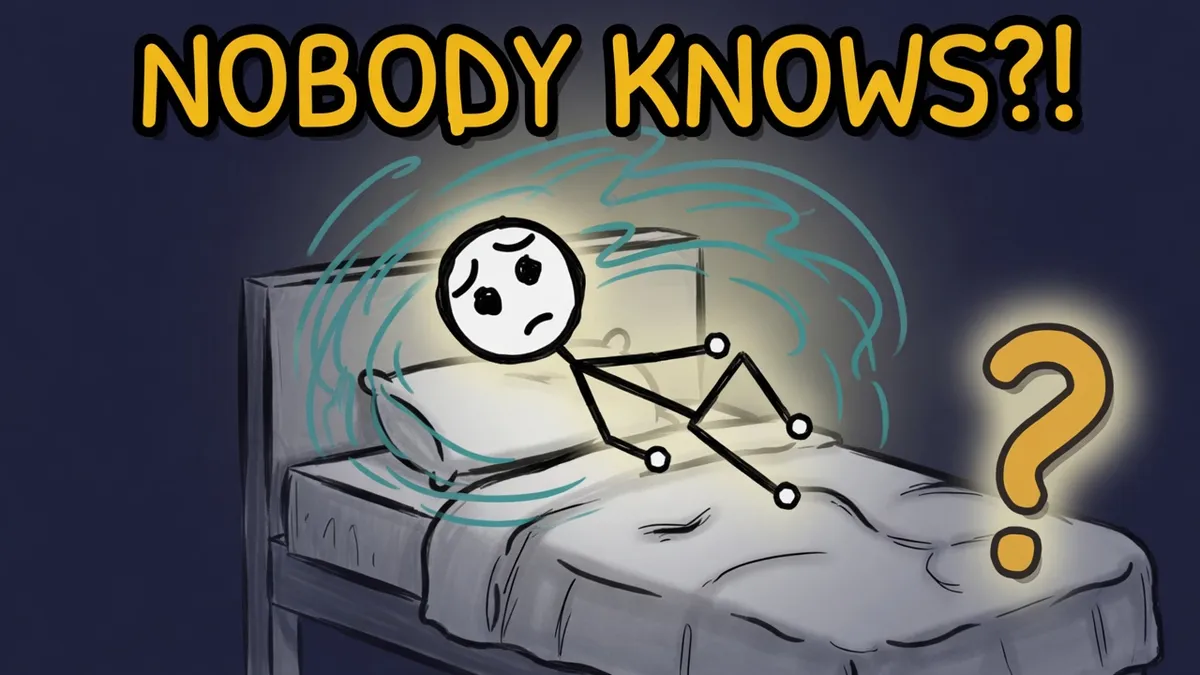
Here is one of the strangest things medicine does, dressed up as one of the most ordinary. Every single day, all over the world, we take a fully conscious person, delete their awareness completely, hold them in that void for hours while we cut them open, and then hand consciousness straight back as if nothing happened. We have done this reliably since 1846. It is utterly routine. And if you ask exactly how it works, how a drug switches you off, the honest answer is that nobody can fully tell you.
01 · The countdownTen, nine, eight… and then nothing
You know the scene even if you’ve never lived it. You’re on the table, a doctor asks you to count down from ten, and you get to about eight. Then, nothing. Not darkness, not a dream, not a sense of time passing. There’s no experience at all to report, because “you” briefly stopped existing. The next thing you’re aware of, it’s over and hours have simply vanished from your life. That total, seamless gap is the whole trick. And we’ve been performing it since the very first public ether demonstration at Massachusetts General Hospital in 1846, where a dentist named William Morton put a patient under so a surgeon could remove a neck tumour without agony.
02 · The routine miracleWe delete consciousness for a living
Sit with how odd that is. We don’t just dull pain: we take a conscious mind and switch it clean off, on purpose, on schedule, millions of times a year. It is one of the most common things in all of medicine, and it works with astonishing reliability. And yet it rests on a genuine, unsolved mystery, the kind you might assume was tidied up a century ago and simply wasn’t. We can drive the car brilliantly. We just can’t fully explain the engine.
03 · Puzzle oneThe drugs share almost nothing
Here’s the first thing that should bother you. The drugs that pull off this vanishing act have almost nothing in common. At one extreme sits xenon, a single atom of a noble gas, so chemically aloof it barely reacts with anything. At the other, propofol: a big, greasy molecule. In between, things like nitrous oxide, plain laughing gas. Chemically, they’re strangers. So how on earth do such wildly different substances all reach in and switch off the exact same thing, your awareness? A good answer would have to explain what they secretly share.
04 · The old clueThey all dissolve in fat
For a long time there was one tantalising thread. Around 1900, working independently, Hans Meyer and Charles Overton noticed that the one property these drugs did share was this: they all dissolve nicely in fat. And the better a drug dissolved in oil, the more powerfully it knocked you out, a correlation so clean it now carries both their names. So maybe, the thinking went, anaesthetics simply melt into the fatty membranes of your neurons and gum up the works. Elegant. But it turned out to be far from the whole story: there are drugs that fit the fat profile and don’t anaesthetise you, and the theory can’t explain the fine details.
05 · The real targetsWhat they actually grab
The modern picture is more precise than “melting into fat.” We now know these drugs latch onto specific proteins on your brain cells. Most of them crank up a receptor called GABA-A, the brain’s main brake pedal, the thing that quiets neurons down. Push that brake harder everywhere and activity slumps. A few oddballs, xenon, nitrous oxide, ketamine, barely touch GABA and instead jam a different receptor called NMDA, the brain’s main accelerator, cutting excitement rather than adding inhibition. Different keys, different locks, but every one of them tips the brain toward off.
You'd think that solves it. It doesn't. Knowing which molecular switch a drug flips still doesn't tell you why your entire conscious experience blinks out, and that gap is the whole mystery.
06 · The gapWhy the chemistry isn't the answer
This is the part that trips people up, so it’s worth being blunt. “The drug boosts GABA-A” is a fact about a protein. “You cease to exist for two hours” is a fact about a person. There is a huge, unbridged canyon between the two. Plenty of things dial down brain activity without abolishing the self. So the molecular story, as far as it goes, is real, but it describes the pull on a lever, not why pulling that lever makes the lights of consciousness go out. That missing link is exactly what remains unexplained.
07 · The leading ideaNot silence, disconnection
So here’s where the best current thinking lands, and it’s a genuinely lovely idea. Under anaesthesia, your neurons don’t simply go dead quiet. Many of them keep firing away, locally, quite happily. What changes is that they stop talking to each other. The long-range lines of communication go down. Being awake, on this view, might not live in any single region of the brain. It might live in the conversation between regions, billions of cells integrated into one connected whole. Cut those connections, and each piece still works alone, but the unified thing they were building, the you, quietly dissolves. This is the leading idea, not a settled fact; the field is still actively arguing the details.
08 · The jaw-dropping hintPoke the thalamus, and they wake
And there’s an experiment that makes this feel almost eerily right. Deep in the middle of your brain sits the thalamus, a kind of central switchboard routing signals everywhere. In 2022, a team led by Jordy Tasserie took macaque monkeys, put them fully under, and then electrically stimulated the central thalamus, and the brain-wide signatures of consciousness came flooding back, on and off, in step with the stimulation. Switch it on: the marks of an awake, integrated brain returned. Switch it off: they faded away again. A tiny jolt in one deep spot could flick the connected state back on, mid-anaesthesia. That’s about as direct a clue as neuroscience gets that consciousness lives in the brain’s connectivity.
09 · The deepest reasonThe same mystery as consciousness itself
Which brings us to why all of this is so genuinely hard, and it isn’t for lack of trying. We can’t fully explain anaesthesia because we can’t explain consciousness. Nobody truly knows how a kilo and a half of wet tissue produces the felt sense of being you in the first place, the so-called hard problem. Anaesthesia is simply the off-switch to a machine we don’t yet understand. You can’t fully explain how a switch works when you can’t explain what it’s switching. In fact, anaesthesia has become one of neuroscience’s best tools for probing consciousness precisely because it turns it off and on so cleanly.
10 · The payoffSo why don't we know?
So here’s the honest answer, whole. We know when anaesthesia works, and we know a great deal about how: which receptors the drugs grab, roughly what happens to brain activity, that the drugs stop the brain integrating itself. What we can’t yet do is close the final gap: explain why any of that adds up to the total, seamless erasure of you. And that’s not sloppiness, it’s downstream of the biggest open question in all of science. The next time someone counts you down from ten, sit with it for a second. That everyday little injection is quietly performing the single deepest trick we know of, switching a mind off, and back on, and doing it far, far better than anyone can actually explain.
The animated version
Same answer, told as a little animated story with the strange little stickman acting it out. Dry, quick, and, obviously, correct.
Quick questions
What is anaesthesia?
Anaesthesia is medicine that stops you feeling pain during surgery or a procedure. There are a few kinds: a general anaesthetic switches your whole consciousness off; a local numbs one small area while you stay awake; a regional (like an epidural or spinal) blocks a whole region such as everything below the waist; and sedation makes you drowsy and relaxed but not fully out. This piece is about the general kind, the one whose deepest workings we still can't fully explain.
Do we really not know how anaesthesia works?
We know a lot, which receptors the drugs grab, roughly what happens to brain activity, but not the crucial last step: why that produces the total loss of consciousness. And the reason is deep: you can't fully explain anaesthesia without explaining consciousness itself, which no one can yet do.
Is general anaesthesia safe?
For a fit, healthy person having planned surgery, it's very safe, the Royal College of Anaesthetists puts the risk of dying from the anaesthetic itself at roughly 1 in 100,000. An anaesthetist monitors your breathing, heart and drug levels continuously throughout. Risk rises with age, emergency or complex surgery, and serious underlying illness, which is why they ask about your health beforehand.
Can you wake up during surgery?
It's rare, but it can happen, it's called accidental awareness. The large UK NAP5 audit found patients reported it in roughly 1 in 19,000 general anaesthetics, and it's far rarer when muscle-relaxant drugs aren't used. It tends to be brief moments around going under or waking up rather than mid-operation, and modern brain-and-drug monitoring is designed to catch it.
What's the difference between a general and a local anaesthetic?
A general anaesthetic switches off your consciousness entirely, you're unaware of anything until it wears off. A local just numbs one small patch of the body (a filling, a mole removal) while you stay fully awake. In between sits regional anaesthesia, an epidural or spinal that numbs a whole area like everything below the waist, often with light sedation to keep you calm.
How do anaesthetic drugs actually work in the brain?
Most of them latch onto specific proteins and potentiate a receptor called GABA-A, the brain's main inhibitory 'brake', pushing neurons toward silence. Others, like xenon, nitrous oxide and ketamine, instead block the excitatory NMDA/glutamate receptor. Different keys, same result: the brain tips toward off.
Why do they ask you to count backwards?
Partly it's a simple way for the anaesthetist to see exactly when you slip under, most people don't get far. Modern general anaesthetics reach the brain within seconds of entering a vein, so the counting rarely lasts long. It also gives you something calm and ordinary to hold onto in the last few conscious moments.
What are the common side effects of a general anaesthetic?
The usual, short-lived ones are feeling sick or vomiting, a sore or dry throat (from the breathing tube), shivering, grogginess, and a little confusion as you come round. Most fade within a day. Nausea is the most common complaint, and anaesthetists can give anti-sickness drugs to head it off.
How long does it take to recover from a general anaesthetic?
You'll usually come round within minutes of the drugs being stopped, but 'awake' and 'back to normal' aren't the same thing. Expect to feel groggy, slow and forgetful for the rest of the day, and the drugs can take 24 hours or more to fully clear, which is why you're told not to drive, sign anything important, or make big decisions for a day afterwards.
Can a general anaesthetic affect your memory afterwards?
Short-term fuzziness for a day or so is normal. A longer dip in memory and concentration, called postoperative cognitive dysfunction, mostly affects older patients after major surgery, and usually improves over weeks to months. Whether the anaesthetic itself is to blame, versus the surgery, inflammation and illness around it, is still genuinely debated, so it's one to hold loosely rather than treat as settled.
Is being under anaesthesia the same as sleeping?
No. Natural sleep is something the brain does to itself and can be woken from by a loud noise; you also dream and pass through cycles. General anaesthesia is a drug-forced state with no dreams, no sense of time, and no waking you until the drug wears off. Calling it 'sleep' is a comforting simplification, not the biology.
What is the thalamus doing in all this?
The thalamus is a deep central hub that routes signals across the brain. In a 2022 study, electrically stimulating the central thalamus of anaesthetised macaques restored the brain-activity signatures of consciousness, and when the stimulation stopped, those signatures slipped away again. It's a strong hint that consciousness lives in the brain's connectivity.
Why is it strange that the drugs are so different?
Because they have almost nothing in common chemically. Xenon is a single inert atom of a noble gas; propofol is a big, greasy molecule; nitrous oxide is tiny. That such wildly unrelated substances all abolish the exact same thing, your awareness, is a genuine puzzle.
Take the quiz on this
A quick 4-question check on what you just read. Get them right to earn XP: no points for just scrolling.
Our sources 9 checked
// every claim on this page was checked before it went up