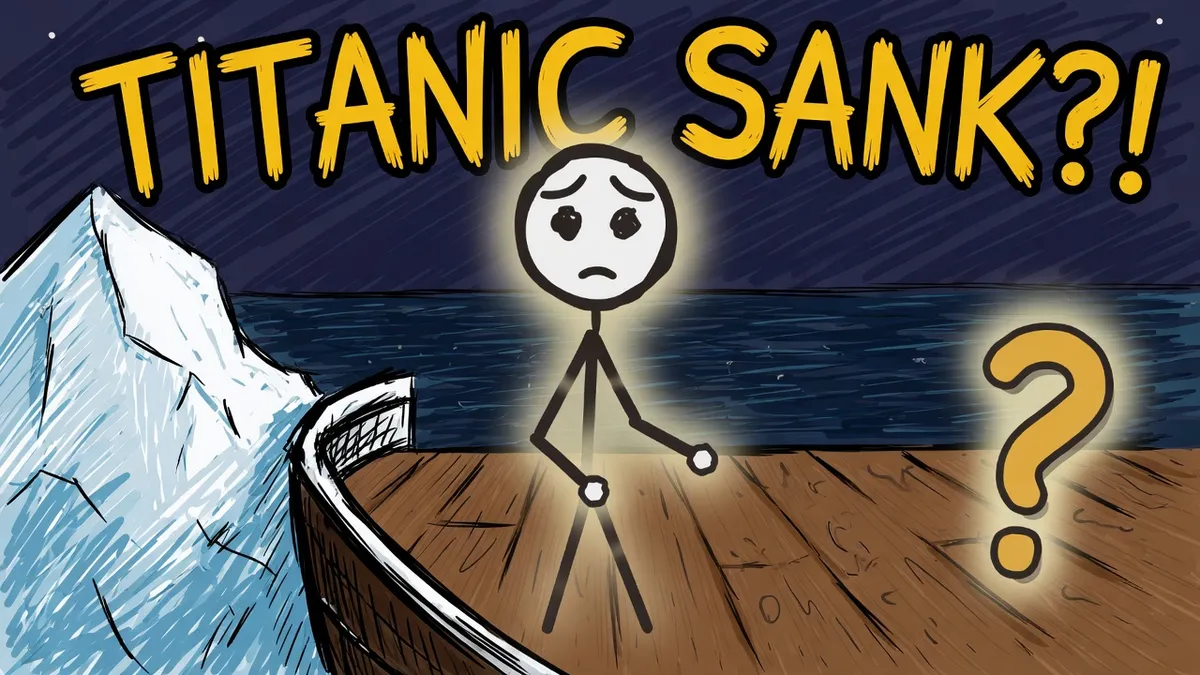
Everyone knows the Titanic hit an iceberg. That single fact has become the whole story, a ship, a berg, bad luck, the end. But it explains almost nothing. The iceberg tore open barely thirteen square feet of a hull the length of three football pitches. On its own, that damage should not have been enough to sink her, and certainly not to kill more than fifteen hundred people. The real question is not what the Titanic hit. It is why hitting it was fatal. And the answer is a chain of choices, compromises and outdated rules, any one of which, changed, might have brought almost everyone home.
01 · The warningsSteaming full speed into a known ice field
Throughout 14 April 1912, the Titanic’s wireless room received roughly seven separate warnings of ice ahead. The officers knew they were heading into a field of bergs on a moonless, glassy-calm night, the worst possible conditions for spotting ice. And yet the ship kept moving at about 22 knots, close to her top speed. The British inquiry would later put the blame squarely here: the disaster was caused by collision with an iceberg “brought about by the excessive speed at which the ship was being navigated.” The berg was the trigger. The speed was the decision.
02 · The collisionA sideswipe, not a smash
When the lookouts finally saw the iceberg, it was too late to turn cleanly away. The ship swung hard, and instead of a head-on crash she scraped it, a glancing blow down the starboard side. For eighty years, people pictured this as a great knife-slash, a 300-foot gash ripped in the hull. Then sonar and ultrasound surveys of the wreck found no gash at all. The truth was stranger and smaller: the impact buckled the steel plates and sprang the seams, popping rivets and opening a series of narrow slits totalling only twelve or thirteen square feet. Tiny. But in exactly the wrong places.
03 · The flawWatertight compartments with no lid
The Titanic’s great safety boast was her sixteen “watertight” compartments, sealed off by bulkheads so that flooding in one could be contained. She could float with any four of them flooded. The iceberg opened six. And here lies the fatal design flaw: those bulkheads did not reach all the way up. They rose above the normal waterline, but were open at the top, like the dividers in an ice-cube tray. As the bow settled under the weight of incoming water, the sea simply rose to the top of each compartment and spilled over into the next, and the next, and the next. The safety feature had no ceiling, and so it had no limit.
04 · The boatsHalf a ship's worth of people, and legally so
Even flooding, the Titanic took about two hours and forty minutes to go down, long enough, in principle, to evacuate everyone. Except there was nowhere near enough room. She carried just 20 lifeboats, with space for about 1,178 people, roughly half the number aboard. The most shocking part is that this broke no rules. British lifeboat regulations had not been updated since the 1890s and were scaled to much smaller ships, so a vessel the size of the Titanic could legally sail across the Atlantic with lifeboats for half her passengers. Worse still, in the panic many boats were lowered half-empty. The ship was following the law all the way to the bottom.
Some metallurgists argue the "unsinkable" ship was undone by its smallest parts. Studies of recovered rivets found some contained around 18% slag, roughly three times the normal amount, which would make the wrought iron brittle and quick to pop under impact, while the hull steel itself may have turned glassy in the near-freezing water. It remains debated among historians. But if it holds, it means the great ship was not felled by the mountain of ice so much as by a few thousand faulty rivets the size of your thumb.
05 · The coldWhy the water, not the sea, did the killing
The final, grim link in the chain was the water itself. The North Atlantic that night sat at about minus two degrees Celsius, kept liquid below freezing by its salt. Of the more than 1,500 who died, only a few dozen were pulled alive from the sea; the rest, floating in lifejackets, did not drown but froze, hypothermia taking them within minutes. The nearby SS Californian had stopped for the ice, saw rockets fired into the dark, and did not come. Both official inquiries concluded that had she answered, many, perhaps most, of those in the water might have lived.
06 · The payoffSo why did the Titanic sink?
Because almost nothing about that night was simply bad luck. She was warned and sped anyway. She was scraped, not gutted, but her watertight compartments had no lids. She stayed afloat long enough to save everyone, but carried lifeboats for half. She spilled her passengers into freezing water, within sight of a ship that never came. Change any single one of those links, the speed, the bulkheads, the boats, the Californian, and the Titanic is a near-miss we would have forgotten. That is the real lesson of the disaster, and the reason it still grips us: the ship did not have to sink. From it came the modern safety-of-life-at-sea treaty, enough lifeboats for all, round-the-clock radio watches and the ice patrol that still guards the Atlantic today. It took fifteen hundred lives to update the rules.
Quick questions
Why did the Titanic really sink?
It struck an iceberg late on 14 April 1912 while steaming at about 22 knots through a known ice field. The glancing blow opened six of its sixteen compartments, and because the watertight bulkheads were not sealed at the top, water spilled from one to the next until the bow dragged the ship under. It sank in about two hours forty minutes.
How many people died on the Titanic?
More than 1,500 of roughly 2,224 people aboard died. Estimates for those aboard range from about 2,200 to 2,224, and deaths are usually cited between 1,500 and 1,517. It remains one of the deadliest peacetime maritime disasters in history.
Could the Titanic have been saved?
In several senses, yes. Slowing down in the ice field, sealing the bulkheads at the top, or simply carrying enough lifeboats would each have changed the outcome. The iceberg opened only about 12 to 13 square feet of hull, so this was a survivable accident made catastrophic by design compromises and outdated rules.
Why were there not enough lifeboats?
Titanic carried 20 lifeboats with capacity for about 1,178, roughly half of those aboard. Astonishingly, this met the law, because the Board of Trade lifeboat rules had not been updated since the 1890s and were based on far smaller ships. The Titanic was fully legal but woefully under-equipped.
Was the steel really faulty?
This is debated. Metallurgical studies of recovered pieces suggest the hull steel became brittle in near-freezing water and that the wrought-iron rivets contained unusually high slag, making them prone to popping on impact. Many historians accept the rivets may have contributed, but others caution any steel of the era would have struggled, so treat 'faulty steel' as a contributing theory, not a settled fact.
How long did it take the Titanic to sink?
About two hours and forty minutes. It hit the iceberg around 11:40pm on 14 April 1912 and foundered at roughly 2:20am on 15 April. That window was just long enough to load the lifeboats, but there were nowhere near enough of them.
How cold was the water when the Titanic sank?
About 28 degrees Fahrenheit, roughly minus two Celsius, colder than the freezing point of fresh water because salt water stays liquid below that. In water that cold, hypothermia sets in within minutes, which is why most victims died of the cold rather than by drowning.
Did the Titanic really have a 300-foot gash in its hull?
No. That long-standing image is now considered folklore. Sonar and ultrasound surveys of the wreck found no gash. The real damage was about six narrow openings totalling only 12 to 13 square feet, caused by buckling plates and failed rivets along the seams.
What was the ship that ignored the Titanic?
The SS Californian was stopped in the ice not far away, and its crew saw rockets in the night but did not respond. Both the British and American inquiries concluded that many or all of the lost lives might have been saved had it come to the Titanic's aid, though the exact distance is still argued.
Was the Titanic going too fast?
Yes, that was a central finding of the British inquiry. It was travelling at about 22 knots, near top speed, through waters it had been repeatedly warned held ice. Slowing down or posting extra lookouts might have given the crew time to avoid the berg.
Why did the 'unsinkable' ship sink so easily?
The 'practically unsinkable' reputation rested on watertight compartments, but those bulkheads were open at the top. The ship could survive four flooded compartments; the iceberg opened six, so water cascaded over each bulkhead in turn. The safety feature had a fatal design limit.
What safety changes came out of the Titanic disaster?
It led directly to the first International Convention for the Safety of Life at Sea (SOLAS) in 1914, still the backbone of maritime safety law. Key reforms included lifeboat capacity for everyone aboard, a 24-hour wireless radio watch, and the creation of the International Ice Patrol to track North Atlantic icebergs.
Our sources 8 checked
// every claim on this page was checked before it went up