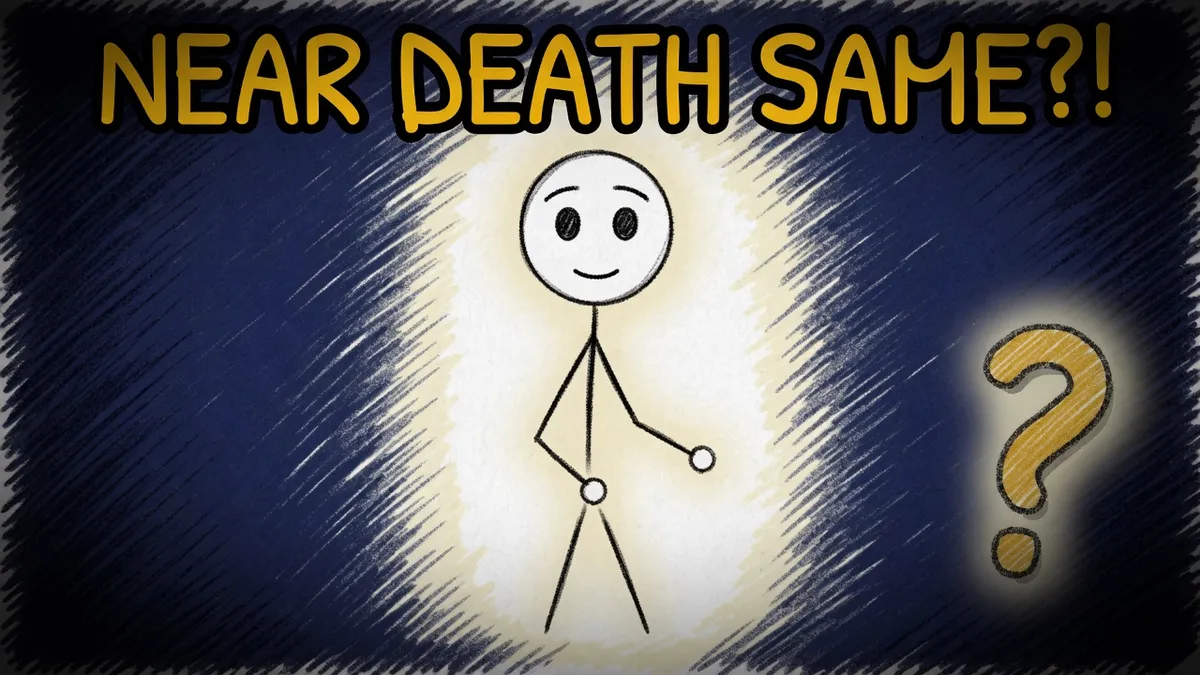
Here is something that should not happen, but does. A person on an operating table in Ohio and a person pulled from a river in Japan, who will never meet and share no language, come back from the edge of death and describe the same thing. A dark tunnel. A brilliant light at the far end. A deep, floating calm with no fear in it. Maybe a review of their whole life, and figures waiting in the glow. Different people, different continents, the same strange script. That consistency is the real mystery, and it is also the biggest clue to what is actually going on.
01 · The scriptThe experience that repeats
Researchers who collect near-death experiences, or NDEs, keep finding the same handful of elements in the same rough order: a sense of peace, a feeling of leaving and floating above the body, a passage through a tunnel toward a light, sometimes an encounter with figures or lost loved ones, and a rapid replay of one’s life. Not everyone gets all of it, and culture colours the details. But the skeleton is spookily stable. And when a profound experience turns out to be that consistent across humanity, it usually means it is tapping into something we all share. The question is whether that something is out there, or in here.
02 · The tunnel and the lightWhat oxygen loss does to vision
Start with the two most famous features, because they have the cleanest explanation. As the heart fails, blood and oxygen to the eye and brain drop fast, and the visual system starts to misbehave in a very particular way. The edges of vision fail first, narrowing sight to a shrinking circle: tunnel vision. Meanwhile the oxygen-starved visual cortex begins firing randomly, and because the centre of your visual field is packed with the most cells, that noise reads as a bright, expanding blaze of light dead ahead. A dark tunnel with light at the end is, in this view, exactly what a dying visual system looks like from the inside.
03 · The peace and the floatingA brain flooding itself
Then there is the strangest part for something happening in a crisis: the calm. People describe not terror but serenity, even bliss, and a sense of watching from outside themselves. The leading explanation is the brain’s own chemistry. Extreme stress triggers a surge of endorphins and other neurochemicals that dull fear and pain, and as the systems that hold together your normal sense of self and body position break down, the mind can generate that classic feeling of drifting up and away. It is the same machinery that, gently disturbed in a lab, can make a wide-awake person feel they have left their body.
04 · The surgeThe dying brain does not go quietly
For a long time the assumption was that a dying brain simply fades to black, too starved to produce anything as rich as an NDE. That assumption broke. Studying dying animals, researchers found that in the seconds after the heart stops, the brain can fire off a surge of highly organised, high-frequency activity, the kind normally linked to intense, focused awareness. In 2023 the same pattern showed up in dying human patients. Far from switching off, the brain may briefly light up. A last, intense burst of organised activity is exactly the sort of thing that could stamp in a vivid, unforgettable experience. (We go deeper into that surge in why dying brains blaze with activity.)
The near-death experience may not be the mind leaving the brain. It may be the brain's most intense performance, staged in the one moment it is supposedly shutting down.
05 · The honest debateNot everyone is convinced
Here is where a careful article has to slow down. The dying-brain view explains a great deal, and it is where most scientists land. But it is not airtight, and a serious minority pushes back. In large resuscitation studies, a few patients have reported lucid, structured experiences, and in rare cases have described real events around them during a period when the brain should have been incapable of forming memories. Researchers like Sam Parnia argue that these cases are too clear to wave away as mere noise from a broken brain. They are not claiming to have found heaven. They are saying the science of what the mind does at the very edge is genuinely unfinished. The honest position is that the tunnel and light are well explained, and the deepest, most lucid cases are still argued over.
06 · The payoffSo why are they all the same?
Because, most likely, they are built from the same parts. A tunnel of light is what oxygen-starved vision produces. Calm and floating are what a flooded, destabilising brain produces. A vivid, seared-in memory is what a final surge of organised activity could produce. Run the same shutdown in billions of similar brains and you get the same recurring script, which is why a stranger’s near-death story can sound like your own would. That does not make it small. Whether it is only the brain’s last act or a genuine glimpse of something beyond is a question the evidence does not yet close. What it does tell you is that the human brain, in the one moment we assume it surrenders, may instead put on the most extraordinary show of its life.
The animated version
Same answer, told as a little animated story with the strange little stickman acting it out. Dry, quick, and, obviously, correct.
Quick questions
What is a near-death experience?
It is a vivid, often profound experience reported by some people who come close to death or are resuscitated. Common features include a sense of peace, leaving the body, moving through a tunnel toward a light, meeting figures or lost loved ones, and reviewing one's life.
Why do so many people report the same things?
Because the experiences seem to arise from shared brain biology under the same extreme conditions. If oxygen starvation and a stressed, dying brain produce the tunnel, the light and the calm, then people the world over hit the same script for the same physical reasons.
Why the tunnel and the bright light specifically?
The leading explanation is oxygen loss. As blood flow to the eye and brain drops, vision narrows to a tunnel, and the visual parts of the brain start firing in a disordered way that the mind reads as an expanding blaze of light at the centre.
Where does the feeling of deep peace come from?
Probably the brain's own chemistry. Extreme stress triggers a release of endorphins and other neurochemicals that blunt fear and pain, which can leave a dying or resuscitated person feeling calm, detached and even blissful rather than terrified.
Is there real brain activity during death to explain this?
Yes, and it is striking. Studies of dying animal brains found a surge of highly organised, high-frequency activity just after the heart stops, and a 2023 study reported the same gamma surge in dying human patients. It is a plausible physical basis for a vivid final experience.
What is the AWARE study?
A large international study led by Sam Parnia that examined thousands of cardiac arrest cases. It found that a minority of survivors reported NDE-type experiences, a small fraction described awareness or out-of-body perception, and one case was partly verified against real events during resuscitation.
Does an NDE prove there is an afterlife?
It does not prove it, and it does not disprove it. The experiences are real and powerful, but a real, powerful experience can still be produced by the brain. Most scientists favour a brain-based explanation, while some argue the lucidity of certain cases is hard to explain and keep an open mind.
Is DMT involved in near-death experiences?
It is a popular hypothesis. The psychedelic DMT produces experiences that overlap strikingly with NDEs, and some suggest the brain may release its own DMT near death. That the DMT state resembles an NDE is well documented, but that the dying human brain actually floods itself with DMT is not proven.
Do children and people from different cultures have the same NDEs?
The core elements (peace, light, leaving the body) show up broadly across ages and cultures, which supports a shared biological cause. The specific figures people meet or how they interpret the experience are shaped by their culture and beliefs.
Are NDEs the same as out-of-body experiences?
They overlap but are not identical. An out-of-body experience, feeling you are floating outside and above your body, is one common element of many NDEs, and it can also happen on its own, and has been linked to disruption of the brain region that maps your body in space.
Can a near-death experience change someone permanently?
Very often, yes. Many people who have one report lasting effects: less fear of death, shifts in values and priorities, and a sense of meaning. Whatever the cause, the aftereffects on the person are real and can reshape a life.
Why do only some people who nearly die have one?
That is still unclear. Only a minority of people resuscitated from cardiac arrest recall an NDE, and researchers do not yet know why some brains generate and remember the experience while others recall nothing at all.
Take the quiz on this
A quick 4-question check on what you just read. Get them right to earn XP: no points for just scrolling.
Our sources 7 checked
// every claim on this page was checked before it went up