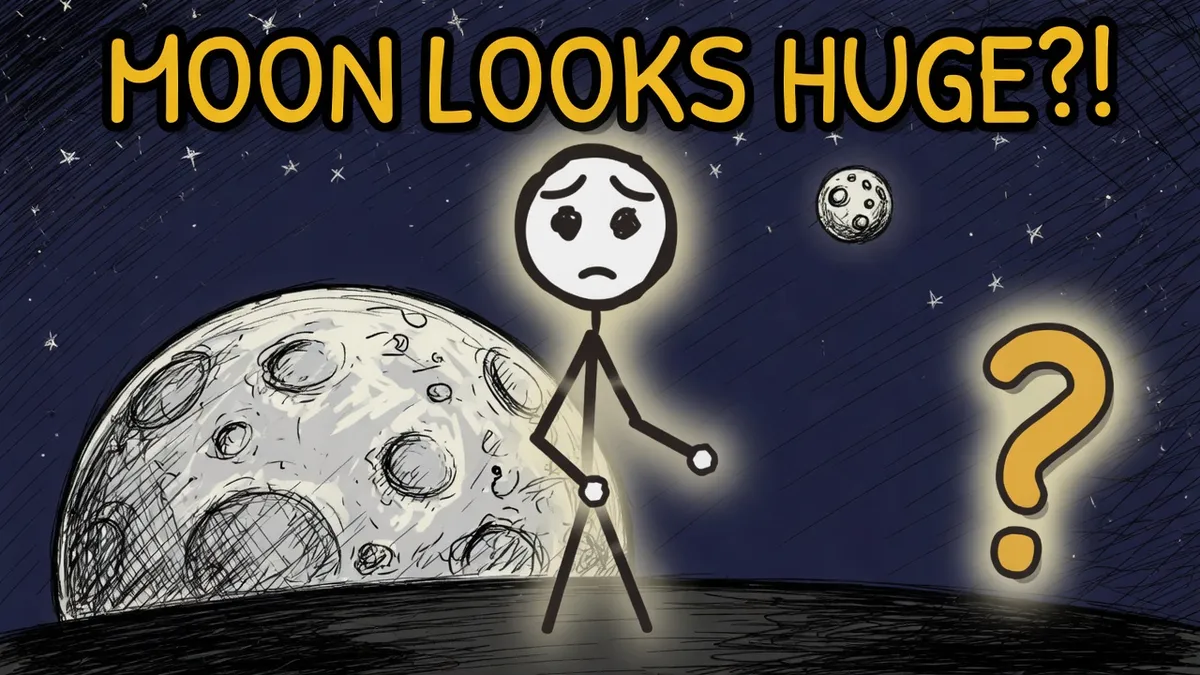
You've seen it: a full moon heaving itself up over the rooftops, swollen and orange and impossibly huge, the kind of moon that makes you stop the car. Hours later it's sailing high overhead, a neat little coin. Same night, same moon, and it seems to have shrunk. Here's the strange part: it hasn't. Measure it and the two moons are identical. The giant rising moon is a lie your brain tells you, one of the oldest lies we know of, and after two thousand years of trying, we still can't fully explain how it does it.
01 · The impossible factThey're exactly the same
Start with the thing that should be impossible. The vast rising moon and the tiny overhead moon are the same size in the sky, to a fraction of a percent. The Moon doesn’t swell and deflate over a few hours; its distance from you barely changes across a night. You can catch the illusion red-handed in seconds: hold your thumbnail at arm’s length against the monster on the horizon, then again against the coin overhead. It covers exactly the same sliver of sky both times. Whatever is making the rising moon look enormous, it isn’t the Moon.
02 · Not the airKilling the obvious answer
The first guess most people reach for is the atmosphere: surely the thick air near the horizon acts like a lens and magnifies the Moon? It’s a good instinct, and it’s wrong. The atmosphere does mess with a low moon, it bends and scatters its light, which is why it often glows orange or red down there. But it does nothing to enlarge the disc. If anything, refraction slightly squashes the Moon vertically, making it a touch flatter, the opposite of bigger. So the colour of the harvest moon is real physics, but the size is not. Cross the atmosphere off the list. The effect is happening inside your skull.
03 · The distance trickFarther means bigger
So if it’s in the brain, what’s the brain doing? The oldest surviving idea comes from the scholar Ibn al-Haytham, around a thousand years ago, and it turns on a subtle assumption your mind makes about the sky. Your brain doesn’t picture the heavens as a true half-sphere; it treats them as a flattened dome, so the horizon feels farther away than the point straight overhead. Now here’s the logic: the Moon casts the same-sized image on your eye in both spots, but if the brain believes the horizon version is much farther away, it reasons that it must actually be bigger to look that size from so far off. So it inflates it. Same image, but tagged “distant”, and the brain scales it up.
You can break the spell with your own body. Bend over and look at the giant rising moon upside down between your legs, and it snaps back to its true, modest size. Turning your head scrambles the distance cues your brain was leaning on, and the illusion simply collapses.
04 · The company it keepsTrees, roofs and comparison
There’s a second big ingredient, and it’s about what surrounds the Moon. Low on the horizon, the Moon hangs among things you know: trees, hills, houses, a distant ridge, all objects your brain files as large and far away. Set against that company, the Moon reads as big and remote too. Lift it high into an empty black sky with nothing to measure it against, and it shrinks to a lonely disc. This is close cousin to classic size illusions, where an identical circle looks bigger or smaller depending on what you put around it. The rising moon borrows grandeur from the landscape it rises through.
05 · The unsolved bitWhy we still argue
Here’s what makes this one special. Most illusions, once explained, stay explained. The Moon Illusion refuses. The flattened-dome idea, the apparent-distance idea, and the surrounding-objects idea each capture part of it, and probably all contribute, but researchers still can’t agree on how they combine or which matters most. An effect that literally everyone can walk outside and see, that Aristotle and Ptolemy wrote about, that has been chewed over for two millennia, and we still don’t have one clean, settled answer. It’s a humbling reminder that some of the deepest mysteries aren’t out at the edge of the universe. Some of them are the moon over your street.
06 · The payoffSo why does the moon look bigger on the horizon?
Because your brain, not the sky, is doing the swelling. The Moon is the same size low or high, but down near the horizon your mind judges it to be far away, beyond the distant trees and rooftops, and enlarges what it thinks is distant and vast. Lift it into the empty overhead and the cues vanish, so it shrinks back to a coin. The air only paints it orange; the size is all you. And the final twist is the best one: this humble, everyday illusion, staring us in the face for thousands of years, still hasn’t fully given up its secret.
Quick questions
Why does the moon look bigger on the horizon?
Because your brain is fooling you, not because the Moon has changed. The rising Moon looks huge, but it is exactly the same size in the sky as it is overhead. The best explanations are about how your brain judges size and distance: near the horizon the Moon sits among familiar things like trees and buildings that make it seem far away, and the brain enlarges what it thinks is distant. It's a genuine illusion, and a famously stubborn one.
Is the moon actually bigger when it rises?
No, not at all. The Moon's size in the sky is essentially unchanged from horizon to overhead. In fact, when the Moon is overhead you're slightly closer to it (by the radius of the Earth), so if anything it's a touch bigger high up, the opposite of how it looks. The dramatic 'huge rising moon' is purely a trick of perception, with no change in the real object.
How can I prove the moon is the same size?
Several easy ways. Hold your outstretched thumbnail up to the rising Moon, then check it again when the Moon is high: it covers the same amount both times. Or photograph the Moon low and high with the same zoom and compare, the disc is identical. A classic trick is to bend over and look at the rising Moon upside down between your legs, which disrupts the illusion and shrinks it back to normal. The illusion lives in your brain, not the camera.
What is the Moon Illusion?
It's the name for this exact effect: the Moon (and the Sun) appearing larger near the horizon than when higher in the sky, despite no real change in size. It's one of the oldest recorded illusions, discussed for over two thousand years, and it's entirely perceptual. The puzzle isn't whether it's an illusion, that's settled, but precisely why our brains produce it, which is still argued over.
Does the horizon being 'farther away' explain it?
That's one of the leading ideas. Roughly a thousand years ago the scholar Ibn al-Haytham suggested the brain perceives the sky not as a true dome but as a flattened one, so the horizon seems farther away than the point directly overhead. Since the Moon makes the same-sized image on your eye in both positions, but the brain thinks the horizon version is farther, it concludes that one must be physically bigger, and inflates it. It's elegant, though not the whole story.
What about the objects on the horizon, do they matter?
Very likely, yes. When the Moon is low, you see it next to trees, hills, buildings and other things you know are far away and large. Your brain compares the Moon to these distant reference points and judges it to be big and remote. High overhead the Moon floats alone in empty sky with nothing to compare it to, so it reads as small. This 'relative size' effect (related to classic illusions like the Ebbinghaus illusion) is thought to be a major ingredient.
Why is there more than one explanation?
Because the illusion is surprisingly hard to pin down, and different explanations each capture part of it without fully settling it. The apparent-distance idea, the flattened-sky-dome idea, and the surrounding-objects idea all have support and may all contribute, and researchers still disagree on the balance between them. It's a rare case where an effect everyone can see, and has seen for millennia, resists a single tidy scientific answer.
Does the atmosphere magnify the rising moon?
No, and this is a common misconception. The atmosphere does bend and redden the light of a low Moon, which is why it can look orange, but it does not perceptibly change its size, and if anything it very slightly squashes the disc vertically. So the enlargement is not a lens effect of the air. The colour change near the horizon is real physics; the size change is pure illusion.
Do other things look bigger on the horizon too?
Yes. The same illusion applies to the Sun, which looks large and looming as it sets for exactly the same perceptual reasons (never look directly at the Sun to check). Constellations and star patterns can also appear somewhat larger near the horizon. This tells us the effect is about how we perceive things low in the sky in general, not something special about the Moon itself.
Why does the moon look orange or red when it's low?
This part is real physics, not an illusion. When the Moon is near the horizon, its light travels through much more of the atmosphere before reaching you, and that thick layer of air scatters away the shorter blue wavelengths while letting the longer red and orange ones through. The result is the warm, coppery glow of a low Moon, the same reason sunrises and sunsets are red. Note that the colour is genuine, while the apparent size is the illusion.
Is a supermoon the same thing as the moon illusion?
No, they are two different things. A supermoon is a real, if small, effect: it happens when a full Moon coincides with the Moon being near its closest point to Earth, making it genuinely a little larger and brighter, by only a few percent, hard to notice by eye. The moon illusion, by contrast, is purely perceptual and involves no real change in size. A low supermoon can look striking because both effects happen to stack, but only one of them is actually physical.
Who first noticed the moon illusion?
It is one of the oldest recorded observations in science. Ancient thinkers including Aristotle and the astronomer Ptolemy discussed it well over two thousand years ago, and the scholar Ibn al-Haytham offered an influential explanation around a thousand years ago. That such a familiar effect was debated by the earliest astronomers, and still isn't fully settled today, is part of what makes it so remarkable.
Does the moon illusion look the same to everyone?
The illusion is experienced very widely, across cultures and throughout history, which is a clue that it comes from general features of how human vision and the brain judge size and distance. That said, how strong it appears can vary from person to person and with the surroundings, since foreground objects and the openness of the view feed into it. The basic effect, though, is close to universal: almost everyone sees the low Moon as larger.
Our sources 7 checked
// every claim on this page was checked before it went up