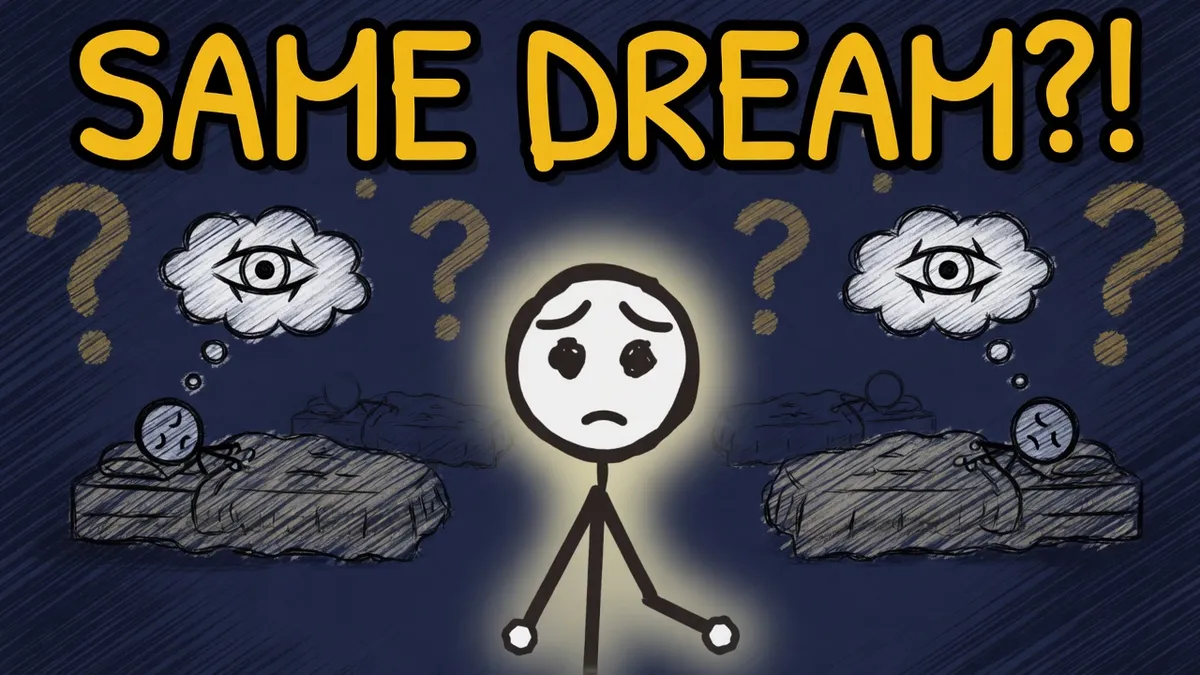
Ask a room full of strangers what they dream about and something uncanny happens. Someone mentions the falling. Someone else, the thing chasing them through a house that keeps rearranging itself. A third person, the exam they walked into having never opened the book. Then teeth, crumbling like wet chalk. Then the classic: fully clothed in the dream until, somehow, not. Different lives, different childhoods, different countries. And yet the same short playlist keeps coming back. Nobody handed these people a script. So where did they all get the same one?
01 · The catalogueThere really is a shared menu
This isn’t just a vibe, it’s measured. In 2003, Tore Nielsen and colleagues ran a big questionnaire on Canadian university students using something called the Typical Dreams Questionnaire, a list of 55 recurring dream themes. The results were startlingly lopsided. Being chased or pursued came top, reported by around 81% of people at least once. Sexual dreams next, about 77%. Falling, about 74%. School, teachers and studying, about 72%. Further down: arriving too late, seeing a living person as dead, flying, failing an exam, and yes, teeth falling out at roughly 39%. Out of a near-infinite space of things a mind could invent overnight, the population keeps landing on the same couple of dozen scenarios.
02 · The stabilityIt barely changes across the world
Here’s the part that rules out “it’s just our culture.” When researchers ran similar surveys in Germany, China and elsewhere, the rank order stayed remarkably stable. Being chased, falling and arriving too late travel across borders. A living person appearing dead lands in the top ten almost everywhere it’s checked. The exact percentages shift, school dreams are especially common in some East Asian samples, sexual dreams a bit more prevalent in Western ones, but the core menu is close to universal. When something is that consistent across cultures that share almost no folklore, the cause probably isn’t folklore. It’s something we all carry underneath the culture.
03 · The real reasonSame hardware, same predicament
So why the overlap? Not because your minds are secretly linked. Because they’re secretly similar. Every human runs on close to the same neural wiring, inside close to the same body, facing close to the same set of problems: things that hunt you, heights that can kill you, a group whose approval you need to survive in. Feed a lot of similar machines a lot of similar situations, and they generate similar output. The dream about falling isn’t a message. It’s what a brain built by evolution does with the simple, ancient fact that a body plus gravity plus a cliff is a lethal combination worth taking seriously. Shared dreams are evidence about what we have in common as animals, not about any shared soul.
04 · The threat theoryDreaming as a fire drill
The most striking version of this idea comes from the Finnish neuroscientist Antti Revonsuo, who proposed around 2000 that dreaming might have evolved to do exactly this: rehearse danger. On his threat-simulation theory, the dreaming brain runs the fight-or-flight scenarios you’d never want to practise for real, over and over, like a fire drill for the nervous system. It fits some suggestive facts: fear is the single most common emotion in dreams, and chase and falling dreams dominate the charts. It’s a genuinely elegant hypothesis. But be careful here: nobody has direct evidence that dream-rehearsal ever improved anyone’s survival, and several of the theory’s specific predictions have come out mixed at best. So take it as a well-argued idea about why the menu looks so threat-heavy, not as a proven fact.
Some of these "symbolic" dreams may not be about your psyche at all. The teeth one might be your jaw. The falling one might be your body. The dream is reading your hardware, not your secrets.
05 · The teeth twistYour jaw, not your anxiety
Take the most over-interpreted dream of all: the teeth crumbling and falling out. For a century the standard reading was symbolic, anxiety, loss of control, a fear of getting old. Then in 2018, Naama Rozen and Nirit Soffer-Dudek actually tested it. In their sample, teeth dreams weren’t linked to psychological distress at all. What they were linked to was teeth and jaw tension on waking, the tell-tale sign of clenching or grinding in the night. In other words, a real physical sensation in your mouth may simply get woven into the dream, and your sleeping brain narrates it as your teeth falling out. It’s one study on a student sample, so hold it lightly, but it’s a beautiful example of the pattern: a bodily input, not a hidden meaning.
06 · The body inputsFalling, jerking, and being pinned
The teeth aren’t the only case where the “symbol” turns out to be a signal. That sudden falling sensation as you drift off, the one that yanks you awake with a jolt, is a hypnic jerk, a real muscle twitch that your half-asleep brain sometimes builds a tiny falling story around (we’ve got a whole piece on why you jerk awake as you fall asleep). The nightmare where something is on your chest and you cannot move? Often that’s sleep paralysis, your body’s normal REM shutdown caught overlapping with waking awareness, and the terror gets a monster attached to it (see why you get sleep paralysis). Over and over, the “universal symbol” is really a universal bodily event. Same body, same glitch, same story, in millions of different heads.
07 · The debunkNo secret code, no shared mind
Which brings us to the two ideas people reach for, and why both miss. Freud’s dream dictionaries, the notion that a specific image always carries a specific hidden meaning, have essentially no empirical support; decades of research have failed to find the fixed symbol code they promised. And the romantic idea of a “collective unconscious” you’re all plugged into? You don’t need it. The convergence is fully explained by the boring, beautiful truth that we’re the same kind of creature. Remember, too, that dreams feel surreal for a simple reason: the brain’s logic centre, the prefrontal cortex, goes largely offline in REM, so an ordinary fear gets staged with no editor to keep it sensible. Mundane theme, hallucinatory production values.
08 · The payoffSo why do strangers share the same dreams?
Because they were never really sharing a dream. Two strangers are never plugged into one dreamscape, swapping the same footage overnight. What they share is everything upstream of the dream: a body that can fall and clench and freeze, a nervous system tuned by evolution to take threats seriously, and a social life where being exposed, judged, or caught unprepared is a real and universal fear. Give a million versions of the same animal the same handful of problems, and they’ll dream a million private versions of the same few nights. The dreams aren’t shared. The predicament is. And the predicament, it turns out, is just what it means to be human, asleep, in a body, afraid of the same old things.
The animated version
Same answer, told as a little animated story with the strange little stickman acting it out. Dry, quick, and, obviously, correct.
Quick questions
What are the most common dreams people have?
In Nielsen's large Typical Dreams Questionnaire study, the top themes were being chased or pursued (about 81%), sexual experiences (about 77%), falling (about 74%), and school, teachers or studying (about 72%). Further down came arriving too late, a living person being dead, flying, failing an exam, and teeth falling out. Roughly the same short list shows up almost everywhere it's measured.
Do people in different countries really dream the same things?
Broadly, yes. When researchers compared students in Canada, Germany, China and elsewhere, the rank order of common dream themes was remarkably similar: being chased, falling and arriving too late travel across cultures, and a living person appearing dead lands in the top ten almost everywhere. The exact percentages shift with culture (school dreams are especially common in some East Asian samples), but the core menu barely changes.
Does sharing a dream mean there's a collective unconscious?
No. The convergence is much better explained by shared biology and shared circumstances than by any mystical shared mind. Every human brain runs on similar wiring, in a similar body, facing similar dangers and social pressures. Feed a lot of similar minds a similar predicament and you get similar output. It's evidence about what we have in common as animals, not about a psychic network.
Why do so many people dream about being chased?
Being chased is the single most common dream theme, and it maps neatly onto an ancient survival problem: something is coming for you, and you must escape. One leading idea (threat-simulation theory) is that the dreaming brain rehearses exactly this kind of danger. It's a well-argued hypothesis rather than a settled fact, but the sheer prevalence of chase dreams is hard to ignore.
Why do people dream their teeth are falling out?
The old answer is symbolic: anxiety, loss of control, fear of ageing. But a 2018 study found teeth dreams were linked to teeth and jaw tension on waking, not to psychological distress, hinting that the sensation of clenching or grinding your teeth in the night gets woven into the dream. It's one study, so treat it as a strong clue rather than the last word, but it's a neat example of a bodily signal writing the script.
Why do we dream about showing up naked or unprepared?
These are social-exposure dreams: being naked in public, walking into an exam you never studied for, forgetting your lines. They cluster around embarrassment and being judged, which is one of the most universal human anxieties. You don't need a hidden meaning, just a brain that takes the fear of being caught out and stages it, vividly, while the logical parts of you are offline.
Is the falling sensation in dreams the same as the jerk that wakes you up?
Not quite, and it's worth separating them. The sudden jolt as you drift off, often with a sense of falling, is a hypnic jerk, a real muscle twitch your brain sometimes wraps a mini-dream around. Longer falling dreams during deeper sleep are more of a recurring theme. In both cases, a bodily event may be feeding the imagery, which is a very different thing from a symbol. See our pieces on jerking awake and on sleep paralysis.
Does everyone have these typical dreams?
Most people report at least some of them at some point, but not everyone, and not equally. The questionnaire figures are lifetime prevalences (have you ever had this dream), so a high number means the theme is widespread, not that you have it nightly. Plenty of people never dream about, say, flying, and that's perfectly normal.
What is the threat-simulation theory of dreaming?
Proposed by Finnish neuroscientist Antti Revonsuo around 2000, it argues that dreaming evolved as a kind of safe rehearsal for danger: the brain repeatedly simulates threats so it can practise spotting and escaping them. It fits the fact that fear is the most common dream emotion and that chase and falling dreams are so prevalent. But direct evidence that dream-rehearsal improved real survival is missing, and some predictions haven't held up, so it stays a hypothesis, not a proven function.
Did Freud prove dreams have universal symbols?
No. Freud's idea that specific images carry fixed hidden meanings (and later dream dictionaries built on it) has essentially no empirical support. Dreams do draw on shared human concerns, but that reflects shared biology and shared life, not a fixed symbol code. A falling dream is far more likely a common brain-and-body event than a coded message about your relationships.
Why are dreams so bizarre if they come from ordinary fears?
Because the brain region that keeps things logical, the prefrontal cortex, goes largely quiet in REM sleep. So an ordinary anxiety, like being unprepared, gets staged without an editor: your exam is in a language you've never spoken, in a building that's also your childhood home. The theme is mundane and shared; the surreal production values come from the offline logic circuits.
Do animals or hunter-gatherer societies have the same dreams?
We can't ask animals, but studies of small-scale and hunter-gatherer societies find similar threat-heavy dream content, which is part of the case for an evolved, shared basis. It supports the idea that these scripts come from a common human (and animal) predicament rather than from modern culture. As with much dream research, the samples are limited, so it's suggestive rather than conclusive.
Are recurring dreams the same as typical dreams?
They overlap but aren't identical. Typical dreams are themes lots of different people report (chase, falling, teeth). A recurring dream is the same scenario returning to one person over time, and these are often typical themes too, frequently threat-related. Recurring versions tend to cluster around ongoing stress, which fits the idea that the brain keeps re-running unresolved fears.
So are two strangers ever having literally the same dream?
No, and that's the twist. Two people are never sharing one dream the way they'd share a photo. What they share is the raw material: the same body, the same fears, the same handful of situations the human brain finds worth simulating. The overlap is real and measurable, but it lives in the ingredients, not in some connected dreamscape.
Take the quiz on this
A quick 4-question check on what you just read. Get them right to earn XP: no points for just scrolling.
Our sources 8 checked
// every claim on this page was checked before it went up