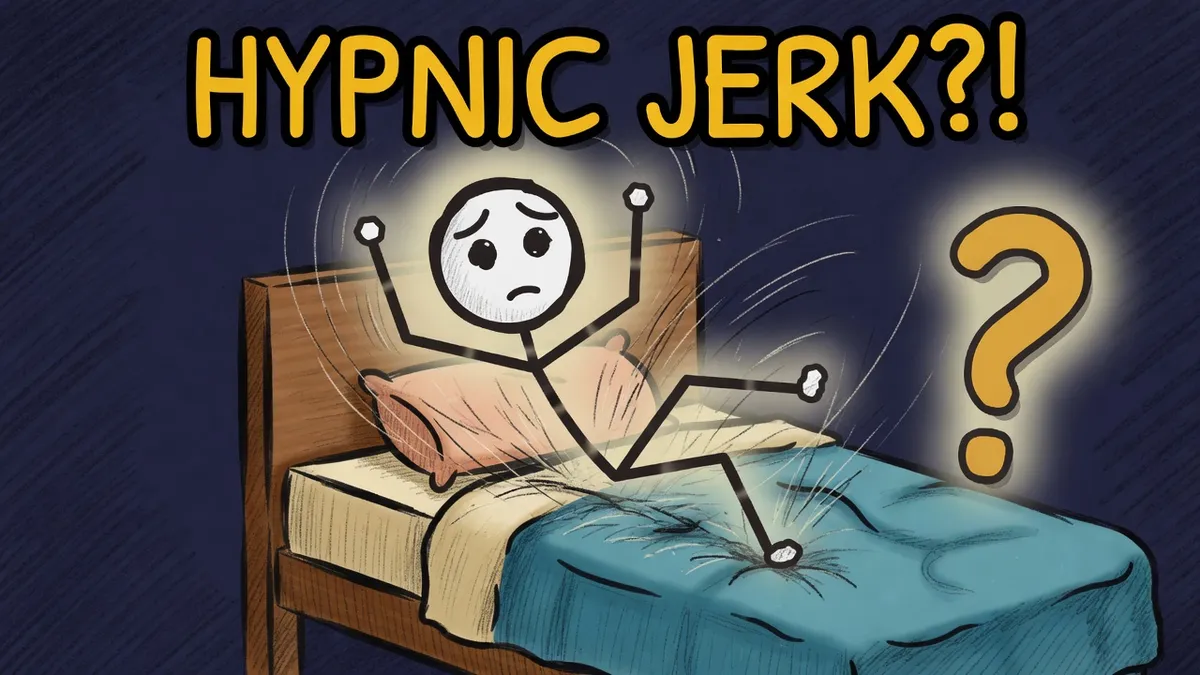
Here is a small violence your own body commits against you most nights, right when you least want it. You're warm, heavy, sinking down into that fuzzy place at the very edge of sleep, thoughts going strange, almost gone. And then, out of nowhere, your leg kicks or your arm flails and you're yanked bolt upright, heart going, with the vivid and horrible certainty that you were falling. It's such a specific little event that it has a proper medical name. And once you know what's actually happening, it turns out to be one of the best windows we have into how falling asleep really works.
01 · The joltIt has a name, and you're in good company
The twitch is called a hypnic jerk, also known as a sleep start or hypnagogic jerk. It’s a sudden, involuntary muscle contraction, often of the whole body at once, that fires right as you cross from being awake into the first stage of sleep. And if it happens to you, you are extremely normal. Estimates suggest it affects up to around 70% of people at some point. It happens across all ages and all over the world, and despite how alarming it feels, it’s recognised as a completely harmless physiological event, not a seizure, not a warning sign of anything sinister. Just a quirk of the way we switch off.
02 · The handoverFalling asleep isn't a switch
Here’s the thing that makes the jerk so revealing. We tend to picture falling asleep as flipping a switch, awake one second, out the next. But that’s not remotely how it works. Falling asleep is more like a shift change at a factory. One system, the one that keeps you awake and alert, is clocking off. Another, the one that runs sleep, is clocking on. And for a brief window at the threshold, both are partly at the wheel at the same time, the wake system powering down but not yet let go, the sleep system powering up but not yet in charge. The handover, for a few strange moments, is messy.
03 · The misfireWhere the twitch comes from
As you drift off, your muscles are meant to go limp: deep in your brainstem, the machinery keeping your body tense is being switched off. But the leading idea is that in this messy handover, a last stray burst of that old wake-up activity escapes: a brief neural volley thought to originate in the brainstem’s reticular formation, misfiring as your muscle tone drops. That misfire reaches your muscles and fires them all at once, in a single sudden, involuntary twitch. It’s worth being honest that this is the leading explanation rather than a closed case. The exact cause of hypnic jerks is still not fully settled.
04 · The storyWhy it feels like falling
But what about the falling? Why does a plain muscle twitch come wrapped in this powerful sense of plummeting off a cliff? Here’s the fascinating part. Your half-asleep brain suddenly gets a jolt of movement, completely out of the blue, and it does what brains always do. It scrambles to explain it. It reaches for a story that fits a sudden lurch of the body, and the story it lands on is: you’re falling. On the best current understanding, the falling sensation and those falling dreams may not be the cause of the jerk at all. They appear to be your brain inventing a reason for it, a fraction of a second too late. You felt the effect and got handed a fictional cause.
You've almost certainly heard that the jerk is a leftover reflex to catch yourself falling out of a tree. It's a lovely story, and there's basically no evidence for it. It got repeated online so many times it started to sound like a fact.
05 · The tree mythThe neat explanation nobody can back up
That “archaic reflex from our tree-dwelling ancestors” idea, a jolt to grab a branch before you plummet, is genuinely everywhere. But it’s speculation that hardened into folklore. No published work supports it, and the honest position is that we don’t yet know why we evolved to do this, or whether there’s an evolutionary reason at all. What we do know is far less romantic and much more useful: what makes it worse. Too much caffeine or nicotine, high stress, being overtired and sleep-deprived, and intense exercise late in the evening. Anything that leaves your wake system revved up and reluctant to clock off makes that messy handover even messier, so the more wired you are, the harder your brain slams the gears.
06 · The bigger pictureThere's no single moment you switch off
And the jerk points at something quietly mind-bending. There is no single instant where you go from awake to asleep. Brain-imaging work shows that different regions actually nod off at slightly different times, a phenomenon researchers call local sleep. Bits of you can be asleep while other bits are still awake; sensory areas can stay busy while higher-order regions have already gone quiet. Falling asleep isn’t a clean line you cross. It’s a gradual, patchy, slightly chaotic surrender, happening region by region, which is exactly the kind of ragged transition where a stray twitch can slip through.
07 · The payoffSo were you ever falling?
No. That violent little jerk dragging you back from the brink isn’t a glitch and isn’t a warning. It’s the sound of your brain grinding the gears as it changes from waking to sleeping, a stray pulse of wake-up activity escaping just as your body goes limp. And the terror of falling that comes with it is your mind, half-asleep, telling itself a quick bedtime story to explain a twitch it didn’t see coming. You weren’t falling out of a tree, or off a cliff, or out of anything. Your brain just really, briefly, wanted you to think you were, and then, a second later, let you go back to sleep.
The animated version
Same answer, told as a little animated story with the strange little stickman acting it out. Dry, quick, and, obviously, correct.
Quick questions
What is it called when you jerk awake as you fall asleep?
A hypnic jerk, also known as a sleep start or hypnagogic jerk. It's a sudden, involuntary muscle contraction, often of the whole body, that happens right at the transition from being awake into the first stage of sleep, and it frequently comes with a falling sensation.
Are hypnic jerks dangerous or a sign of something wrong?
No. They're recognised as a normal, harmless physiological event, not a seizure and not a warning sign. They can be startling enough to wake you with a racing heart, but in themselves they're benign. They happen to healthy people of all ages, all over the world.
Why do I feel like I'm falling when I jerk awake?
Because your half-asleep brain gets a sudden jolt of movement out of nowhere and scrambles to explain it. The story it reaches for, a lurch of the body, is that you're falling. The falling feeling and falling dreams appear to be the brain's after-the-fact explanation, not the trigger for the twitch.
What makes hypnic jerks worse?
Anything that leaves your wake system revved up and reluctant to switch off: too much caffeine (and nicotine), high stress, being overtired or sleep-deprived, and intense or late-evening exercise. The more wired you are at bedtime, the messier the handover into sleep.
Is the 'catching yourself falling out of a tree' theory true?
It's a popular story, but there's no published evidence for it. It's a speculative idea that got repeated so often it started to sound like fact. Honestly, we don't yet know whether there's an evolutionary reason for hypnic jerks at all.
What actually causes a hypnic jerk?
The leading idea is a timing glitch at the edge of sleep. As you drop off, the brainstem machinery that keeps your muscles tense is switching off, but a last stray burst of that wake-up activity, thought to originate in the brainstem's reticular formation, escapes and misfires just as your muscle tone falls, firing your muscles all at once. It's worth being honest that this is the leading explanation rather than a settled fact; the exact cause is still not fully pinned down.
How do you stop hypnic jerks?
You probably can't switch them off completely, they're a normal part of falling asleep, but you can make the handover into sleep smoother. The measures usually suggested: cut caffeine and nicotine (especially in the afternoon and evening), keep a consistent sleep schedule so you're not overtired, avoid intense exercise late at night, and wind down with something calming before bed. Magnesium is often recommended online, but the evidence that it specifically helps hypnic jerks is thin, so don't count on it. And simply knowing the jerks are harmless helps, because anxiety about them can make them worse.
Is a hypnic jerk a seizure?
No. A hypnic jerk is technically a form of myoclonus, the same broad category of sudden muscle twitch that includes some seizure movements, but it's a benign one. The tells that separate it from an epileptic jerk: it happens only at the moment of falling asleep, brain-wave (EEG) activity is normal, and there's no tongue-biting, loss of bladder control, or confusion afterwards. Seizure-related myoclonus tends to also happen while you're awake and can cluster in the morning.
Are hypnic jerks a sign of anxiety?
Not by themselves. Stress and anxiety can make hypnic jerks more frequent: an anxious, revved-up nervous system is slower to hand over into sleep, and fixating on the jerks can set up a feedback loop where worry makes them more likely. But experiencing them does not mean you have an anxiety disorder. Most people who get them are simply tired, wired, or over-caffeinated at bedtime.
Why do I get hypnic jerks more when I'm overtired or stressed?
Because those are exactly the states that leave your wake system reluctant to clock off. Sleep deprivation, stress, too much caffeine or nicotine, and vigorous late-evening exercise all keep your arousal levels high while your body is trying to power down. The more wired you are as you cross into sleep, the messier the handover, and the more likely a stray twitch is to slip through.
When should I see a doctor about jerking awake?
Occasional jerks as you drop off are normal and need no treatment. It's worth getting checked, though, if the jerks are frequent enough to wreck your sleep, if they happen while you're fully awake or during the day, or if they come with things that point away from a simple hypnic jerk: confusion, injury, loss of consciousness, tongue-biting, or loss of bladder control. Those features are worth a conversation with a doctor rather than something to diagnose from a web page.
What is a hypnic jerk?
A sudden, brief muscle twitch as you fall asleep, often with a feeling of falling. It is extremely common, usually harmless, and thought to involve a misfire between sleep-onset relaxation and residual wake-system activity.
Are hypnic jerks the same as seizures?
No. Hypnic jerks are brief, occur at sleep onset, and leave you immediately aware. Seizures have different patterns, timing and often other signs. If jerks happen while fully awake, cluster strangely, or come with confusion, get them checked to rule other causes out.
Take the quiz on this
A quick 4-question check on what you just read. Get them right to earn XP: no points for just scrolling.
Our sources 12 checked
// every claim on this page was checked before it went up