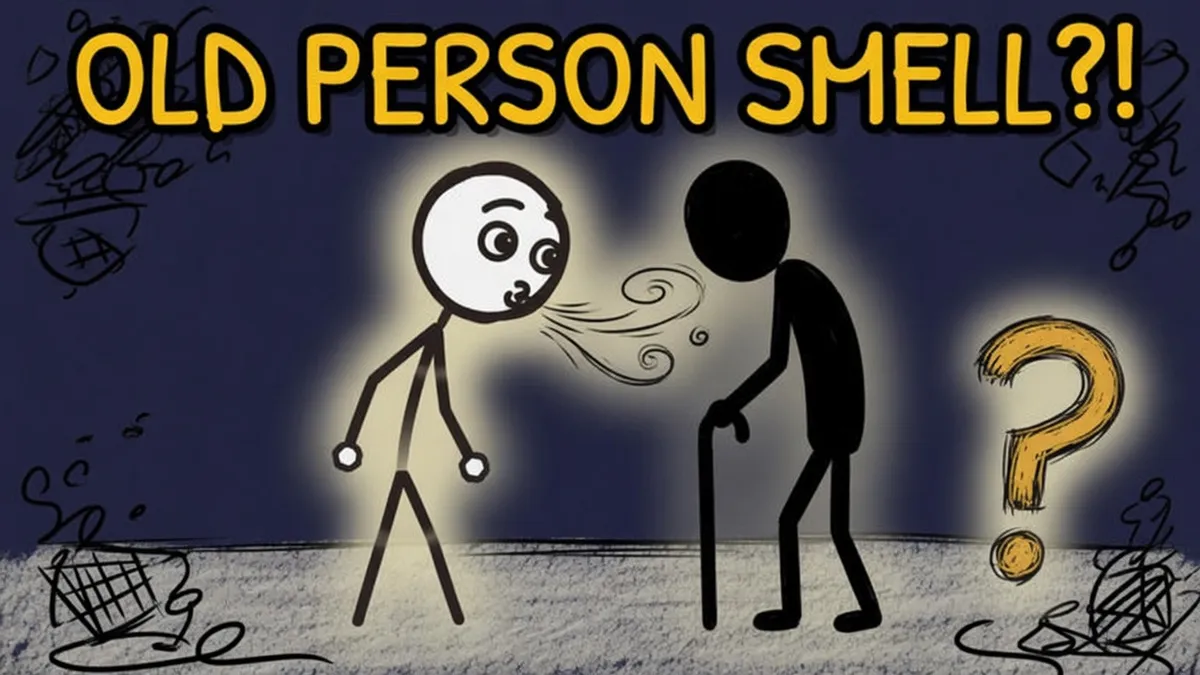
You know the smell. It's weirdly specific, and almost everyone recognises it instantly, that faint, slightly greasy, slightly grassy scent you notice around elderly relatives, or in an older person's home. It isn't sweat. It isn't being unwashed. It isn't any particular perfume. It's its own distinct thing, and it's so consistent, all over the world, that it clearly isn't a coincidence.
01 · The nameA smell so universal it has a word
It’s so widely recognised that Japan has a specific term for it: kareishū, which translates, quite matter-of-factly, as “aging smell.” And unlike a lot of these little mysteries, this one has actually been cracked. In fact, it was Japanese cosmetics researchers who first ran it to ground, which is why we can name the exact molecule responsible.
02 · The moleculeIt all comes down to 2-nonenal
The scent traces to one chemical compound: a molecule called 2-nonenal. It’s an unsaturated aldehyde, and on its own it carries an unpleasant greasy, grassy, faintly old-book odour. When you get a nose full of that classic aging scent, what you are actually smelling is 2-nonenal, drifting up off the skin. One compound, doing nearly all the work.
03 · The timerIt switches on around 40
Here’s the first genuinely strange thing: it appears almost on a schedule. When researchers at the cosmetics company Shiseido went looking, in a 2001 study in the Journal of Investigative Dermatology, they found something remarkably clean-cut. They collected body-odour samples from people aged 26 to 75, and 2-nonenal simply wasn’t there on younger skin. It was detected only in subjects aged 40 and over, and it steadily increased with age from there. So it really is, quite literally, a smell of age.
04 · The sourceYour own skin oils
So why does 40 flip the switch? The answer is in the natural oils coating your skin. That thin film of fatty substances slowly changes recipe over a lifetime, and as you head past 40, the amount of one particular fatty acid, palmitoleic acid, an omega-7 fat, begins to climb. Your skin, in effect, starts stocking up on the raw ingredient. But the fatty acid on its own barely smells of anything. The transformation happens next.
05 · The chemistryOxidation does the dirty work
That fat, sitting on your warm skin, gets attacked, by oxygen in the air, by reactive molecules called lipid peroxides, and by the ordinary bacteria living on all of us. As they break the fatty acid down, they transform it into 2-nonenal. The smell, in other words, is the by-product of your own skin oils slowly oxidising. And the Shiseido team found the accelerant built right in: the amount of lipid peroxides in skin-surface oils rises with age, so the reaction speeds up exactly when there’s more raw material to feed it.
There's a cruel double-whammy: just as your skin starts producing more of the raw material, its antioxidant defences, which used to mop up the reactive molecules, begin to fade. More fuel, less protection.
06 · The double-whammyDefences down, fuel up
When you’re young, your skin is loaded with antioxidants that neutralise those reactive molecules before they can do this kind of damage, and rapid skin turnover clears things quickly. But with age, that protection weakens and reactive oxygen species build up, the exact conditions that drive lipid peroxidation. So you end up caught in a pincer: more of the fat that makes the smell, and less of the defence that used to prevent it. (This weakening-defences half of the picture is well supported by aging-skin research, though it’s a broader mechanism than the single Shiseido paper set out to prove.)
07 · The payoffChemistry, not hygiene
You’d think the obvious fix is to just wash more. But this is the genuinely annoying part: 2-nonenal barely dissolves in water and clings stubbornly to skin, so a normal shower with normal soap does a surprisingly poor job of shifting it. (Products designed to target it, in Japan, some use persimmon-tannin extracts, work by chemically binding or breaking down the molecule, not simply rinsing it off.) So let’s be completely clear: the smell has nothing to do with being unclean or letting oneself go. It is pure, unavoidable chemistry, the quiet molecular signature of getting older.
Which makes it one of the most precise things about the whole body. Not a vague decline, but a specific molecule, produced by a specific fatty acid, oxidising on aging skin, switching on at a specific age. It’s less a smell than a kind of chemical clock, one your own skin will start ticking, right on cue, right around the big four-oh.

The animated version
Same answer, told as a little animated story with the strange little stickman acting it out. Dry, quick, and, obviously, correct.
Quick questions
What causes the 'old person smell'?
A single molecule called 2-nonenal, an unsaturated aldehyde with a greasy, grassy odour. It forms when omega-7 fatty acids on the skin, chiefly palmitoleic acid, are broken down by oxidation. It starts appearing on skin from around age 40 and increases with age.
Is the old person smell a sign of poor hygiene?
No. 2-nonenal is a normal by-product of aging skin chemistry, and because it barely dissolves in water, ordinary washing removes it poorly. So the smell has nothing to do with someone being unclean: it's unavoidable chemistry, not neglect.
What is kareishū?
Kareishū is the Japanese word for the 'old person smell,' translating roughly as 'aging smell.' The concept is well enough recognised that Japanese cosmetics researchers, notably at Shiseido, were the first to isolate the molecule behind it.
At what age does 2-nonenal start to appear?
In the 2001 Shiseido study, 2-nonenal was detected only in subjects aged 40 and over, and its concentration tended to rise steadily with age. So it genuinely behaves like a smell that switches on around 40.
Why doesn't the old person smell wash off?
Because 2-nonenal barely dissolves in water and clings stubbornly to skin, so a normal shower with normal soap shifts it poorly. Products aimed at it (in Japan, some use persimmon-tannin extracts) work by chemically binding or breaking down the molecule rather than simply rinsing it away.
What exactly is 2-nonenal?
It's an unsaturated aldehyde, a small, oily molecule formed when omega-7 fatty acids on your skin (chiefly palmitoleic acid) oxidise. On its own it smells greasy and grassy, with a faintly papery, old-book edge. It's the same aldehyde (trans-2-nonenal) that gives stale beer its classic 'cardboard' note, a neat hint that this is oxidation chemistry, nothing to do with the person. Shiseido researchers first tied it to aging body odour in 2001.
Does everyone get the old person smell?
Not equally. 2-nonenal is a normal by-product of aging skin and its levels rise with age, but how noticeable it gets varies a lot with oxidative stress, skin oiliness, smoking and diet. One honest caveat: while the 2001 Shiseido study pinned the smell on 2-nonenal, at least one later analysis failed to detect 2-nonenal at all and instead flagged other compounds, so 2-nonenal is best described as the leading culprit rather than the sole one.
Can you wash off or get rid of the old person smell?
Not with ordinary soap: 2-nonenal barely dissolves in water and clings to skin. Products that genuinely target it (notably Japanese persimmon-tannin, or polyphenol, soaps) work by chemically binding or breaking the molecule down rather than rinsing it away. And because the molecule transfers onto fabric, regularly laundering clothing, bedding and towels helps as much as washing skin does.
Does diet or lifestyle change it?
Probably, at the source. Since 2-nonenal is a product of oxidation, habits that raise oxidative stress, smoking, heavy drinking, tend to amplify body odour, while an antioxidant-rich diet may dampen the reaction. One small trial found New Zealand blackcurrant powder, rich in anthocyanins, cut skin 2-nonenal emission by about 39% in middle-aged and older adults. That's early, small-scale evidence (just 14 people), so treat it as promising rather than proven.
Is the old person smell a sign of ill health?
No, 2-nonenal itself is ordinary aging chemistry, not a disease marker. It's worth separating it, though, from body odours that genuinely can flag a problem: a sweet, fruity smell on breath or sweat (a sign of uncontrolled diabetes and ketones), an ammonia-like or fishy smell (linked to kidney or liver trouble), or a sudden foul odour (often infection). A distinct new smell that isn't the usual faint greasy note is the kind of thing worth mentioning to a doctor.
Is the old person smell the same as body odour from sweat?
Not really. Everyday sweat odour is mostly bacteria breaking down fresh sweat, and it washes off. The classic aging smell is mainly 2-nonenal, an unsaturated aldehyde from the slow oxidation of omega-7 skin lipids. It sticks to skin, resists ordinary washing, and tends to appear from about age 40 onward.
Is 2-nonenal the same chemical that makes stale beer taste cardboardy?
Yes. Trans-2-nonenal is also the classic papery, cardboard note in staled beer, formed when unsaturated fatty acids oxidise. On aging skin the chemistry is similar: omega-7 lipids break down and leave that greasy, grassy odour people notice.
Take the quiz on this
A quick 4-question check on what you just read. Get them right to earn XP: no points for just scrolling.
Our sources 10 checked
// every claim on this page was checked before it went up