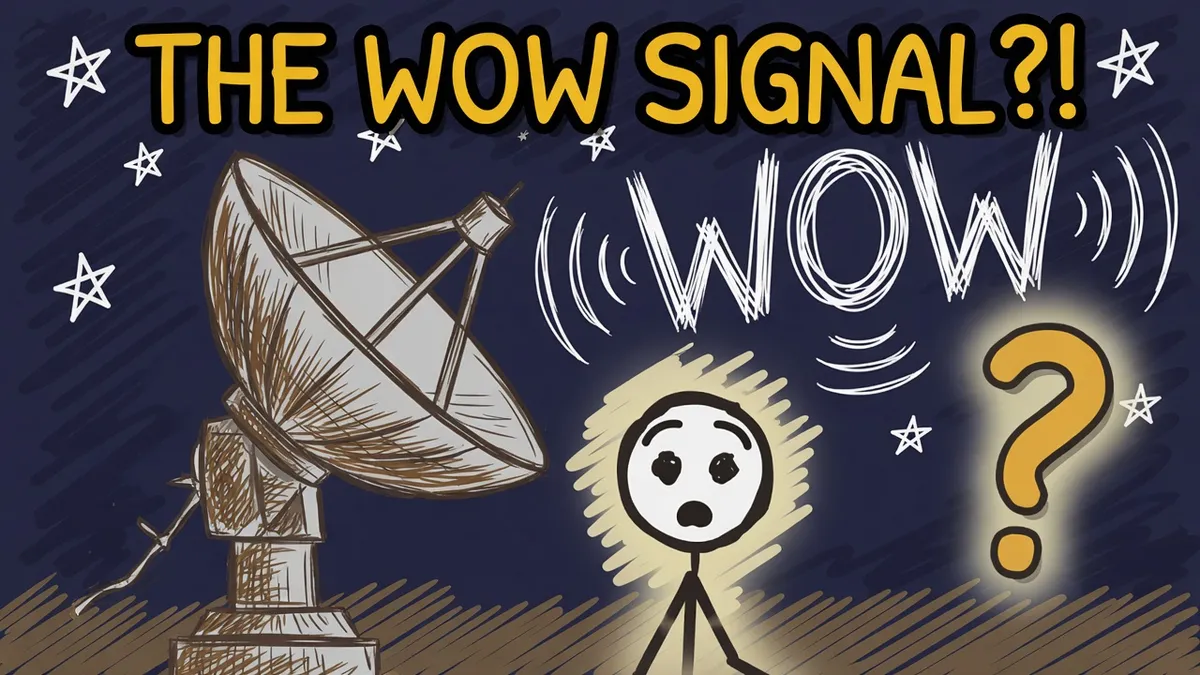
On a summer night in 1977, a radio telescope in Ohio was quietly listening to the sky, writing its readings onto a long paper printout that nobody would look at for days. When astronomer Jerry Ehman finally ran his eye down the columns, one line stopped him cold: a signal so strong, so sharp and so precisely alien-looking that he grabbed a red pen, circled the reading, and scrawled a single word in the margin. "Wow!" Nearly fifty years later, that word is still the best name we have for the closest thing to a message from the stars we have ever caught, and we still have no idea what sent it.
01 · The setupA telescope built to hear whispers
The signal was caught by Big Ear, a football-pitch-sized radio telescope at Ohio State University running one of the first long-term searches for extraterrestrial intelligence. Big Ear could not steer quickly; it stared at a fixed strip of sky and let the Earth’s rotation drift the heavens slowly past its view. Everything it heard was dumped, as numbers, onto reams of printout. There were no alarms and no screens flashing. Whatever the telescope found, a human would have to notice, by hand, later.
02 · The readingSix letters that mean 'something got loud'
What Ehman circled was 6EQUJ5, and people have been misreading it as a coded message ever since. It isn’t one. Big Ear measured how strong the signal was every 12 seconds and wrote down a single character for each measurement: digits 1 to 9, then letters A onward for anything higher. So 6EQUJ5 is simply a graph in disguise. It reads as a signal climbing, 6, then E, then Q, peaking at U, before falling back through J to 5. That “U” represents a burst about thirty times louder than the empty background hiss of space. In a survey that mostly recorded nothing at all, it was a shout.
03 · The frequencyBroadcasting on the cosmic dial tone
Here is why astronomers cared so much. The signal sat almost exactly on 1420 MHz, the frequency naturally emitted by hydrogen, the most common substance in the universe. For decades, SETI researchers had argued that if anyone wanted to be found, this is the frequency they would choose, a natural “dial tone” any technological species would know about. The Wow! signal was narrow, focused, and parked right on it. It was, in other words, transmitting on exactly the channel we had agreed to listen for.
04 · The 72 secondsIt moved with the sky, not the ground
The signal lasted precisely 72 seconds, and that number is not a coincidence, it is a clue. Because Big Ear stared at a fixed point while the Earth turned, any real object out in space would drift through its view in exactly 72 seconds, rising and fading in a smooth, predictable curve. That is precisely the shape the Wow! signal traced. A car radio, a passing plane or a faulty microwave on the ground would not behave that way. Everything about the signal’s profile said the source was out there, beyond the Earth, moving with the stars.
Big Ear actually had two listening horns, so any genuine sky source should have been recorded twice, minutes apart, as each horn swept past. The Wow! signal appeared in only one. Ehman could never even work out which horn caught it, so the exact patch of sky stayed uncertain. And when he and others pointed telescopes back at it, again and again over the following decades, they heard nothing at all. The loudest, most promising signal in SETI history came exactly once, and then went silent forever.
05 · The suspectsComets, hydrogen clouds and honest uncertainty
Plenty of natural explanations have been offered, and most fall short. A 2017 claim that a passing comet produced it was firmly rejected: the comets were in the wrong place, and comets don’t glow brightly at that frequency anyway. The most credible idea to date comes from a 2024 team led by astrobiologist Abel Mendez, who suggest a cold cloud of hydrogen was briefly lit up by a passing blast of radiation from a magnetar, a hyper-magnetic dead star, producing a natural laser-like flash on the hydrogen line. It is elegant, and it is still just a preprint awaiting peer review. Nobody has proven anything.
06 · The payoffSo what was the Wow! signal?
Honestly, we do not know, and we almost certainly never will. That is precisely why it endures. The Wow! signal ticked nearly every box a genuine alien beacon was supposed to tick: narrow, strong, on the hydrogen line, moving with the sky. Then it broke the one rule that makes a discovery real, it never repeated, so it can never be confirmed, studied or attributed to anyone. It is the most famous forty-two seconds of listening in the history of the search for life, and its whole meaning is a shrug. For one summer night in 1977 the universe seemed to say something. Then it went quiet, and it has not spoken since.
The animated version
Same answer, told as a little animated story with the strange little stickman acting it out. Dry, quick, and, obviously, correct.
Quick questions
Was the Wow! signal aliens?
There is no evidence it was, and no scientist has confirmed an alien origin. It had several features a deliberate signal might show, but it never repeated, so it can neither be verified nor attributed to any source. It remains officially unexplained.
Why was it called the Wow! signal?
Astronomer Jerry Ehman wrote 'Wow!' in the margin of the computer printout beside the reading '6EQUJ5' when he saw how unusually strong it was. The name stuck ever since.
Has the Wow! signal ever been detected again?
No. Dozens of follow-up searches of the same patch of sky, using Big Ear and other telescopes, have never recovered it. Its one-off nature is a core part of the mystery, because science cannot verify something that happens only once.
What does 6EQUJ5 mean?
It is the telescope's intensity code, sampled every 12 seconds, showing the signal rise and fall. Single digits ran 1 to 9 and letters continued from 10 upward, so 6EQUJ5 traces a climb to a peak of about 30 times the background noise and back down. It is not a message or a word.
When was the Wow! signal detected?
On 15 August 1977, though Jerry Ehman only noticed it while reviewing the printouts a few days later. By then the moment had long passed and could not be re-observed.
Who discovered the Wow! signal?
Astronomer Jerry R. Ehman, working on Ohio State University's SETI survey with the Big Ear radio telescope. His handwritten 'Wow!' on the data printout became one of the most famous annotations in the history of astronomy.
What frequency was the Wow! signal?
About 1420 MHz, essentially on the neutral hydrogen line (also called the 21 cm line). This frequency is significant because it is produced by the most common element in the universe and is the band SETI researchers most expect an intentional beacon to use.
How long did the Wow! signal last?
72 seconds, which is exactly how long Earth's rotation would take to sweep the fixed telescope's beam across a single fixed point in the sky. That matching profile is strong evidence the source was out in space, not a local transmitter.
Where did the Wow! signal come from?
From the direction of the constellation Sagittarius. The exact position is uncertain because Big Ear had two feed horns and the signal was recorded by only one of them, leaving the precise patch of sky ambiguous.
Has the Wow! signal been explained?
Not conclusively. The strongest current natural idea, from a 2024 team led by Abel Mendez, is a cold hydrogen cloud briefly brightened by a burst of radiation such as a magnetar flare, but that work is still a preprint awaiting peer review. No explanation has been confirmed.
Was the Wow! signal a comet?
Almost certainly not. A 2017 comet idea was rejected by astronomers, including original Big Ear team members, because the comets were not in the beam at the right time and comets are not known to emit strongly at 1420 MHz. Treat the comet explanation as debunked.
Why is the Wow! signal important?
It is the strongest and most tantalising candidate signal in the history of the search for extraterrestrial intelligence. Yet because it never repeated it cannot be confirmed, which makes it a perfect illustration of both how close and how far that search has come.
Our sources 8 checked
// every claim on this page was checked before it went up