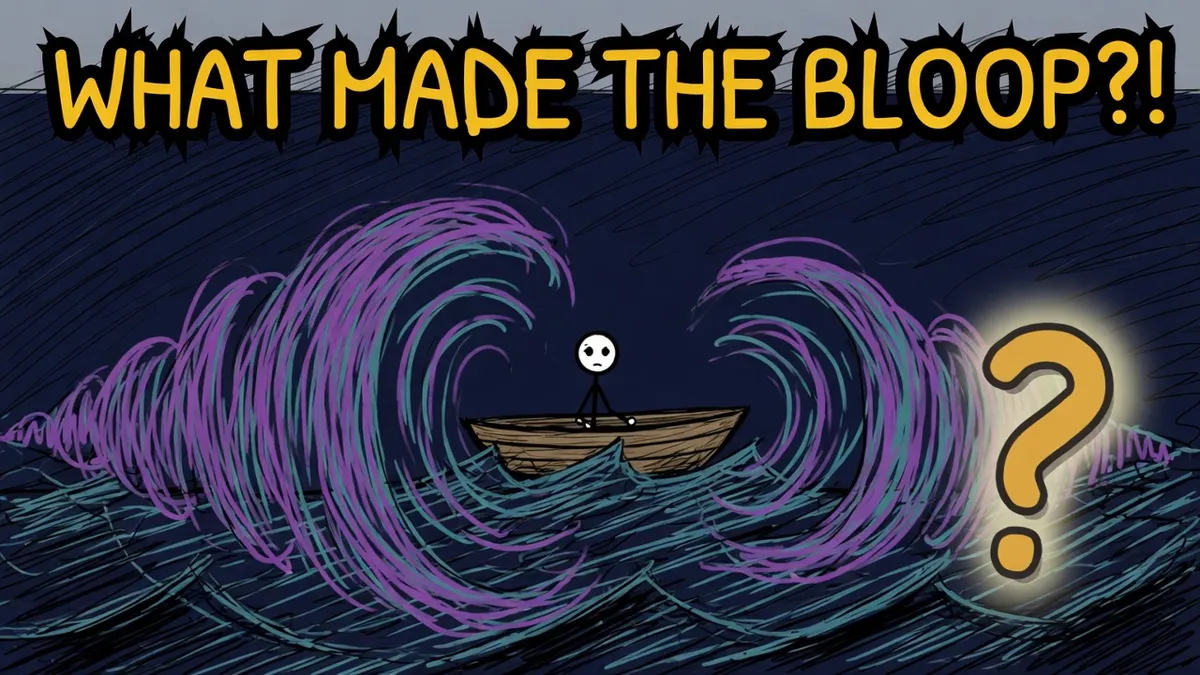
In the summer of 1997, an array of underwater microphones scattered across the equatorial Pacific caught something huge. A single sound, rising quickly in pitch over about a minute, so powerful that sensors more than 5,000 km apart all heard it. It did not match any ship, any quake, any known animal. The internet took one look at the numbers and reached a thrilling conclusion: something enormous was alive down there, something bigger than a blue whale. They called it the Bloop. The truth turned out to be stranger, and quieter, than any monster.
01 · The signalA sound that crossed an ocean
NOAA listens to the deep ocean with hydrophones, underwater microphones descended from SOSUS, the US Navy’s Cold War network for tracking submarines. In 1997 that array recorded the Bloop, and what made it famous was its sheer reach. To register on sensors thousands of kilometres apart, the source had to be extraordinarily loud, louder than any animal on record. That single fact, “too loud to be an animal”, is what launched a thousand sea-monster theories. It was also, it turned out, the clue that pointed away from biology entirely.
02 · The legendBigger than a blue whale
The myth wrote itself. If no known creature could be that loud, then surely an unknown one could, some colossal thing lurking in unmapped depths. The Bloop became a fixture of online lists of the ocean’s greatest mysteries, often paired with tentacled art and ominous music. But this was never NOAA’s claim. The agency’s scientists were less interested in monsters than in matching the Bloop’s spectrogram, the visual fingerprint of the sound, against known sources. And the fingerprint did not look like a voice. It looked like something breaking.
03 · The answerNot a creature. Ice.
NOAA’s conclusion: the Bloop was an icequake. A vast Antarctic iceberg cracking and breaking away from a glacier, a process that releases a broad-spectrum roar powerful enough to cross an ocean. And this was not just a tidy guess. When NOAA later sailed hydrophones down toward Antarctica to study seafloor quakes and volcanoes, they recorded numerous icequakes whose spectrograms looked almost identical to the Bloop. The likely source sits somewhere between the Bransfield Strait and the Ross Sea. The monster of the deep was the continent of ice itself.
The whole legend was built backwards. The Bloop got famous as possible proof of a creature so loud that nothing known could match it. The real answer is arguably stranger: a single iceberg cracking apart made a sound that travelled 5,000 km. NOAA did not just theorise it, they went and recorded fresh icequakes that matched. The scariest sound in the ocean was ice doing what ice does.
04 · The othersA whole chorus of icebergs
The Bloop has siblings, and most of them are ice too. NOAA’s catalogue includes sounds nicknamed Slow Down, Julia, and Train, each once mysterious, each now tied to icebergs grinding, grounding, and sliding against the seafloor off Antarctica. Slow Down drifts downward in pitch over seven minutes as a berg drags on the seabed. Julia swept across an entire ocean array in 1999. Listen to the deep for long enough and you realise a lot of its strangest voices are the same story: enormous frozen masses, cracking and scraping at the bottom of the world.
05 · The ones still hummingWhy the ocean carries so far
A few sounds do stay open. Upsweep, heard since 1991 near likely undersea volcanism, has an origin NOAA still calls unresolved. What lets any of these sounds travel so far is a quirk of physics called the SOFAR channel: a deep layer where sound moves slowest, so low-frequency noise gets bent back toward that layer and glides for thousands of kilometres losing almost no energy. It is why an Antarctic icequake, or a distant volcano, can be heard an ocean away, and why the deep can seem to whisper from everywhere at once. The same physics explains other booms that seem to come from nowhere.
06 · The payoffSo what made the Bloop?
Ice. A giant Antarctic iceberg, cracking apart and shouting across an ocean. Not a creature, not a mystery the science left dangling, but a natural event powerful enough to sound like a legend. The Bloop is a small lesson in how these stories work: a real, verifiable answer is often quieter than the myth, and somehow more astonishing for it. The deep still holds genuine puzzles, a handful of unresolved hums near hidden volcanoes. But the monster everyone wanted was, all along, the coldest, most patient force on the planet, simply breaking.

The animated version
Same answer, told as a little animated story with the strange little stickman acting it out. Dry, quick, and, obviously, correct.
Quick questions
Was the Bloop a sea monster?
No. Despite viral claims about a giant undiscovered creature, NOAA never said that. It concluded the Bloop was an icequake, a large Antarctic iceberg cracking apart. The sound was far too powerful and broad in spectrum for any known animal.
What did NOAA say the Bloop was?
NOAA describes it as the sound of an icequake, an iceberg cracking and breaking away from an Antarctic glacier. The broad-spectrum signal closely matched icequakes the agency later recorded near Antarctica.
Is the Bloop still unexplained?
No, it is explained. NOAA resolved it as iceberg cryoseism, or icequake, activity, most likely somewhere between the Bransfield Strait and the Ross Sea. The 'unexplained monster' framing is the hook, not the answer.
When and where was the Bloop recorded?
In the summer of 1997, on NOAA's autonomous hydrophone array in the equatorial Pacific. It was loud enough to register on multiple sensors more than 5,000 km (about 3,100 miles) apart.
How did NOAA confirm the Bloop was ice?
When NOAA later deployed hydrophones closer to Antarctica to study seafloor quakes and volcanoes, they recorded numerous icequakes with spectrograms very similar to the Bloop. So the confirmation came from matching real ice sounds, not just theory.
Could the Bloop have been a giant squid or whale?
No. NOAA found the sound was far too powerful and spread across too broad a spectrum for any animal, and its profile matched cracking ice rather than biology. Even a blue whale, the loudest known animal, falls well short.
What is the SOFAR channel?
SOFAR stands for SOund Fixing And Ranging. It is a deep ocean layer where sound travels slowest, so low-frequency sound gets bent back toward that layer and can travel hundreds to thousands of kilometres with very little energy loss, a bit like light in a fibre-optic cable.
How does NOAA record deep-ocean sounds?
With hydrophones, which are underwater microphones, arranged in arrays across the ocean. NOAA's program grew out of SOSUS, the US Navy's Cold War network built to track submarines, which scientists began using for research in 1991.
What made the Julia sound?
NOAA says Julia, recorded on 1 March 1999, was most likely a large iceberg run aground off Antarctica, grinding against the seafloor. It was picked up across the whole eastern equatorial Pacific array.
What caused the Slow Down sound?
Slow Down, recorded in May 1997, gradually drops in frequency over about seven minutes. NOAA attributes it to a large iceberg grounding and sliding against the seabed. So, like the Bloop, it comes down to ice.
Is the Upsweep sound explained?
Not fully. Upsweep has been heard since 1991 from the South Pacific near likely volcanic activity, and NOAA states its origin is unresolved, though undersea volcanism is the leading guess. Its overall level has declined over the years.
Are any deep-sea sounds still a mystery?
Mostly no. The Bloop, Slow Down, Julia, and Train are all tied to ice. Upsweep and the single-sensor 'Whistle' remain unresolved, with volcanic activity the leading candidate. So the famous 'monster' cases are solved, but the ocean still hums with a few open questions.
Why do so many strange ocean sounds come from Antarctica?
Because icebergs are enormous and constantly cracking, calving, and grinding aground, producing powerful low-frequency events. The SOFAR channel then carries those sounds across whole oceans to distant hydrophones, so an Antarctic icequake can be heard thousands of kilometres away.
Our sources 6 checked
// every claim on this page was checked before it went up