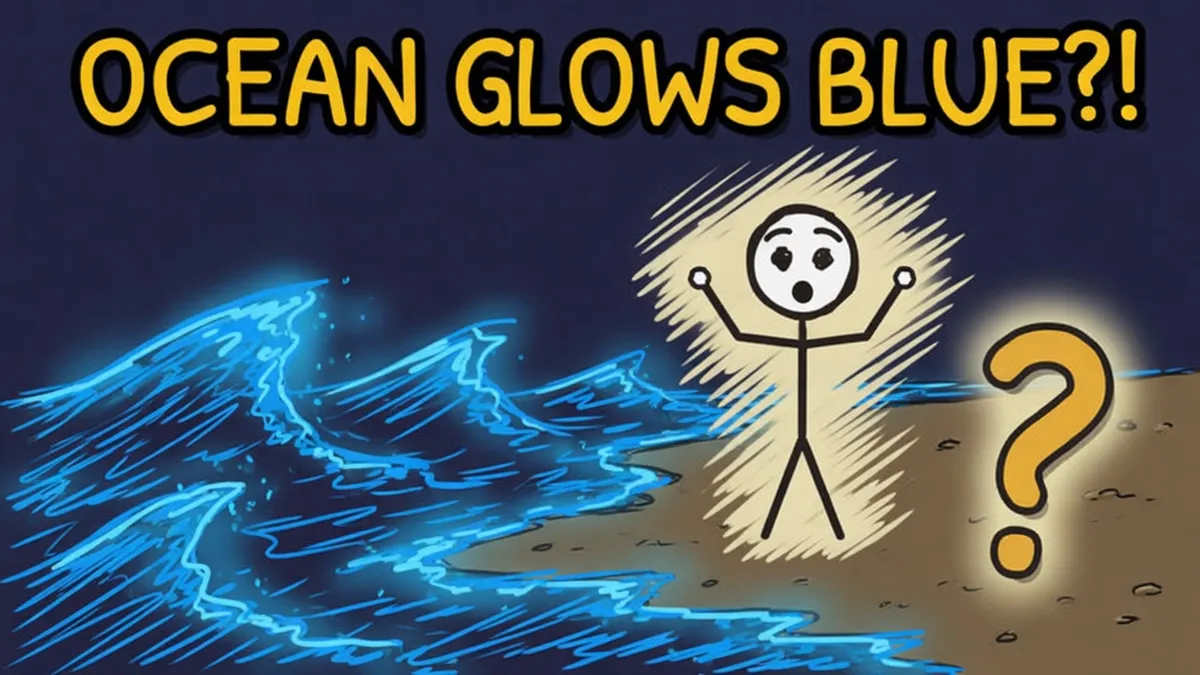
You wade into dark water at night, and where your legs move, the sea lights up. Electric blue, cold and silent, tracing every ripple before fading back to black. Further out, the breaking waves glow along their crests like neon rolling in from the horizon. It looks supernatural, and in a way it is alive: the light is made by creatures too small to see, in their billions. But the strangest part is not that the sea glows. It is why. These tiny organisms are not lighting up for your benefit. They are sounding an alarm.
01 · The sourceThe water is full of tiny lights
The glow does not come from the water. It comes from dinoflagellates, single-celled plankton drifting in their countless millions near the surface. One of the most common is nicknamed “sea sparkle”, and sailors long ago called its shimmer the burning of the sea. Each cell is a self-contained lantern. On its own it is invisible; gathered into a dense bloom, and disturbed all at once, the collective flash can outline an entire wave. What you are seeing is not one light but a chorus of them, firing together.
02 · The chemistryCold light, made to order
Inside each cell is a chemical trick. A molecule called luciferin reacts with oxygen, helped along by an enzyme called luciferase, and the reaction releases its energy almost entirely as light. Barely any heat. This is why bioluminescence is called “cold light”, and why it is so different from a flame or a bulb: it is astonishingly efficient, nearly all glow and no warmth. The same basic machinery, luciferin and luciferase, is what lets fireflies glow on a summer evening. The sea just runs it a trillion times over.
03 · The triggerWhy it only glows when it moves
Still water stays dark. The light fires only when the plankton are disturbed: a breaking wave, a passing boat, a paddle, your hand. Movement sends a fast electrical signal through the cell, briefly shifting its internal chemistry and releasing the luciferin to react. The whole flash lasts about a tenth of a second. That is why the glow always rides the moving edge of things, the crest of a wave, the swirl of a wake, and vanishes the instant the water goes calm. You are not lighting up the sea so much as startling it.
The plankton do not glow to be beautiful. They glow to survive. The leading explanation is the "burglar alarm": when a tiny grazer tries to eat a dinoflagellate, the cell flashes, like a shop alarm going off during a break-in. That flash startles the grazer and draws the attention of bigger predators, so the little thief becomes dinner. Bioluminescence can cut nighttime grazing on these plankton by 50 to 80 percent. The glow you find so lovely is really a microscopic security system, firing thousands of times in every wave.
04 · The colourWhy blue, and not green or red
Almost all ocean bioluminescence is blue, and that is no accident. Blue light, at a wavelength of around 440 to 500 nanometres, travels farthest through seawater, while red and violet are absorbed within metres. For an organism trying to be seen in the water, blue is simply the most efficient signal to send. It is the same physics that makes the open ocean look blue to us: the sea keeps the blue and swallows the rest. The plankton, in effect, evolved to shout in the one colour the water lets travel.
05 · The bloomsSea sparkle by night, red tide by day
The glow comes and goes with blooms, sudden population explosions of plankton. The same bloom that lights up blue at night often stains the water a reddish brown by day, a “red tide”. Most are a harmless wonder, but some species carry toxins, which is why the safest rule is to check local advisories before swimming in glowing surf. Enclosed bays like Mosquito Bay in Puerto Rico glow every night of the year, holding hundreds of thousands of cells per gallon. Along open coasts the shows are unpredictable, most likely on warm nights, and best on a dark, moonless one when nothing washes the glow out.
06 · The payoffSo why do the waves glow blue?
Because the sea is briefly full of tiny alarms, and you set them off. Each glowing crest is billions of single cells flashing a chemical light, cold and blue, in the one colour the ocean carries best, for the ruthless purpose of getting their attackers eaten. The beauty is real, but it is a side effect of a war too small to see. Next time you find yourself in a glowing tide, remember that every spark under your feet is a living thing shouting “predator”, and that you, wading through the dark, have just tripped a security system older than any wave.

The animated version
Same answer, told as a little animated story with the strange little stickman acting it out. Dry, quick, and, obviously, correct.
Quick questions
What causes ocean waves to glow blue at night?
Microscopic plankton called dinoflagellates. When a wave disturbs them, a chemical reaction inside each cell releases a quick flash of blue light. Thousands of cells flashing together light up the whole wave.
What is sea sparkle?
Sea sparkle is the nickname for Noctiluca scintillans, one of the most common glowing dinoflagellates in coastal waters worldwide. Sailors once called its shimmer the 'burning of the sea'.
Why does the water only glow when it moves?
The light is triggered by mechanical agitation. Movement sends an electrical signal through the cell that briefly changes its chemistry and fires the flash. Undisturbed water stays dark, so the glow appears in the breaking crest of a wave, a boat's wake, or the swirl around your hand.
Why is bioluminescence blue and not another colour?
Blue light, around 440 to 500 nanometres, travels farther through seawater than red or violet, which are absorbed quickly. Marine organisms evolved to glow blue because it is the most efficient colour to be seen underwater. It is also why the open ocean looks blue.
Is the glowing light hot?
No. Bioluminescence is 'cold light', a chemical reaction that gives off almost no heat, unlike a flame or a light bulb. Nearly all of the energy comes out as light.
Is sea sparkle the same thing as a red tide?
Often, yes, seen at different times of day. The same dinoflagellate blooms that glow blue at night can tint the water reddish-brown in daylight, which is a red tide. Not every red tide glows, and not every glow is a red tide, but they frequently overlap.
Is bioluminescent water safe to swim in?
Usually, but it depends on the species. Many glowing blooms are harmless, while some red-tide species produce toxins that can irritate skin, eyes, or airways in dense concentrations. It is wise to check local health advisories before swimming.
When can you see bioluminescent waves?
After dark, on nights when a bloom is present. Enclosed bays like Mosquito Bay in Puerto Rico glow year-round, while open-coast displays are seasonal and unpredictable, most common in warmer months. A darker, moonless night makes the glow easier to see.
Where is the best place to see it?
Mosquito Bay in Vieques, Puerto Rico, holds the Guinness World Record as the brightest bioluminescent bay and glows every night of the year. Other famous spots include San Diego, the Maldives, Japan's Toyama Bay, and Tasmania.
Why do the plankton glow at all?
The leading idea is defence. The flash acts like a burglar alarm: when a tiny grazer tries to eat the plankton, the cell lights up, which can startle the grazer and draw bigger predators to it. Studies show glowing cells can cut nighttime grazing dramatically.
Does a full moon affect how well you can see it?
In practice, yes. The glow itself does not change, but bright moonlight washes it out, so dark, moonless nights offer the best viewing. This is a practical viewing tip rather than a change in the biology.
Is it plankton, algae, or bacteria doing this?
On glowing beaches it is dinoflagellates, a type of single-celled plankton (also loosely called microalgae). Some deep-sea and other glows come from bacteria or animals, but the classic glowing surf is plankton.
How many organisms does it take to light up a wave?
An enormous number. Mosquito Bay holds up to about 700,000 dinoflagellates per gallon of water, and it is that dense concentration that makes the glow bright and consistent.
Our sources 6 checked
// every claim on this page was checked before it went up