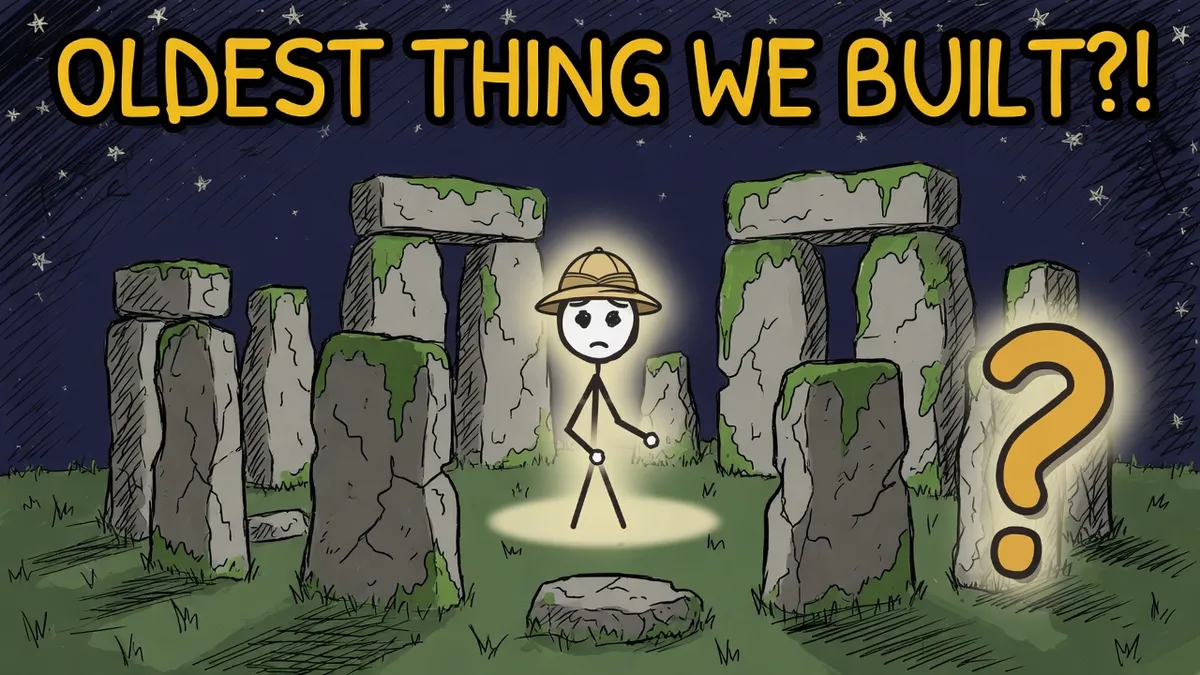
Ask what the oldest thing humans ever built is, and you expect a single answer: a place, a date, a photograph of some weathered ruin. Instead you get a question back. What do you mean by "built"? A shaped stone? An assembled structure? A building you could walk into? A monument raised on purpose? Each has a different record holder, stretching back through wildly different depths of time. And the deepest record of all belongs to a builder who was not, strictly speaking, one of us yet.
01 · The trap in the questionWhat "built" even means
The reason there is no one answer is that “built” is a ladder, not a rung. A chipped stone tool is a made object. A stack of shaped logs is a structure. A house is a building. A great pillar raised for ritual is a monument. These are genuinely different achievements, separated by hundreds of thousands of years, and each has its own oldest example. So the honest reply to the question is not a single site but a series of them, each answering a slightly different version of “oldest thing built.”
02 · The oldest objectTools before us
If you mean the oldest shaped thing, go to Lomekwi in Kenya, where stone tools have been dated to about 3.3 million years old. That is not a typo. These flakes and cores predate the genus Homo by roughly half a million years, which means our own genus had not yet appeared when someone, most likely an australopith, sat down and deliberately struck one rock against another to make an edge. The very first “technology” on Earth was made by a creature we would not quite recognise as human, and it still counts.
Here is the record that stops people cold. The oldest known assembled structure is not a hut or a temple. It is a pair of interlocking logs, deliberately notched so they lock together, found waterlogged at Kalambo Falls in Zambia, and dated to at least 476,000 years ago. Our species, Homo sapiens, is only about 300,000 years old. So this structure was built roughly 176,000 years before we existed, by an earlier human relative who was already shaping and joining wood with a cut notch, a level of planning nobody expected that far back. The first builders were not us. We only know about it because the wood happened to survive in water when almost all wood rots away.
03 · The cousins who builtNeanderthal architecture
Between those deep records and our own era, other humans were building too. Deep inside Bruniquel Cave in France, about 176,500 years ago, Neanderthals broke off some 400 stalagmites and arranged them into deliberate rings and piles, hundreds of metres from the entrance, in total darkness, with traces of fire. Nobody knows what the rings were for. But making them required light, planning, and cooperation deep underground. It is a haunting reminder that the impulse to build and arrange, like the impulse to bury the dead, was not unique to us.
04 · The first monumentGobekli Tepe
If you mean the oldest great monument, deliberate large-scale architecture, the answer is Gobekli Tepe in Turkey, built around 9600 BCE. Hunter-gatherers quarried, carved, and raised stone pillars weighing up to ten tonnes, decorated with animals, some 6,000 to 7,000 years before Stonehenge or the pyramids. What makes it revolutionary is the timing: it came before farming, pottery, and writing, overturning the old assumption that monuments were a luxury of settled agricultural societies. Sometimes the wish to build something enormous comes first.
05 · Still standing, still usedBuildings that survived
There is one more version of the question: not the oldest thing ever built, but the oldest still in use. For freestanding buildings, the Megalithic Temples of Malta (around 3600 BCE) and the chambered tomb of Barnenez in France (around 4800 BCE) are among the oldest surviving. And for a building still doing its job today, the usual answer is the Pantheon in Rome, completed around 125 CE and in near-continuous use for some 1,900 years, a temple turned church that has never stood empty. The definitions are slippery, but the wonder is not: people are still walking through a room raised nineteen centuries ago.
06 · The payoffSo what is the oldest thing we ever built?
It depends what you count, and that is the real answer. Stone tools 3.3 million years old, from before our genus. A notched wooden structure 476,000 years old, from before our species. Neanderthal rings deep in a cave. A hunter-gatherer temple older than farming. A Roman dome still in use today. Together they tell a single, humbling story: the urge to make, shape, join, and raise is far older than humanity itself. We did not invent building. We inherited it, from ancestors who were already at work long before there was anyone around to call it history. It is the same deep past that produced the first cities older than the pyramids.
The animated version
Same answer, told as a little animated story with the strange little stickman acting it out. Dry, quick, and, obviously, correct.
Quick questions
What is the single oldest thing humans have ever built?
It depends what 'built' means. The oldest shaped object is a set of stone tools from Lomekwi, Kenya, about 3.3 million years old, though those were made by a pre-human ancestor. The oldest assembled wooden structure is at Kalambo Falls, Zambia, at least 476,000 years old.
What is the oldest building in the world?
As a freestanding, enclosed building, contenders include the Megalithic Temples of Malta (around 3600 BCE) and the chambered tomb of Barnenez in France (around 4800 BCE). If you mean the oldest building still in everyday use, that is the Pantheon in Rome, completed around 125 CE.
What is the oldest structure ever found?
The oldest deliberately assembled structure is the wooden construction at Kalambo Falls, Zambia, dated to at least 476,000 years ago. Two logs were shaped and notched to lock together, likely as a platform or walkway.
What did humans build first?
The earliest surviving 'builds' are stone tools, from Lomekwi in Kenya about 3.3 million years ago, though made by a pre-Homo ancestor. The earliest structures we know of are wooden and stone arrangements from hundreds of thousands of years ago.
How old is Gobekli Tepe?
Its oldest layers date to around 9600 BCE, roughly 11,600 years ago. That makes it about 6,000 to 7,000 years older than both Stonehenge and the Egyptian pyramids.
What is the Kalambo Falls structure?
It is a wooden construction found in Zambia, made of two interlocking logs joined by a deliberately cut notch, with visible tool marks. Luminescence dating puts it at least 476,000 years old, making it the oldest known wooden structure in the world.
What is the oldest monument in the world?
Gobekli Tepe in Turkey, built around 9600 BCE, is widely regarded as the world's oldest monumental site, with carved stone pillars weighing up to 10 tonnes raised by hunter-gatherers.
What is the oldest building still in use today?
The Pantheon in Rome, finished around 125 CE, has been in near-continuous use for about 1,900 years and has served as a church since the 7th century. The claim depends on how you define continuous use, but it is the most commonly cited answer.
What is the oldest thing Neanderthals built?
Deep inside Bruniquel Cave in France, Neanderthals arranged around 400 broken stalagmites into rings and piles roughly 176,500 years ago, one of the oldest known constructions by any human relative.
What are the oldest stone tools ever found?
The oldest known stone tools come from Lomekwi 3 in Kenya and are about 3.3 million years old. They predate the genus Homo, so they were probably made by Australopithecus or a related ancestor.
Did humans build things before Homo sapiens existed?
Yes. The Kalambo Falls wooden structure (about 476,000 years old) and the Bruniquel Cave stalagmite rings (about 176,500 years old) both predate our species, which emerged around 300,000 years ago. They were made by earlier human relatives.
What is the oldest man-made structure built by Homo sapiens?
A strong candidate is the stone wall in Theopetra Cave, Greece, dated to about 23,000 years ago and thought to be a windbreak against Ice Age cold. Older structures exist, but they were built by pre-sapiens human relatives.
What is the oldest wooden structure in the world?
The Kalambo Falls find in Zambia, at least 476,000 years old, is the oldest known. It survived only because the waterlogged site preserved the wood, which normally rots away.
Our sources 5 checked
// every claim on this page was checked before it went up