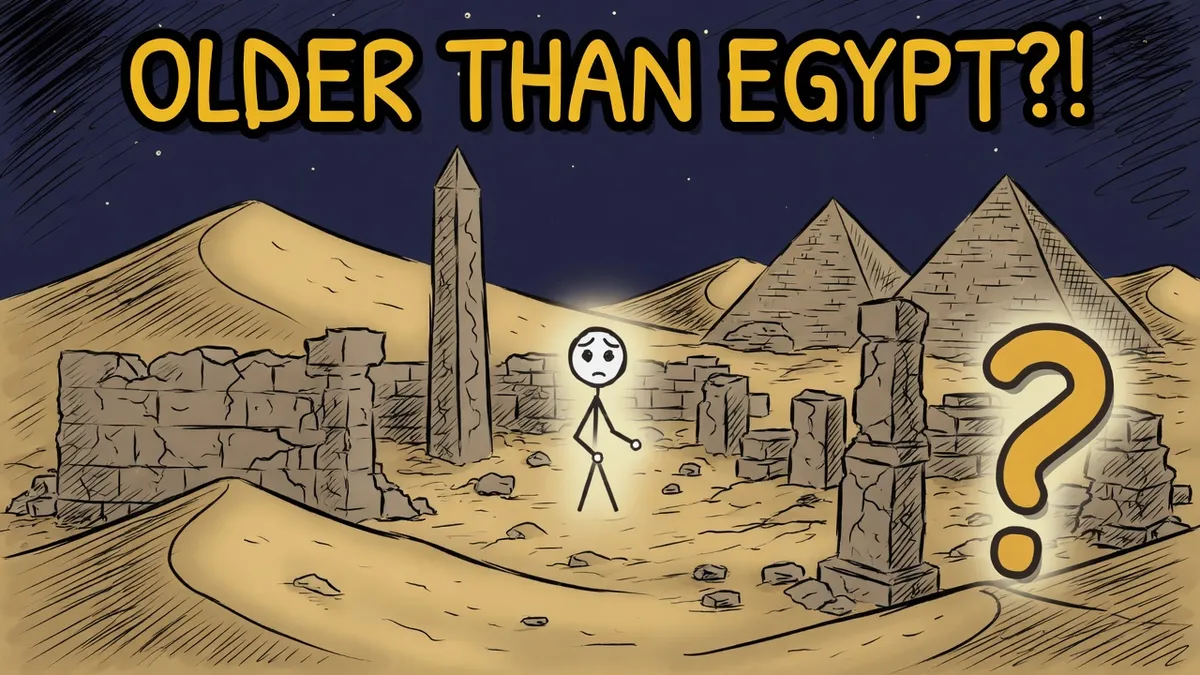
Say "ancient civilisation" and most people picture the pyramids of Egypt, rising out of the desert at the dawn of history. It is a powerful image, and it is wrong about the timeline. By the time Egyptian workers laid the first block of the Great Pyramid, around 2600 BCE, people had already been living in walled towns for more than five thousand years. Some had raised stone temples so old they were built before anyone knew how to farm. The pyramids are not the beginning of the story. They are closer to the middle.
01 · The benchmarkHow old the pyramids really are
Start with the number everyone knows. The Great Pyramid of Giza went up around 2600 BCE, which makes it about 4,600 years old. That is genuinely ancient, older than Rome, older than the Bible, older than almost anything still standing. But “ancient” is relative. Four and a half thousand years feels like the edge of deep time until you set it beside the places that came before, at which point the pyramids start to look surprisingly recent, a late achievement of a species that had already been building for ages.
02 · The walled townJericho, thousands of years earlier
Go to the West Bank and you find Jericho, one of the oldest continuously inhabited places on Earth. People were living there around 9000 BCE, and by about 8000 BCE they had built a stone wall and a tower, the oldest known city fortifications anywhere. Think about what that means: five thousand years before the pyramids, human beings were already gathering in numbers large enough to need defences, organised enough to quarry and stack stone, settled enough to call one place home for generation after generation. Jericho was old news by the time Egypt began.
03 · The crowded cityCatalhoyuk and its rooftop streets
Further north, in what is now Turkey, Catalhoyuk housed thousands of people from about 7500 BCE. It was a genuine proto-city, mud-brick homes packed so tightly there were no streets between them: residents walked across the rooftops and climbed down through holes into their houses. There was art on the walls and burials beneath the floors. A UNESCO World Heritage Site today, it thrived for nearly two thousand years and had been abandoned for millennia before the first pharaoh dreamed of a pyramid. Cities, plainly, came first.
Now the real upset. In southeastern Turkey stands Gobekli Tepe, built around 9600 BCE, roughly 7,000 years before the pyramids and 6,000 before Stonehenge. Its builders carved and raised stone pillars weighing up to ten tonnes, decorated with animals. And here is the staggering part: they were hunter-gatherers. No farming. No pottery. No metal. No writing. No wheel. For a century the textbook said farming came first, then surplus food, then towns, then finally the spare time to build temples. Gobekli Tepe flips that order. The temple may have come before the farm, and the urge to gather and build something monumental may be what pushed people to settle down in the first place.
04 · Monument or city?Two different questions
It is worth being precise, because “oldest city” and “oldest monument” are not the same. Gobekli Tepe is the oldest known monument, but it was probably a ritual gathering place, not somewhere people lived year-round. Jericho and Catalhoyuk are the stronger claims for oldest lived-in settlement. Either way, the headline holds: whether you mean a place people called home or a great structure they raised on purpose, both existed thousands of years before Egypt. The pyramids were a magnificent late entry into a very old human habit.
05 · The tempting fakesLost cities that probably weren't
Because the real answer is so dramatic, it attracts exaggerations. You will read about a sunken city off Cuba, spotted by sonar in 2001 and billed as 6,000 years old, older than the pyramids. It has never been confirmed, and sinking to that depth would take far longer than the claim allows. You will read that the Yonaguni Monument off Japan is a drowned metropolis; most geologists say it is natural rock, fractured into deceptively neat terraces. The genuine ancient sites are astonishing enough. They do not need the help, and the fakes only muddy a story that is remarkable on the evidence alone.
06 · The payoffSo was there a city older than the pyramids?
Yes, and not by a little. People were living in walled Jericho five thousand years before Giza, crowding into Catalhoyuk two thousand years before that, and raising the great pillars of Gobekli Tepe seven thousand years before any pyramid, without even a plough between them. The lesson is quietly thrilling: civilisation did not switch on with Egypt. It had been building, gathering, and worshipping for millennia already. The pyramids are not where our story starts. They are one chapter in a book that was already very, very long. For the oldest things humans ever made, the trail runs back even further still.
The animated version
Same answer, told as a little animated story with the strange little stickman acting it out. Dry, quick, and, obviously, correct.
Quick questions
What is the oldest city in the world?
Jericho is the usual answer, continuously inhabited for around 11,000 years, back to roughly 9000 BCE. Catalhoyuk in Turkey, from about 7500 BCE, is another top contender for the oldest large settlement. Both are thousands of years older than the Egyptian pyramids.
Is Gobekli Tepe older than the pyramids?
Yes, dramatically. Gobekli Tepe dates to about 9600 BCE, roughly 7,000 years before the Great Pyramid was built around 2600 BCE. It is the oldest known monumental structure anywhere on Earth.
How old are the pyramids?
The Great Pyramid of Giza was built around 2600 to 2560 BCE, making it about 4,600 years old. The Step Pyramid of Djoser is slightly older, at roughly 2670 BCE.
What is the oldest building on Earth?
Gobekli Tepe's stone enclosures, from about 9600 BCE, are the oldest known monumental construction. For everyday dwellings, the mud-brick houses of Jericho and Catalhoyuk are among the oldest surviving human homes.
Was Jericho older than the pyramids?
Yes. Jericho was already a walled town by about 8000 BCE, over 5,000 years before the pyramids. Its people were living there and building stone defences while Egypt's pyramid age was still millennia away.
Did any city exist before farming?
Gobekli Tepe shows monumental building before agriculture, but it was likely a ritual gathering site rather than a lived-in city. True settled cities like Jericho and Catalhoyuk emerged as farming took hold, still long before the pyramids.
What is the oldest temple in the world?
Gobekli Tepe, built around 9600 BCE, is widely called the world's oldest temple. Its carved pillars and enclosures suggest organised religious or ceremonial use thousands of years before writing existed.
How much older is Gobekli Tepe than Stonehenge?
About 6,000 to 7,000 years older. Stonehenge dates to roughly 3000 to 2000 BCE, while Gobekli Tepe goes back to about 9600 BCE.
Is Catalhoyuk older than the pyramids?
Yes. Catalhoyuk flourished from about 7500 BCE, roughly 5,000 years before the Great Pyramid. It housed thousands of people in tightly packed mud-brick homes entered through the roof.
Is the Yonaguni Monument a real sunken city?
Probably not. Most geologists conclude it is a natural sandstone formation shaped by fracturing, not a man-made ruin. The 'lost city' idea is popular but not scientifically accepted.
Is there a sunken city older than the pyramids off Cuba?
Sonar images from 2001 showed shapes some called a 6,000-year-old sunken city, but the claim is unverified and widely doubted. No confirming research has been done, and mainstream archaeologists do not accept it.
What is the oldest wall in the world?
The stone wall at Jericho, built around 8000 BCE, is the oldest known city wall. Along with its tower, it represents some of the earliest large-scale organised construction we know of.
Which came first, cities or the pyramids?
Cities came first, by a wide margin. People were living in walled towns like Jericho by 8000 BCE, more than 5,000 years before Egyptians built the pyramids around 2600 BCE.
Our sources 5 checked
// every claim on this page was checked before it went up