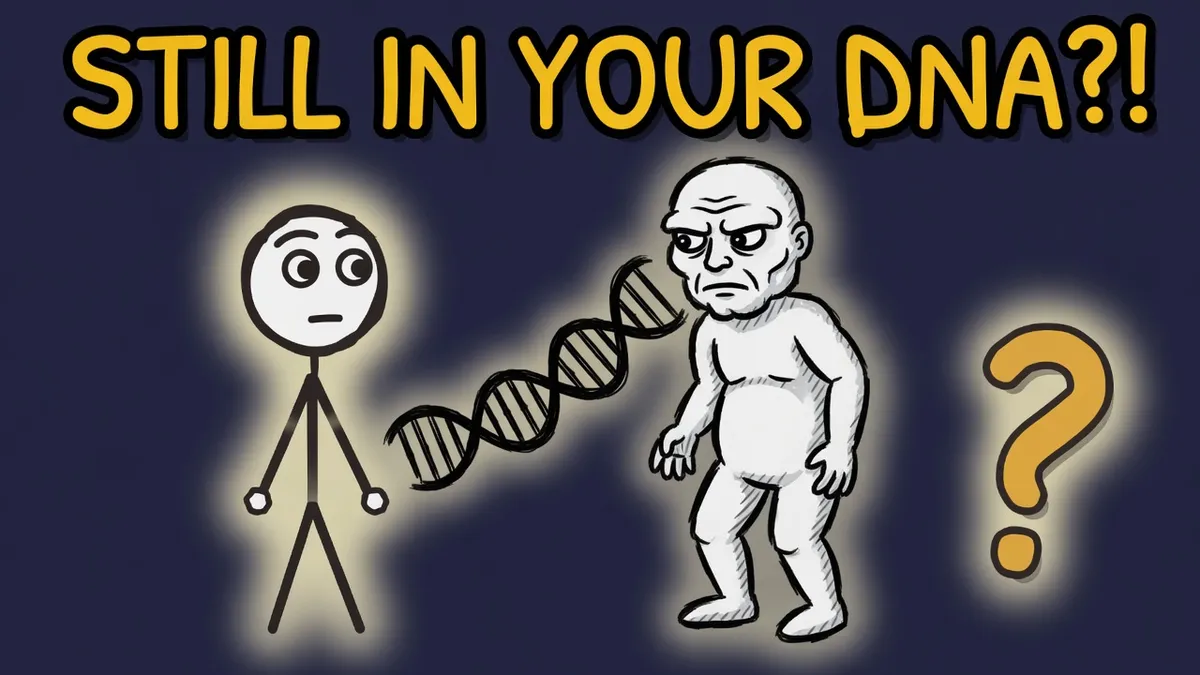
For a long time the Neanderthals had a simple, sad ending. They were the brutish cousins who lost: outcompeted by clever, graceful Homo sapiens, they dwindled and died out around 40,000 years ago, and that was that. It is a tidy story, and it is mostly wrong. The Neanderthals did disappear as a distinct people. But they never fully left. A small, stubborn piece of them is written into the DNA of most people reading this sentence, which raises a strange question: if part of them is still here, did they really vanish at all?
01 · The disappearanceWhat actually happened 40,000 years ago
The basic fact is real. Around 40,000 years ago, Neanderthals stopped appearing in the archaeological record as a recognisable population, with some of the very last groups clinging on in southern Europe. For hundreds of thousands of years they had thrived across Europe and western Asia, making tools, controlling fire, burying their dead. And then, over a span of a few thousand years, they were gone. The disappearance is not in doubt. What is in doubt, and far more interesting, is what “gone” really means.
02 · The DNAA little of them is in you
The turning point came when scientists sequenced the Neanderthal genome and compared it to ours. The result was startling: everyone with ancestry outside sub-Saharan Africa carries roughly 1 to 2 percent Neanderthal DNA. That is not a metaphor. It is a physical inheritance, genes for skin, immunity, and more, handed down from Neanderthal ancestors who interbred with early modern humans. The main mixing began around 50,500 years ago and lasted some 7,000 years. They are, for most of humanity, quite literally family.
03 · The many causesWhy they faded
So why did the distinct Neanderthal population end? Almost certainly not one reason. The likeliest picture is a stack of pressures: they were outnumbered by waves of incoming Homo sapiens, buffeted by an unstable Ice Age climate, and trapped in small, isolated groups where inbreeding sapped their resilience. Add possible new diseases and the slow dilution of their gene pool through interbreeding, and you have a population squeezed from every side. There is little sign of a war or a massacre. Unlike the sudden catastrophe that ended the dinosaurs, this looks less like a defeat and more like a slow fade.
Push the "blended into us" idea to its conclusion and it flips completely. Because there are now roughly 8 billion humans, and most of us carry a little Neanderthal DNA, the total amount of Neanderthal DNA on Earth today is arguably greater than it ever was when actual Neanderthals were alive and there were only a few tens of thousands of them. A species that "went extinct" 40,000 years ago is, in raw genetic terms, more abundant now than at any point in its own existence. Extinction has rarely looked so much like success.
04 · Absorbed, not erasedThe assimilation model
This is where the leading idea comes in: assimilation. Rather than being wiped out, Neanderthals may have been genetically swamped. Picture small numbers of modern humans repeatedly moving into Neanderthal territory over thousands of years, interbreeding each time. With every generation, the much larger Homo sapiens population diluted the Neanderthal signal a little more, until the distinct group simply dissolved into the crowd. It is a leading model, not settled fact, and much of its support comes from genetic simulation. But it fits the evidence better than the old story of a clean extinction.
05 · The seamless handoverWhat a Turkish cave revealed
A 2026 study added a haunting detail. At Ucagizli II Cave in Turkey, researchers traced more than 20,000 years across the Neanderthal-to-modern-human transition and found remarkable continuity: both groups made similar flint tools and hunted the same animals, wild goat, deer, boar. The handover looks culturally seamless, not a sudden rupture. (This is successive occupation of the cave, not proof the two lived there together at the same moment.) It echoes what the DNA already hinted: the boundary between “them” and “us” was blurrier than we imagined. The Denisovans, another vanished cousin whose DNA survives in people today, tell a similar story, as does the deep human record of the very oldest things our ancestors built.
06 · The payoffSo did they vanish, or blend in?
They did both, and that is the honest, stranger answer. As a distinct people, the Neanderthals ended around 40,000 years ago, undone by a slow accumulation of pressures rather than a single catastrophe. But they were never fully erased. They live on, at one or two percent, in the bodies of billions of people, carried forward inside the very species that replaced them. The next time you hear that the Neanderthals died out, you can hold a truer thought: some of them simply became us, and in doing so, quietly outlasted their own extinction.
The animated version
Same answer, told as a little animated story with the strange little stickman acting it out. Dry, quick, and, obviously, correct.
Quick questions
Do humans have Neanderthal DNA?
Yes. Everyone with ancestry outside sub-Saharan Africa carries roughly 1 to 2 percent Neanderthal DNA. It entered our gene pool when Homo sapiens and Neanderthals interbred tens of thousands of years ago, and it is still measurable in your genome today.
Why did Neanderthals go extinct?
There is no single agreed cause. Researchers point to a mix of competition with the larger incoming Homo sapiens population, climate swings, small and inbred populations, possible new diseases, and gradual absorption through interbreeding. Most experts now see it as several pressures stacking up rather than one knockout blow.
Did humans and Neanderthals interbreed?
Yes, repeatedly. The main interbreeding began around 50,500 years ago and lasted roughly 7,000 years, with evidence of earlier contact too. This is exactly why non-African people carry Neanderthal DNA today.
Are Neanderthals our ancestors?
Partly. They are not our main ancestral line, which is Homo sapiens, but for most people outside Africa a small slice of ancestry does trace back to Neanderthals through interbreeding. They are more like a cousin lineage that partly merged into ours.
How much Neanderthal DNA do I have?
If you have non-African ancestry, roughly 1 to 2 percent of your genome is Neanderthal. Any single person carries only a fraction of the total, but across all living humans a large share of the Neanderthal genome survives.
Did Neanderthals really go extinct, or did they blend into us?
Both are true at once. As a distinct population they disappeared about 40,000 years ago, but genetically they partly live on inside us, because their DNA was absorbed into the modern human gene pool through interbreeding.
When did Neanderthals die out?
The last known Neanderthals disappeared around 40,000 years ago, with some of the final populations surviving in southern Europe. Their decline played out over thousands of years, not overnight.
Did humans kill the Neanderthals?
There is little evidence for a deliberate wipeout by violence. Newer research favours quieter explanations: Homo sapiens simply outnumbered them, and interbreeding plus small populations gradually dissolved the Neanderthals into us.
What is the assimilation model of Neanderthal extinction?
It is the idea that Neanderthals were absorbed rather than eliminated. Small numbers of modern humans repeatedly moved into Neanderthal areas and interbred, so over thousands of years the Neanderthal genetic signal was diluted and folded into the larger Homo sapiens population.
Did Neanderthals and modern humans live together?
In some regions they overlapped for thousands of years and clearly interacted. At Ucagizli II Cave in Turkey they used the same cave in succession, with strikingly similar tools and diets, though that is successive occupation rather than proof they lived there side by side.
What did the 2026 Turkish cave discovery reveal?
At Ucagizli II Cave, researchers found more than 20,000 years of cultural continuity across the Neanderthal-to-Homo sapiens handover: both made similar flint tools and hunted the same animals. It suggests the cultural transition was smooth rather than a sudden break.
Are Denisovans the same as Neanderthals?
No, Denisovans are a separate archaic human group, but the story rhymes. Like Neanderthals, they interbred with modern humans, and their DNA lives on today, especially in Melanesians and Aboriginal Australians at around 2 to 4 percent.
Is there more Neanderthal DNA now than when Neanderthals lived?
In a sense, yes. With about 8 billion people alive and most carrying a little Neanderthal DNA, the total amount of Neanderthal DNA on Earth today is arguably greater than when Neanderthals were a living population.
Our sources 6 checked
// every claim on this page was checked before it went up