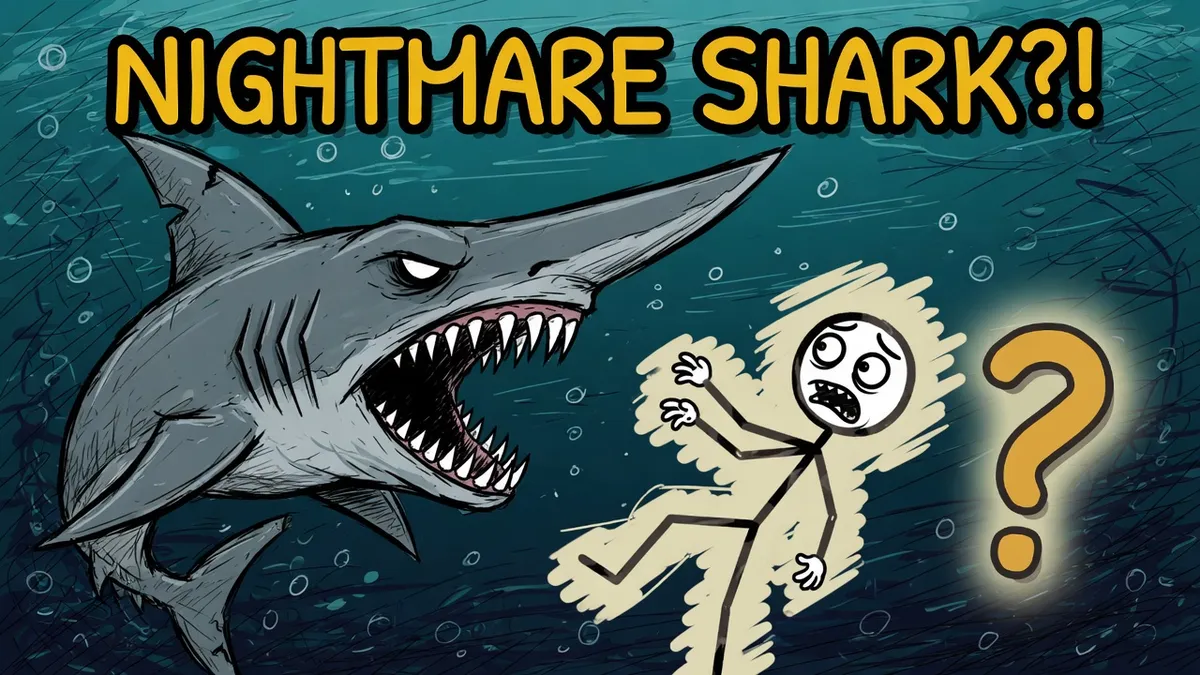
There is a shark that looks like it was designed by a nightmare and then apologised for. Pale pink, soft and flabby, with a long blade of a snout and a mouth full of nail-like teeth, the goblin shark drifts through the deep ocean a kilometre or more below the waves. It is one of the strangest hunters on Earth, and its most famous trick is genuinely unsettling: when it strikes, its whole jaw fires forward out of its face. For almost all of the time we have known it existed, we only ever saw it dead. That just changed.
01 · The living fossil125 million years old
The goblin shark is the last of its line. It is the only surviving member of a shark family, Mitsukurinidae, that stretches back roughly 125 million years, to the age of the dinosaurs. Everything else in its family is extinct, known only from fossils, which is why the goblin shark is called a “living fossil”: a creature carrying an ancient body plan into the present almost unchanged. When you look at one, you are looking at a design that was already old when Tyrannosaurus walked the Earth.
02 · The slingshot jawWhen the mouth leaves the face
Most sharks bite by lunging the whole body forward. The goblin shark does something else. It keeps its mouth folded up under that long snout, and when prey drifts close, it catapults the entire jaw structure outward, at about 3.1 metres per second, the fastest and greatest jaw protrusion ever measured in any shark. A tongue-like muscle then sucks the victim in. It is a real “the mouth leaves the face” mechanic, the sort of thing that looks impossible until you see the slow-motion footage. And it is attached to one of the least threatening bodies in the sea.
03 · The see-through skinWhy it's pink
The goblin shark’s eerie pink is not pigment. Its skin is semi-translucent, so the blood vessels beneath show right through, tinting it pinkish, the way your fingertip glows red against a bright light. Young goblin sharks are nearly ghost-white and darken toward pink as they age. In the lightless deep, colour is almost irrelevant anyway; no sunlight reaches down there to see it by. The pink is simply an accident of thin skin over blood, revealed only when a camera or a fishing net drags one up into a world it was never built for.
Here is the delicious contradiction. That horror-movie slingshot jaw, the fastest strike of any shark, is bolted onto a slow, soft, nearly weightless drifter. The goblin shark has a flabby body and small fins, and it hangs almost motionless in the dark using its oil-rich liver for buoyancy, waiting. It is not a fast, muscular predator like a mako. It is a patient ambusher that saves every scrap of energy, then unleashes one of the most violent feeding mechanisms in the ocean, in a body that has barely changed in 125 million years.
04 · The vanishing actWhy we never see it
The reason the goblin shark feels mythical is simple: it lives where we almost never look. Its home is the deep sea, usually below 100 metres and often around 1,200 metres, along continental slopes, canyons, and seamounts. That is far beyond the reach of divers and sunlight. For most of the time science has known the species, nearly every specimen came from accidental deep-sea catches, hauled up dead or dying, mostly off Japan. We built our whole picture of the animal from corpses, the way we once knew the deep ocean’s strangest sounds only from distant recordings.
05 · Caught on cameraThe 2026 first
Then, in 2026, a University of Hawaii team reported something that had never been confirmed before: live footage of goblin sharks in their natural deep-sea habitat. Two encounters made it happen, one in 2019 near a seamount by Jarvis Island at about 1,237 metres, and one in 2024 in the Tonga Trench at nearly 2,000 metres, the deepest confirmed sighting for the species and a depth record for its whole group of sharks. (Live goblin sharks had been glimpsed before, but only after being caught and brought toward the surface; seeing one alive, at home, in the dark, was the genuine first.)
06 · The payoffSo what is the goblin shark?
It is a survivor, a soft pink relic of the dinosaur age, drifting weightless through the deep with a mouth that can leap out of its face. It is almost never seen alive not because it is nearly extinct, but because its world is one of the hardest places on the planet to reach, so nearly everything we knew came from the few that blundered into our nets. The 2026 footage finally let us watch one simply being itself, a kilometre down in the dark, exactly where it has quietly persisted for a hundred million years. The ocean still keeps most of its oldest residents to itself. Every so often, briefly, it lets us look.
The animated version
Same answer, told as a little animated story with the strange little stickman acting it out. Dry, quick, and, obviously, correct.
Quick questions
What is a goblin shark?
A rare, deep-sea shark (Mitsukurina owstoni) and the only surviving member of a shark family about 125 million years old. It is known for a long flat snout, pinkish translucent skin, and jaws that shoot forward to catch prey.
Why is the goblin shark almost never seen alive?
It lives in the deep sea, usually below 100 metres and often around 1,200 metres, far from divers and light. For most of its known history it was seen only after being accidentally caught by deep-sea fishing gear.
Why is the goblin shark pink?
Its skin is semi-translucent, so the blood vessels underneath show through and make it look pink. The colour is not pigment. Young ones look nearly white and grow pinker with age.
How do goblin sharks catch prey?
They drift almost weightlessly in the dark, then fire their jaws forward like a slingshot in a fraction of a second, using a tongue-like muscle to suck the prey in. The jaws can extend faster than in any other shark measured.
How deep do goblin sharks live?
Usually deeper than 100 metres, with most records around 1,200 metres. In 2024 one was filmed at about 1,997 metres in the Tonga Trench, the deepest confirmed sighting for the species.
Is the goblin shark dangerous to humans?
No. It lives far too deep to encounter swimmers, moves slowly, and has no record of harming people. Its fearsome look comes from its jaws and teeth, not from any threat to humans.
How big do goblin sharks get?
Adults typically reach about 3 to 4 metres (10 to 13 feet), with some reports up to roughly 6 metres. The body is soft and flabby rather than muscular, built for slow drifting.
What does the goblin shark eat?
Fish, squid, and crustaceans. It hunts infrequently and drifts slowly to save energy between meals, ambushing prey with its projectile jaws.
Why is the goblin shark called a living fossil?
It is the sole survivor of the family Mitsukurinidae, a line that goes back about 125 million years, and it keeps many traits of those ancient sharks.
Was the goblin shark really filmed alive for the first time in 2026?
A University of Hawaii team published the first confirmed footage of live goblin sharks in their natural deep-sea habitat, from 2019 and 2024 encounters, in 2026. Earlier live glimpses existed only after animals were caught and brought toward the surface.
How rare is the goblin shark?
It is rarely encountered, but this may reflect how hard the deep sea is to observe rather than truly low numbers. It is listed as Least Concern by the IUCN, though scientists note how little is actually known about it.
What is that long snout for?
The blade-like snout is packed with sensory organs that detect the faint electrical fields of prey in the pitch-black deep, helping the shark find food where there is no light.
Our sources 6 checked
// every claim on this page was checked before it went up