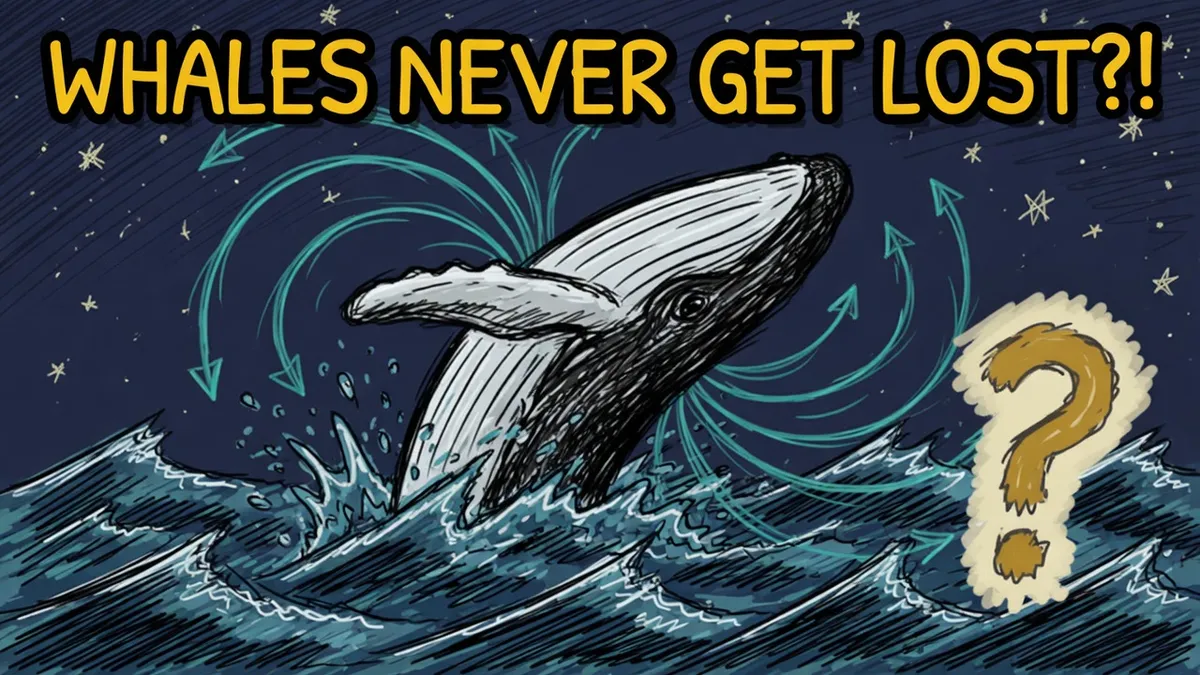
Imagine being dropped into the middle of the ocean with no map, no compass, no landmarks, and told to swim in a dead-straight line to a specific bay thousands of kilometres away. You would drift within an hour. A humpback whale does it routinely, holding its course to within a single degree across open water so featureless it may as well be blank. We can measure that precision with GPS tags and satellite tracks. What we cannot quite do, even now, is explain it.
01 · The journeyOne of the longest on Earth
Humpbacks undertake one of the greatest migrations of any mammal, up to around 8,000 km round trip. They feed through the summer in cold, food-rich polar seas, gorging on krill and small fish, then swim to warm tropical waters to breed and give birth, where newborn calves are safer. Some cover the roughly 4,800 km from Alaska to Hawaii in as little as 28 days. Twice a year, in effect, a creature the size of a bus crosses an ocean, and almost always arrives exactly where it meant to.
02 · The precisionStraighter than a ship
The truly startling part is not the distance but the straightness. When researchers tracked migrating humpbacks in 2011, they found the whales held stretches of 100 to 2,000 km without ever deviating from a constant heading by more than about one degree. One degree. Over hundreds of kilometres of open sea, through currents and storms, with the coastline long gone. A GPS-guided ship would struggle to hold that line. A whale does it with an organ we have not even identified.
03 · The obvious guessesSun and magnetism, and why they fail
The usual suspects for animal navigation are the Sun and Earth’s magnetic field, and whales may well use both. But here is the catch that makes this a genuine mystery. Along a humpback’s route, the Sun’s position shifts by more than 20 degrees, and the magnetic field moves too, with magnetic north changing by as much as 12 percent across a single journey. Yet the whale holds to one degree. No single cue is steady enough to explain that. The Sun alone cannot do it. Magnetism alone cannot do it. Something more is going on.
The honest twist is that we can measure how precisely a whale navigates but not explain it. Their one-degree accuracy holds even though every cue we assume they use drifts by more than twenty degrees along the way. In other words, no compass we know of is steady enough to match a whale. And the 2026 record makes it stranger still: two humpbacks turned up more than 14,000 km apart, on opposite sides of the world, having crossed between Australia and Brazil. Their actual mid-ocean route was never seen. They may not have been heading "home" at all, but swapping destinations entirely after meeting other whales, hinting the map inside them is social and flexible, not simply hardwired.
04 · The likely answerMany cues, working together
The leading idea is that whales do not rely on one cue but combine several, cross-checking the Sun against the magnetic field, perhaps the Moon and stars too, so that the errors in any single one cancel out. The same multi-sense strategy may explain how birds find their way across continents. Layered on top is memory: calves learn the route by following their mothers, and adults return faithfully to the same feeding and breeding grounds year after year. Instinct, sensing, and learning braided together may be what keeps the line so straight. But which cues matter most, and how they are weighed, is still unknown.
05 · The record crossingTwo whales, half a world apart
In 2026 the mystery got a spectacular new data point. Scientists ran more than 19,000 photographs of humpback tail flukes, each as unique as a fingerprint, through a matching program, and found two individuals that had appeared on both sides of the planet: eastern Australia and Brazil, more than 14,000 km apart. It was the greatest distance ever confirmed between sightings of the same humpback, and only about 0.01 percent of tracked whales made such a crossing. Rare, then, but real, and a reminder that these animals routinely do things that stretch the limits of what we thought navigation could achieve.
06 · The payoffSo how do they not get lost?
With something we have not fully worked out. A humpback almost certainly blends the Sun, the magnetic field, perhaps the stars, and a memory of the route passed down from its mother, weaving them into a sense of direction precise enough to hold one degree across an ocean. But the exact recipe remains hidden. It is a humbling thing to admit: an animal we have hunted, filmed, tagged, and studied for decades still crosses the sea by a means we cannot name. The whale is not lost. We are, a little, in trying to follow how it finds its way.

The animated version
Same answer, told as a little animated story with the strange little stickman acting it out. Dry, quick, and, obviously, correct.
Quick questions
How far do humpback whales migrate?
Humpbacks routinely travel up to about 8,000 km round trip between feeding and breeding grounds, one of the longest migrations of any mammal. Some cover the Alaska to Hawaii leg, roughly 4,800 km, in as little as 28 days.
What is the longest humpback whale migration ever recorded?
A 2026 study confirmed a humpback travelling about 15,000 km between Brazil and Australia, the longest distance ever documented between sightings of the same individual. A second whale covered more than 14,000 km.
How do whales navigate across the ocean?
Scientists do not fully know. Whales appear to combine several cues, possibly the Sun, Earth's magnetic field, the Moon and stars, plus routes memorised from their mothers, but no single mechanism explains their precision.
Do whales use Earth's magnetic field to navigate?
It is a leading hypothesis, possibly via magnetite in their tissue, but magnetism alone cannot explain them, because magnetic north shifted by as much as 12 percent along their routes while they held course to within one degree.
Do whales use the Sun or stars to navigate?
Possibly both. Researchers think a combined solar and magnetic system, and maybe the Moon and stars, could be involved, but the Sun alone fails, because whales from one area followed similar headings while seeing the Sun in different positions.
How straight do humpback whales swim?
Astonishingly straight. Tracking showed migration stretches of 100 to 2,000 km in which whales never strayed from a constant heading by more than about one degree.
Why do humpback whales migrate?
They feed in cold, food-rich polar waters in summer, then travel to warm tropical waters to breed and calve, where conditions are safer for newborns.
Do humpback whales get lost?
Very rarely in practice. They hold their heading with better than one-degree precision and show strong site fidelity, returning to the same grounds year after year, though the 2026 record whales may have switched destinations after meeting other whales.
How do baby whales learn to migrate?
Calves typically learn the migration route by following their mothers, so knowledge of the path is passed down across generations.
How do scientists track whale migrations?
They photograph the unique markings on each whale's tail fluke and match individuals over time using image-recognition software. The 2026 study ran more than 19,000 photos through a matching platform to find two record-breaking whales.
How long does humpback whale migration take?
It varies, but some humpbacks complete the roughly 4,800 km Alaska to Hawaii journey in as few as 28 days.
Why can't scientists explain how whales stay on course?
Because the whales' one-degree precision holds even though the Sun's position and the magnetic field shift by more than 20 degrees along the route, which rules out any single guiding cue on its own.
Our sources 6 checked
// every claim on this page was checked before it went up