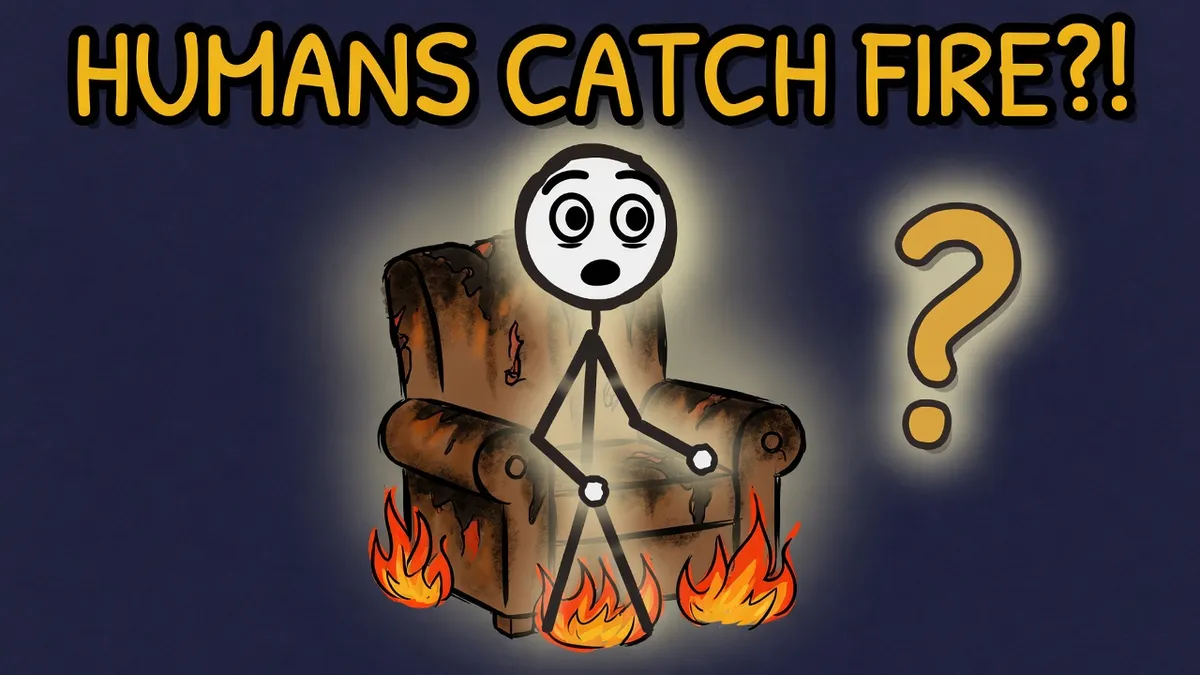
The scene is always eerily the same. An elderly person is found in their home, their body almost entirely reduced to ash, sometimes with just a foot or a lower leg left intact. And yet the room around them is barely touched: the chair a little charred, a nearby television melted, but no sign of the roaring blaze that should have been needed to cremate a human being. For centuries this has fuelled one of the most lurid ideas in the paranormal canon: that some people simply burst into flame from the inside. So is spontaneous human combustion real? The bodies are real. The "spontaneous" part is not, and the truth is grimmer than the myth.
01 · The claimA fire that starts from within
The classic idea of spontaneous human combustion is that a body can ignite on its own, with no external spark, and burn so fiercely and completely that it turns to ash, while somehow leaving the surroundings almost pristine. It’s a genuinely creepy notion, and the cases that inspired it are real events with real, badly burned victims. The question was never whether these people burned. They did. The question is what lit them, and whether it truly came from nowhere. And on that, forensic science has a clear and unglamorous answer.
02 · The real mechanismThe wick effect
The explanation is called the wick effect, and once you understand it, the whole mystery reorganises itself. Think of a candle. A candle is a wick surrounded by wax; the flame melts the wax, the wick draws it up, and it burns steadily for hours. Now run that in reverse with a human body. An external flame chars a person’s clothing and splits the skin. The body’s own fat melts and soaks into the charred cloth, which now acts exactly like a wick, drawing up liquid fat as fuel. The result is a slow, low, self-sustaining fire in which the clothing is the wick and the body’s fat is the wax. A person becomes, horribly, their own candle.
03 · The demonstrationThe pig that proved it
This isn’t armchair theorising. Forensic scientist John DeHaan demonstrated it on camera for the BBC science programme Q.E.D. in 1998. He took a dead pig, whose fat content is close to a human’s, wrapped it in a blanket in a furnished room, and lit it with only a small amount of petrol as the initial spark. It burned for hours, quietly and at high temperature but with low flames, consuming flesh and even bone where the fire sat, while the rest of the room escaped with little damage. His peer-reviewed work put numbers on it: a body can sustain such a fire for around six to seven hours, and the fat-fed flame can reach over 900 degrees Celsius right at the wick, all from a single, tiny, ordinary ignition.
04 · The eerie details explainedWhy it looks impossible
Every “impossible” feature of these cases falls neatly out of the wick effect. Why doesn’t the room burn? Because this is a slow smoulder feeding only on rendered fat, not a spreading blaze; the heat rises and stays concentrated on the body, so objects a metre away barely scorch. Why are the hands and feet often left behind? Because they hold almost no fat, and the wick effect runs on fat, so the fatty torso is consumed while the lean extremities survive. And why is so much of the body gone? Because six or seven hours of steady combustion is more than enough to destroy flesh and bone. What looks like the aftermath of a supernatural firestorm is really the aftermath of a very small fire, left to burn a very long time.
So why do these cases ever look "spontaneous"? Because the fire destroys its own alibi. The typical victim fits a quiet, sad profile: elderly, often immobile or sedated, frequently a smoker, sitting alone near a heat source. A dropped cigarette or an ember lands on their clothing, they're too frail or too drugged to react, and the wick effect does the rest over the following hours. By the time anyone finds them, the cigarette, the match, the whole trigger, has burned away along with everything else. The evidence of an ordinary cause is consumed by the very fire it started. The mystery isn't that there's no ignition source. It's that the ignition source is always the first thing to go.
05 · The famous caseThe cinder lady
The most cited case is Mary Reeser, a 67-year-old widow found in St. Petersburg, Florida, in 1951, reduced almost entirely to ash in her apartment, which earned her the grim nickname “the cinder lady.” For decades she was Exhibit A for spontaneous combustion. But the actual investigation, which reached as far as the FBI, concluded something far more ordinary and far sadder: she was a smoker who had taken sleeping pills, most likely dozed off in her chair with a lit cigarette, and was slowly consumed by the wick effect through the night. Every genuinely mysterious-sounding case that has been properly examined has told a version of the same story.
06 · The payoffSo is spontaneous human combustion real?
No, not the way the legend tells it. Nobody ignites from within. There is no inner fire, no unexplained energy, no exception to the laws of chemistry. What’s real is the wick effect: a small, mundane flame meeting a vulnerable person, and the human body’s own fat turning it into a slow-burning candle that can consume almost everything over the course of a night while a room stays cool enough not to catch. That’s the strange, quiet horror at the centre of one of the paranormal’s favourite mysteries. The flames were never spontaneous. They were just patient, and they burned away the proof.
The animated version
Same answer, told as a little animated story with the strange little stickman acting it out. Dry, quick, and, obviously, correct.
Quick questions
Is spontaneous human combustion real?
No, not in the literal sense of a body igniting from within with no outside spark. Mainstream forensic science finds every well-documented case is consistent with an ordinary external ignition source, such as a cigarette or heater, that is later destroyed in the fire. What people call spontaneous human combustion is best explained by the wick effect.
What is the wick effect?
The wick effect is when a body burns like an inside-out candle. Clothing or upholstery soaks up melted body fat and acts as the wick, while the fat itself is the fuel. A small external flame starts it, and the body can then burn slowly for hours.
Can a human body really burn to ash?
Yes. Forensic experiments show a fat-fed wick fire can sustain itself for six to seven hours and destroy flesh and even bone in the fatty torso. It is slow and localised rather than a fast blaze, which is exactly why it can be so complete.
Why don't the surroundings burn?
Because the fire is small, low and fuel-limited. It feeds only on fat wicking through cloth, not on the whole room, so intense heat stays concentrated on the body. Objects a foot or two away typically suffer only superficial scorching.
Has spontaneous human combustion ever been proven?
No. No case has ever demonstrated ignition without an external source, and no internal mechanism has held up to testing. Laboratory experiments, by contrast, have repeatedly reproduced the wick effect, so the ordinary explanation is the proven one.
What causes a body to catch fire?
An external ignition source: a dropped cigarette, a candle, a heater, an electrical spark or an open flame. It chars the clothing and splits the skin, releasing fat that soaks into the cloth and sustains the fire. The body does not ignite itself.
Who demonstrated the wick effect scientifically?
Forensic scientist Dr John DeHaan demonstrated it on the BBC programme Q.E.D. in 1998 using a blanket-wrapped pig, and published supporting research in Science and Justice in 1999. His work showed fat-fed combustion needs both preheating and a cellulose wick like clothing or upholstery.
Why do the hands and feet often survive?
Because they hold very little fat. The wick effect needs subcutaneous fat as fuel, so the fatty torso is consumed most completely while the low-fat extremities and head are often left behind. This uneven pattern is one of the eeriest features of these cases.
What kind of person is usually a victim?
Cases skew strongly towards the elderly, infirm or immobile, often people who are alone, frequently smokers, and sometimes affected by alcohol or sedatives. This profile explains both the ignition, such as a dropped cigarette, and why the person could not escape.
Who was Mary Reeser?
Mary Reeser was a 67-year-old widow in St. Petersburg, Florida, found largely incinerated in 1951 and dubbed the 'cinder lady'. The FBI concluded she fell unconscious while smoking, having taken sleeping pills, and was consumed by the wick effect. It is the most famous supposed case.
How hot does a wick-effect fire get?
Very hot at the body itself, but contained. In DeHaan's peer-reviewed experiments, cotton-wrapped fat reached a maximum flame temperature of around 911 degrees Celsius on a handheld probe, yet the wider room stayed far cooler. Intense local heat plus low spread is the signature.
Can alcohol in the body make someone combust?
No. Drinking alcohol does not soak the body's tissues in a flammable way, and there is no evidence it enables self-ignition. Alcohol matters only indirectly: an intoxicated or sedated person is less able to react to or escape an accidental ignition.
Our sources 7 checked
// every claim on this page was checked before it went up