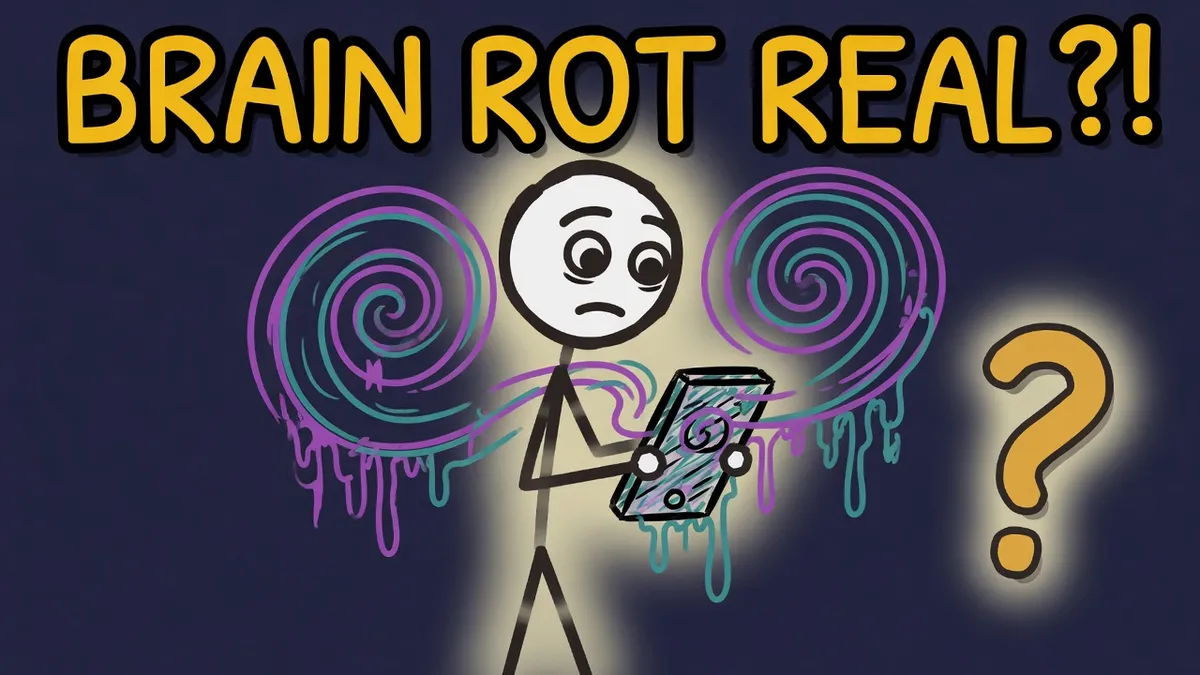
You know the feeling. An hour vanishes into a feed, you cannot remember a single thing you saw, and your attention feels sanded down to nothing. There is a word for it now, "brain rot", and in 2024 it was crowned Oxford's Word of the Year. It certainly feels real. But is it? Are your devices actually rotting your brain, or is something subtler going on, something more reversible, and a good deal older, than the panic suggests? The honest answer is calmer than the headlines, and more interesting.
01 · The wordSlang, not a diagnosis
Start with what “brain rot” actually is: a cultural phrase, not a medical one. It became Oxford University Press’s Word of the Year in 2024, its usage up 230 percent in a year, defined loosely as the mental deterioration supposedly caused by consuming too much trivial online content. But no doctor can diagnose you with brain rot, because it is not a recognised condition. It is a vivid, self-aware bit of internet slang for a feeling, which is a very different thing from a disease. Keeping that distinction clear is the whole key to the question.
02 · The pull of the feedWhy you can't stop
The feeling is real even if the diagnosis is not, and a big reason is design. Short-form feeds run on variable rewards: you never know whether the next clip will be boring or brilliant, so your brain keeps you swiping in search of the payoff. It is the exact principle that makes a slot machine hard to walk away from, unpredictable rewards are far more compelling than predictable ones. This is worth saying plainly: struggling to put the phone down is not a character flaw. It is the intended result of products engineered to hold your attention.
03 · The attention questionWhat actually shrinks
So what does all that scrolling do? The most cited finding is that our attention on screens has dropped sharply, from an average of about two and a half minutes on a single screen in 2004 to around 47 seconds by 2016. Heavy social media use, in particular, is linked to small increases in inattention. But read that carefully: it measures how we behave on our devices, not a permanent shrinking of the brain’s capacity to focus. You have trained yourself to switch tasks quickly. That is a habit, and like a habit similar to how quickly we forget a new name, it says more about attention in the moment than about damage.
The phrase everyone treats as a brand-new symptom of the smartphone age is actually a 170-year-old complaint. Henry David Thoreau coined "brain rot" in his 1854 book Walden, grumbling that people preferred easy ideas to hard ones, long before phones, television, or even radio. Every generation since has been sure a new medium was rotting minds: novels, comics, and TV all got the exact same treatment. And here is the sharper twist: the science does not show phones physically rotting your brain. It shows your brain doing what it always does, adapting to whatever you feed it, which also means it can adapt right back. "Brain rot" is less a disease than a mirror.
04 · The honest caveatsCorrelation, not doom
Because the topic invites panic, the caveats matter. Most of the alarming-sounding findings are correlations: heavy use is associated with poorer attention and mood, but association does not prove the phone caused it, and people who already struggle to focus may simply scroll more. The effect sizes are consistently described as small. Even the famous “blue light ruins your sleep” claim is overstated, blue light delays sleep by under three minutes on average, and the real culprit is gripping content keeping you up. The truthful picture is concern, not catastrophe.
05 · The doomscrollWhere the harm is clearer
One effect is better supported: doomscrolling, compulsively working through a stream of bad news, can genuinely raise stress and anxiety by keeping your brain’s threat-detection system switched on. This is less about attention and more about mood, and it is one place the research points fairly clearly. It is also the most actionable: because the harm comes from the content and the compulsion, stepping away tends to help quickly, which is a hint about how fixable the whole business really is.
06 · The payoffSo is brain rot real?
Real as a feeling and a cultural word, yes. Real as a medical condition your phone inflicts on your brain, no. What the evidence actually shows is that heavy scrolling trains your attention toward quick switching and can sour your mood, mostly in small, correlational ways, and that your brain, being endlessly adaptable, can be trained back with less scrolling and more slow, deep focus. The most reassuring fact in the whole debate is the oldest one: people have feared new media rotting their minds for over a century, and minds have kept working. “Brain rot” is not something being done to you. It is a habit, and habits can change.
The animated version
Same answer, told as a little animated story with the strange little stickman acting it out. Dry, quick, and, obviously, correct.
Quick questions
Is brain rot real?
'Brain rot' is a real, popular term (Oxford's 2024 Word of the Year), but it is not a real medical diagnosis. What it points at, the effects of overconsuming low-quality online content, is a genuine area of research. So the phenomenon people describe is real enough to study, even though 'brain rot' itself is slang, not science.
What does endless scrolling do to your brain?
Scrolling repeatedly triggers your brain's reward system with small, unpredictable hits of novelty, which trains you to keep seeking the next one. Over time, heavy use is linked to poorer sustained attention and, for doomscrolling, higher stress. These are mostly correlations, and your brain can adapt back with different habits.
Does social media shorten your attention span?
Research shows attention on screens has dropped sharply, and social media use specifically is linked to small increases in inattention. But this reflects trained behaviour on devices more than a permanent shrinking of your brain's capacity to focus.
What is popcorn brain?
'Popcorn brain', a term from researcher David Levy in 2011, describes a mind so used to constant fast stimulation that slower offline life feels difficult and boring. It is a helpful metaphor, not a clinical disorder, and it tends to flare up most during heavy scrolling.
How do I fix brain rot?
There is nothing to 'cure', because it is not a disease, but you can retrain your attention. Reducing short-form scrolling, taking regular device breaks, and practising longer-focus activities like reading are shown to help, often within weeks, because the brain rewires with new habits.
Is brain rot a medical condition?
No. No medical body recognises 'brain rot' as a diagnosis. It is an informal cultural phrase. The underlying concerns, attention, mood, and sleep effects of heavy screen use, are studied, but 'brain rot' is not something a doctor diagnoses.
Does scrolling actually damage your brain?
There is no solid evidence that scrolling physically 'rots' or destroys brain tissue. Some studies link heavy screen use to differences in attention, but these are associations, small in size, and cannot prove the phone caused them. Your brain adapts to what you do, and it can adapt back.
Why can't I stop scrolling?
Short-video feeds use a variable-reward design: you never know if the next clip will be great, so your brain keeps you swiping in search of the payoff. This is the same principle that makes slot machines compelling. It is a designed feature of the apps, not a personal failing.
Does phone use before bed ruin your sleep?
Partly, but not mainly because of blue light, which research suggests delays sleep by under three minutes on average. The bigger issue is that engaging or upsetting content keeps your mind active and pushes your bedtime later. The behaviour matters more than the light.
What is doomscrolling and is it bad for you?
Doomscrolling is compulsively reading a stream of negative news. Harvard Health notes it can raise anxiety and stress by keeping your brain's threat system switched on. It is linked to worse mood, which is why stepping away often helps you feel calmer.
Are the effects of too much screen time permanent?
Most evidence suggests they are not. Because of neuroplasticity, the brain keeps rewiring throughout life, so attention and habits can recover with reduced use and focus practice, often over a few weeks. The changes reflect adaptation, not permanent damage.
Is short-form video worse than other screen time?
Some evidence hints yes. Social media and rapid short-form feeds are more strongly linked to inattention than TV or video games in large studies, likely because of the constant stream of new, bite-sized rewards. But the effect sizes are small and the research is still developing.
Where does the phrase 'brain rot' come from?
It is over 170 years old. Henry David Thoreau used it in Walden in 1854 to criticise society for preferring simple ideas over complex ones. It resurfaced online among younger generations and became Oxford's 2024 Word of the Year.
Our sources 6 checked
// every claim on this page was checked before it went up