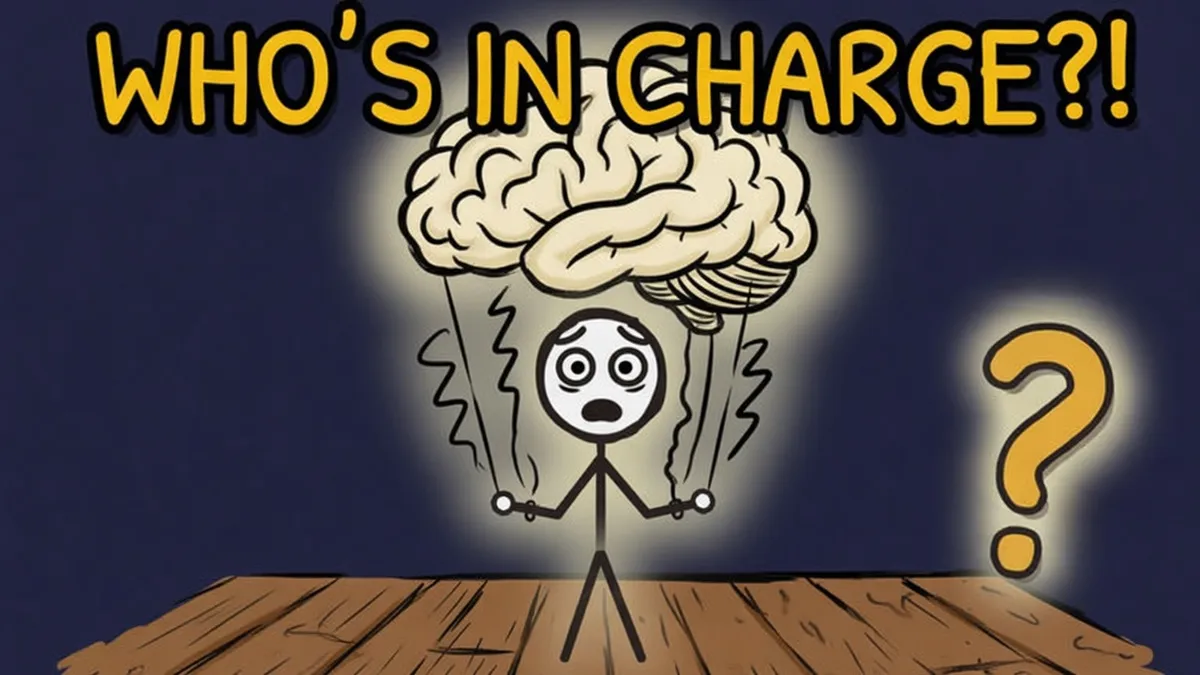
Raise your hand whenever you feel like it. Right now. Did you decide to do it, or did your brain decide, and then let "you" feel like you chose? It sounds like a philosopher's word game, but for forty years it has been a real experiment, and its results have been used to declare that free will is an illusion, that your brain commits to actions before you are even aware of choosing them. It is one of the most unsettling claims in all of science. It is also, on closer inspection, far shakier than the headlines admit.
01 · The famous experimentThe brain jumps first
The story starts with neuroscientist Benjamin Libet in the 1980s. He asked people to flex a wrist whenever they felt like it, while watching a fast clock to mark the exact moment they became aware of the urge to move. The startling result: a brain signal called the readiness potential began rising about 550 milliseconds before the movement, but people reported the conscious urge only about 200 milliseconds before. The brain, it seemed, got a roughly 350-millisecond head start on the conscious mind. The action was already brewing before “you” knew you wanted it.
02 · The prediction machineSeconds in advance
Decades later, brain scanners raised the stakes. In a 2008 study, researchers watched people freely choose to press a left or right button, and found they could predict the choice from brain activity up to seven to ten seconds before the person reported deciding. Seven seconds is an eternity in the brain. Taken at face value, it sounds devastating for free will: your decision was apparently sitting in your neurons long before you experienced making it. This is the finding that launched a thousand “free will is dead” articles.
03 · The first crackA coin flip in disguise
But look closer at that prediction and it wobbles. The 2008 study could guess the upcoming choice with about 60 percent accuracy. Sixty percent. A coin flip is fifty. So the brain was not revealing a locked-in decision waiting to happen; it was revealing a slight bias, a faint lean toward one button, barely better than chance. That is a very different claim from “your future is written.” Unconscious tendencies nudging a trivial choice is real and interesting, but it is not the same as your brain having already made up its mind for you.
Now the twist that undercuts the whole story. In 2012, neuroscientist Aaron Schurger argued that the readiness potential, the smoking gun in every "free will is dead" headline, may not be a decision at all. It may be largely random neural noise. His model: spontaneous brain activity drifts up and down on its own, and a movement is triggered when that noise happens to cross a threshold. Line up thousands of trials by the moment of movement and average them, and that random noise gets smoothed into what looks like a deliberate ramp of preparation, a ramp that was never really there. The evidence everyone cited to bury free will may be a statistical mirage.
04 · The choices that matterWhen the signal disappears
There is a second, even sharper problem. Nearly all of these experiments used meaningless choices: flick a finger, press left or right, for no reason at all. But the choices we actually care about, the ones the free-will debate is really about, are deliberate and consequential. In a 2019 study, researchers gave people a choice that genuinely mattered, deciding which cause received a real 1,000-dollar donation, and found the readiness potential vanished. The pre-decision brain signal showed up for arbitrary flicks but not for meaningful decisions. The one experiment used to say you are not in charge may only describe the emptiest choices you ever make.
05 · What the philosophers sayFree will was never so simple
Even if the neuroscience were airtight, it would not settle the question, because “free will” means different things. Some hold to hard determinism: everything is caused, so free will is an illusion. Others are compatibilists, the most common view among philosophers, arguing that free will and a physical, caused brain are perfectly compatible, so long as “free” means acting from your own reasons without being coerced. On that view, unconscious brain activity preceding a choice is not a threat at all: it is just what choosing, in a physical brain, looks like from the inside. The same uncertainty haunts everyday puzzles of self-control, like why we procrastinate against our own intentions.
06 · The payoffSo does your brain decide before you do?
For trivial finger flicks, brain activity does precede the felt urge, and that is genuinely strange. But the strong claim, that your brain secretly makes your decisions and consciousness just watches, rests on shaky ground: the key signal may be noise, the prediction is barely above chance, and the effect seems to vanish the moment a choice actually matters. Newer work even suggests decisions are spread across the brain rather than made in a single instant. The honest answer is that this is an open, actively argued question, not a solved one. Free will has not been disproven. If anything, the experiment that supposedly killed it may have been reading meaning into static.
The animated version
Same answer, told as a little animated story with the strange little stickman acting it out. Dry, quick, and, obviously, correct.
Quick questions
Does your brain decide before you do?
For simple, arbitrary actions like a finger flick, brain activity does ramp up before people report a conscious urge, which Libet measured at about 350 milliseconds. But newer work argues that early activity may be random neural noise rather than a finished decision, and it may not apply to meaningful choices at all. So the honest answer is: sometimes, for trivial actions, maybe, and it is still debated.
What was the Libet experiment?
In the 1980s Benjamin Libet had people flex a wrist whenever they wished while watching a fast clock to mark the moment they felt the urge. EEG showed a 'readiness potential' building before movement, while the conscious urge came later, a roughly 350 millisecond head start for the brain. It became one of the most argued-about experiments in neuroscience.
What is the readiness potential?
It is a slow rise in electrical brain activity that appears before a voluntary movement. Libet treated it as the brain preparing to act before you are aware of deciding. Later researchers argue it may instead be ordinary fluctuating neural noise that only looks like smooth 'preparation' once you average many trials together.
Can the brain predict your decisions before you know them?
In a 2008 fMRI study, researchers predicted which button people would press up to several seconds before they reported deciding. But accuracy was only around 60 percent, barely better than a coin flip, so the brain revealed a weak bias, not a locked-in choice.
Do we have free will?
Neuroscience has not settled this, and it may not be a question a single experiment can settle. The famous studies used trivial choices, their main evidence has a strong 'it is just noise' counter-explanation, and philosophers disagree on what 'free will' even requires. Many thinkers hold that free will and a physical brain are compatible.
Did the Libet experiment disprove free will?
No. Even Libet did not think so, and he proposed a conscious 'veto' power over the initiated action. Later reinterpretations of his core signal, plus findings that the effect disappears for meaningful choices, have weakened the anti-free-will reading considerably.
What did the 2008 fMRI study actually show?
It showed that patterns in certain brain regions carried a weak, decodable bias toward the upcoming choice several seconds ahead. It demonstrated unconscious influences on simple decisions, not that your future was fully written seconds in advance.
Is the readiness potential just random brain noise?
That is an influential 2012 argument. The 'stochastic accumulator' model says spontaneous fluctuations drift up and down, and movement happens when they cross a threshold, so the pre-movement ramp is a statistical artifact of averaging rather than a pre-made decision. It is the most-cited rebuttal of the standard Libet interpretation.
Does this apply to big life decisions or just finger movements?
Almost all of this research used trivial, in-the-moment actions like flicking a finger. A 2019 study found that when a choice actually mattered, deciding a real donation, the readiness potential did not appear, suggesting deliberate decisions may not work like the finger-flick studies at all.
What is compatibilism?
Compatibilism is the view that free will and determinism can both be true. It defines 'free' not as being uncaused, but as acting from your own reasons and desires without external coercion. It is the most common position among professional philosophers today.
What is Libet's 'free won't'?
Libet noticed that even after the readiness potential began, participants could still stop the movement. He proposed that consciousness might not initiate actions but could veto them in the final fraction of a second, a power sometimes nicknamed 'free won't'.
Has recent research changed the picture?
Yes, in two directions. Reinterpretations since 2012 have weakened the claim that the brain decides before you are aware. Meanwhile a 2026 study suggests decision-related signals start even earlier and more spread out across the brain than thought, reframing decisions as distributed processes rather than single moments.
Our sources 6 checked
// every claim on this page was checked before it went up