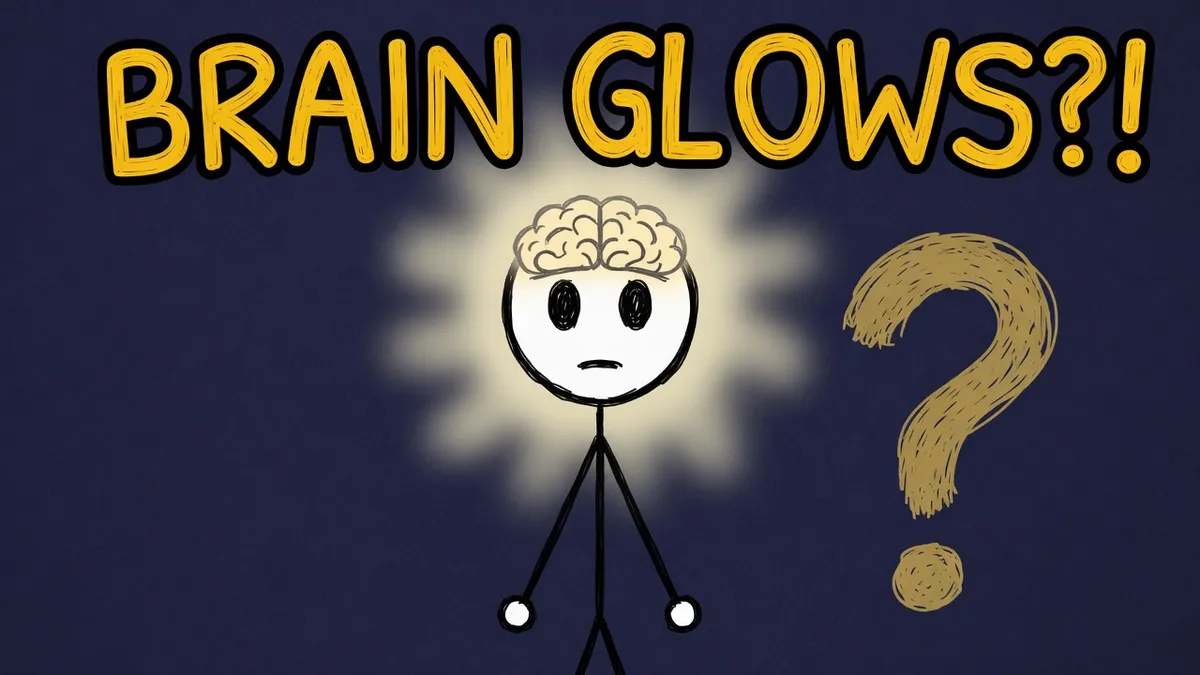
Here is a sentence that sounds like it belongs in a pamphlet you'd politely decline on the street, and is nevertheless true: right now, in total darkness, you are giving off light. Not warmth, actual photons, particles of visible light, trickling out of your skin as you sit there reading this. It's called ultraweak photon emission, and it isn't fringe science. What is new, and genuinely contested, is a 2025 claim that scientists managed to catch this glow coming off the living human brain, and the idea that it might, one day, be worth reading.
01 · The strange factYou are, faintly, glowing
Let’s start with the part that’s actually settled, because it’s odd enough on its own. Every living thing examined, bacteria, plants, mice, you, emits a faint stream of real photons. The phenomenon was first proposed by a Russian biologist, Alexander Gurwitsch, back in the 1920s, dismissed for decades, and then confirmed for real in the 1950s once instruments got sensitive enough to count light one photon at a time. By the 1970s the biophysicist Fritz-Albert Popp had given it the name that stuck: biophotons.
So this isn’t a metaphor and it isn’t body heat. It’s genuine light, in the visible-to-near-infrared range, leaking out of you continuously. Researchers have even photographed it coming off human skin with special single-photon cameras, and found it rises and falls on a daily rhythm.
02 · The mechanismYour cells are, technically, smouldering
Where does it come from? Metabolism. As your cells burn fuel to make energy, the oxygen chemistry involved throws off reactive molecules that leave other molecules briefly excited, bumped up to a higher energy state. When they settle back down, they shed that extra energy as a single photon. It is, in the faintest imaginable sense, the same reason a fire gives off light as it burns: chemiluminescence, scaled down to almost nothing. Your whole body is very quietly, very coldly, smouldering.
03 · Too faint to seeA thousand times below your own threshold
And I do mean almost nothing. This glow is roughly a thousand times fainter than the dimmest light your eye can register, somewhere on the order of tens to a few thousand photons per square centimetre each second. Step into any daylight, any lamplight, even moonlight, and it’s instantly and hopelessly drowned out. To detect it at all, you need a completely sealed, pitch-black room and instruments built to count photons individually. Which is exactly why you’ve spent your whole life glowing and never once noticed.
04 · The brainThe 2025 claim, and why it's contested
Now, your brain is one of the hungriest organs you’ve got, quietly burning through about a fifth of all your energy despite weighing next to nothing. More metabolism, in principle, means more of this faint chemical light. So the tantalising question a few researchers asked was: if we sat someone in a perfectly dark room and pointed the most sensitive detectors we have at their head, could we catch the brain’s own glow leaking out through bone and skin?
In 2025, a team published exactly that claim in the journal iScience. Using photomultiplier tubes trained on the head, they reported picking up emission that wasn’t just flat background: it had more variability and complexity, it shifted from task to task, and it correlated, moderately, with the brainwave signals recorded at the same time. They gave the idea a name to match the ambition: photoencephalography. A brain scan made of nothing but light.
Here’s where I have to be honest, though, because the accuracy is the whole point. That claim is already under serious fire. In 2026, a separate group published a pointed critique arguing two things: first, that under properly dark conditions the light from a head is far weaker than those studies reported, so the measured signal is likely dominated by stray background light; and second, more damningly, that the detectors used are tuned to wavelengths that can’t realistically pass through the scalp and skull in the first place. The wavelengths that can get through, red and near-infrared, are the ones those instruments are worst at seeing. Their conclusion: even if a head does emit detectable light, it’s probably coming from the scalp, not the brain.
So this isn't a story about a discovery that's in the textbooks. It's a story about the raw, unfinished edge of science: one team says they caught the brain glowing, another says the glow is mostly the room and the scalp. Both papers are real. Nobody yet knows who's right.
05 · The wild questionExhaust, or a signal?
Set the measurement dispute aside for a second, and there’s a deeper, wilder question underneath all of this, one that applies to biophotons in general, not just the brain. Is this light simply exhaust? Meaningless waste heat’s optical cousin, thrown off by a busy engine and signifying nothing? Or, and this is the genuinely science-fiction possibility, could a cell, or a neuron, actually use it? Could the brain be signalling not only with electricity and chemistry, but with tiny private flashes of light?
I want to be very clear here, because this is where people overreach. That second idea is speculative and unproven. The mainstream view leans firmly the other way: biophotons are a byproduct. Perhaps, one day, a useful thing to read, a window onto metabolism or brain state, but not a language the body speaks. Anyone who tells you neurons “definitely communicate with light” has sprinted miles past the evidence.
06 · The payoffSo did they catch your brain glowing?
Here’s the honest, complete answer. The glow itself is real and old news: every living cell emits ultraweak light, and we’ve known it for the better part of a century. The brain-specific claim, that we caught that glow leaking out of a living human skull and could one day read it like an EEG, is a 2025 headline that’s genuinely exciting and genuinely disputed, with a 2026 rebuttal arguing the signal is mostly background and scalp. And the wildest idea, that the light might be part of how you think, remains pure speculation that most scientists don’t buy.
Which leaves you with the one thing that’s unambiguously true. There is a faint light on inside you, inside every cell, brain included, that you will never see with your own eyes, that we only recently built machines delicate enough to detect, and whose full meaning we honestly haven’t settled. So the next time someone says the lights are on but nobody’s home, you can, with a clear conscience, tell them the first half is literally correct. The lights are always on. We’re just still arguing about what they’re doing there.

The animated version
Same answer, told as a little animated story with the strange little stickman acting it out. Dry, quick, and, obviously, correct.
Quick questions
Does the human body really emit light?
Yes, genuinely. It's called ultraweak photon emission, and it's been imaged from human skin with single-photon cameras. It comes from ordinary oxidative chemistry inside cells, and it's about a thousand times too faint for the eye to see, so you'll never notice it. This part isn't fringe science; it's been established since the mid-20th century.
Did scientists actually measure the brain glowing in 2025?
One study (Casey et al., iScience, 2025) reported detecting ultraweak photon emission from outside people's heads that differed from background and shifted with tasks. But a 2026 preprint pushed back hard, arguing the detectors used can't really see the wavelengths that pass through skull, and that the signal is mostly background light and emission from the scalp, not the brain itself. So treat "we measured the brain glowing" as an intriguing claim under active dispute, not a settled fact.
What causes biophotons?
Metabolism. As cells burn fuel, reactive oxygen species react with molecules and leave them briefly in an excited state; when they settle back down, they shed the extra energy as a single photon. It's a faint, chemical cousin of the light a fire gives off, chemiluminescence, on an almost unimaginably small scale.
Can neurons signal with light?
That's the wild, speculative idea, and it's unproven. There's lab work on whether light could play a role in cells, but most scientists treat brain UPE as metabolic exhaust: at best a signal you could read, not one the brain uses. Don't believe anyone who states the light-signalling idea as fact.
What is photoencephalography?
A proposed name, coined in the 2025 study, for reading the brain's faint light the way an EEG reads its electricity. It's an idea and an ambition, not an established tool, and it depends entirely on whether the head signal really comes from the brain, which is exactly what's in dispute.
What exactly are biophotons?
Biophotons are individual particles of light, real photons, spontaneously emitted by living cells as a byproduct of ordinary chemistry. The biophysicist Fritz-Albert Popp coined the term in the 1970s; scientists more often call the phenomenon ultraweak photon emission. Crucially, they are not bioluminescence (the bright, purpose-built glow of a firefly) and not body heat, just a faint, incidental leak of light, roughly a thousand times too dim to see.
Do all living cells emit light?
As far as anyone has measured, yes. Ultraweak photon emission has been detected from bacteria, yeast, plants, animals and human tissue, which is why it's often described as a universal property of living systems. The rate is tiny, on the order of 1 to 1,000 photons per square centimetre per second, and it tends to rise and fall with how metabolically busy a tissue is.
Is biophoton emission actually proven, or is it fringe science?
The emission itself is solidly real: it's been measured with photon-counting detectors since the 1950s and imaged from human skin. What's contested is what people claim about it. Popp's stronger ideas, especially that biophotons are 'coherent' like a laser and carry biological information, were criticised for lack of rigour and remain unproven. So the glow is real; the grander interpretations of it are not.
Can you see your own glow, or your brain's, with the naked eye?
No, and you never will. The emission is roughly a thousand times fainter than the dimmest light your eye can register, so it sits far below your own visual threshold even in the dark, and any trace of ambient light drowns it entirely. Detecting it at all takes a sealed, pitch-black room and instruments built to count photons one at a time.
What colour or wavelength is the light?
It isn't one colour: the emission spans a broad band from the ultraviolet through visible light into the near-infrared (very roughly 200 to 950 nm, with human-skin measurements often landing in the 300 to 650 nm range). That detail matters to the brain dispute: the wavelengths most able to escape through skull and scalp are the red and near-infrared ones, which happen to be the ones the 2025 detectors were worst at seeing.
Does being stressed or unwell change how much light you give off?
At the cellular level, it appears to. Because the glow comes from oxidative chemistry, ultraweak photon emission tends to rise with oxidative stress: it increases, for instance, in UV-damaged human skin and has been imaged increasing around implanted tumours in mice, so researchers are exploring it as a non-invasive marker of oxidative-stress-related conditions. Treat that as a promising research direction rather than a proven clinical test; it's early days.
Are biophotons the same thing as a human 'aura'?
No, and this is where a real phenomenon gets hijacked by a fake one. Biophotons are the faint optical residue of cell metabolism; auras, and the Kirlian photographs sometimes sold as proof of them, have never held up as evidence of any 'life force' or emotional field. Researchers working on ultraweak photon emission are explicit that it should not be read as support for aura claims. Same word 'glow', completely different thing.
Take the quiz on this
A quick 4-question check on what you just read. Get them right to earn XP: no points for just scrolling.
Our sources 14 checked
// every claim on this page was checked before it went up