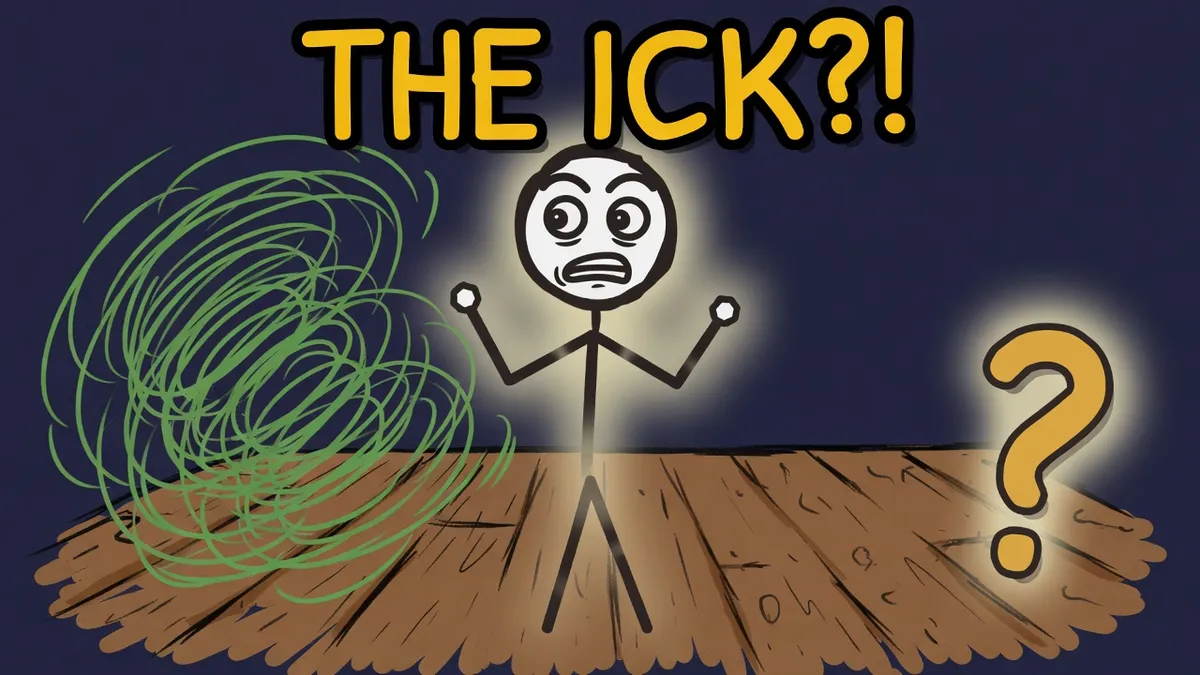
You are on a good date. It is going well. Then they laugh a certain way, or chase a bus, or say a word oddly, and something inside you slams shut. In an instant, attraction curdles into a low, physical disgust, and you cannot un-feel it. This is "the ick", and until recently it was pure internet folklore, a word for a feeling everyone recognised but no one had studied. Now it has real research behind it, and the likeliest explanation is stranger than pickiness: it may be one of your oldest survival instincts, going off over nothing.
01 · Naming the feelingFrom meme to measurement
The ick began as slang, a viral shorthand for that sudden turnoff, before scientists caught up. In 2025 the first peer-reviewed study put numbers to it, and the numbers were striking: about 64 percent of the people surveyed had felt the ick, on average around six times. It is not a rare quirk; it is a near-universal experience with a memorable name. What the researchers wanted to know was not whether it happens, but what it is, where a feeling this common and this sudden actually comes from.
02 · The triggerAlways something tiny
The defining feature of the ick is how small the trigger is. It is almost never a genuine red flag like cruelty or dishonesty. It is a mannerism, an item of clothing, a phrase, a way of eating or walking, something trivial that should not matter at all, and yet it detonates. The common triggers people reported were awkward clothing, annoying speech patterns, embarrassing public behaviour, and social-media obsession. The mismatch is the whole puzzle: an enormous emotional reaction, out of all proportion, sparked by something that means almost nothing.
03 · Who feels it mostThe personality clues
The study found the ick is not random; it tracks with personality. People higher in disgust sensitivity, those who recoil more easily in general, felt it more. So did people high in “other-oriented perfectionism”, meaning they hold very high standards for other people; that was the single strongest predictor. Narcissism was linked to more frequent icks too. In other words, the ick tends to visit people primed to find fault and quick to be repelled. That is a clue not just about who feels it, but about what the feeling really is underneath.
Disgust is one of your oldest survival tools. It evolved to keep our ancestors away from rotting food, disease, and mates whose visible cues suggested poor health or low survival odds. The twist: the ick may be that same ancient alarm system misfiring in modern dating. The machinery built to flag genuine biological threats can now trip over something completely trivial, the way a date holds a fork, a laugh, chasing a bus, and deliver the same gut-level "get away" verdict. The ick can feel like deep intuition while actually being a Stone Age smoke detector going off because someone made toast.
04 · The ancient alarmWhy disgust hijacks you
To understand why the ick feels so total, you have to understand disgust itself. It is a fast, primal emotion, designed to make you recoil first and reason later, because for our ancestors hesitation around rotten food or disease could be fatal. Speed mattered more than accuracy. That same reflex, wired to protect you, is what makes a trivial cue explode into full-body repulsion: the system is not built to weigh whether the trigger is reasonable. It just fires. It is a cousin of the involuntary reactions behind why we blush or why onions make us cry: the body acting before the mind gets a vote.
05 · Signal or noise?When to trust the ick
So should you act on it? The research suggests a useful rule of thumb. A strong, persistent ick with one specific person might be genuine intuition, your instinct flagging a real incompatibility you have not consciously named. But an ick over something trivial, or an ick you get with almost everyone, is far more likely to be noise: your standards or your disgust reflex overreacting, not a true dealbreaker. The lead researcher’s advice is simply to pause and ask why a small thing bothered you so much before ending things over it. Reflection is often enough to dissolve an ick built on nothing.
06 · The payoffSo why do you get the ick?
Because a survival instinct older than dating is doing its job a little too well. Disgust evolved to yank you away from real threats, disease, spoilage, poor mates, fast and without debate, and in the modern world of romance it sometimes latches onto a laugh or a pair of shoes and delivers the same urgent verdict. It is worth remembering this research is new, based on one small study, so hold it lightly. But the core idea is quietly freeing: the ick is not proof that something is wrong with a person, or with you. Often it is just an ancient alarm, overreacting to noise, and knowing that gives you the one thing the ick never does: a moment to think before you run.
The animated version
Same answer, told as a little animated story with the strange little stickman acting it out. Dry, quick, and, obviously, correct.
Quick questions
What is the ick?
The ick is a sudden feeling of disgust or repulsion toward a romantic partner, usually set off by a small, specific turnoff like a mannerism, a phrase, or the way they walk. It can flip attraction to aversion almost instantly. The term went mainstream online before researchers studied it in 2025.
What causes the ick?
Researchers link it to an evolved disgust response that once helped people avoid disease and unsuitable mates, now firing over trivial modern cues. Personality also matters: high disgust sensitivity, perfectionism, and narcissism all predict getting the ick more often. Social media amplifies it by spotlighting tiny turnoffs.
Why do I get the ick so easily?
People who hold very high standards for others (called other-oriented perfectionism) and those who are more sensitive to disgust tend to get the ick more, and more often. In the study, perfectionism was the single strongest predictor. Frequent icks across many partners usually point to high expectations rather than genuine dealbreakers.
Is the ick permanent?
Not necessarily. Some people feel it once and move past it, others end things immediately. In the research, about a third of people kept dating someone despite feeling the ick, suggesting it can fade, especially if the trigger was superficial.
Can you get over the ick?
Often yes. The lead researcher suggests pausing to ask why a small thing bothered you so much before acting on it. If the ick is about a trivial cue rather than a real incompatibility, reflection and time can dissolve it. A persistent, recurring ick with the same person is harder to shake and may signal a real mismatch.
Is the ick real or just a TikTok trend?
Both. It started as internet slang but is now backed by a 2025 peer-reviewed study that found about 64 percent of people had experienced it. The feeling is real and measurable, even though the label is recent.
How common is the ick?
In the first academic study, roughly 64 percent of single adults surveyed had felt it, on average about six times. Women were more likely than men to recognise and report it.
Do women get the ick more than men?
In this study, yes: about 75 percent of women reported it versus roughly 57 percent of men. Researchers link the gap to both evolutionary theory and social amplification, though it is one modest sample, so treat the exact numbers cautiously.
What are the most common icks?
Awkward clothing, annoying speech patterns, embarrassing public behaviour, being obsessed with social media, and physical-appearance quirks. Women in the study reacted especially to misogynistic behaviour; men reacted to vanity and overly trendy behaviour.
Does getting the ick mean something is wrong with me?
No. It is a common, normal reaction tied to ordinary personality traits like disgust sensitivity and high standards. It only becomes worth examining if you get it constantly, which may mean your expectations are unrealistic rather than that every partner is flawed.
Is the ick a red flag or a real dealbreaker?
It can be either. A strong, persistent ick with one specific person may be your instinct flagging a genuine mismatch. But an ick over something trivial, or an ick you feel with almost everyone, is more likely superficial than a true incompatibility.
Why does a small thing trigger such a strong reaction?
Because disgust is a fast, ancient, protective emotion built to make you recoil first and reason later. It evolved to react to threat cues instantly, so it can latch onto a minor detail and blow it up into full-body repulsion.
Is getting the ick a form of self-sabotage?
Sometimes it can be. Some psychologists suggest that for people who fear closeness, a sudden ick can be a convenient exit that creates distance before things get vulnerable. This is an interpretation rather than a proven finding, so it applies to some people, not all.
Our sources 6 checked
// every claim on this page was checked before it went up