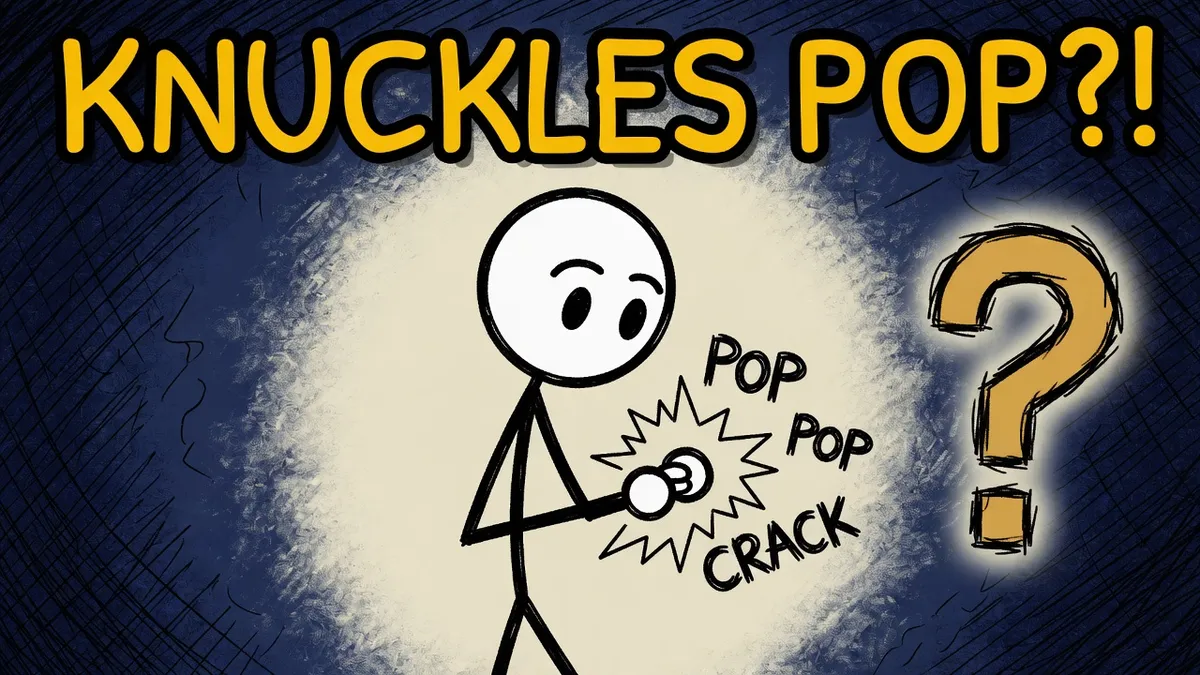
Here is a small, deeply strange fact: you can make a genuine, unexplained scientific mystery happen with your bare hands, right now, for free. Bend your fingers and, pop. That satisfying, slightly disgusting little crack. We've been studying it for more than sixty years, filmed it inside an MRI, built mathematical models of it, and scientists still argue about what the sound actually is. The one thing almost everyone gets wrong, though, is the very first assumption.
01 · The mythIt isn't your bones
The obvious guess is that the pop is bone, two surfaces grinding or clicking against each other. It is not. Nothing in there is actually touching. Your knuckle is a joint held in a sealed capsule, and the bones inside it glide on a cushion of fluid; they never clack together like billiard balls. Whatever’s making that noise, it isn’t a collision. It’s something happening in the fluid itself.
02 · The jointA sealed capsule of fluid and hidden gas
Here’s what’s really going on. Every knuckle is a sealed capsule, and floating inside it is a slippery lubricant called synovial fluid. Dissolved invisibly within that fluid is gas, mostly carbon dioxide, around 80% of it, sitting quietly in solution, exactly the way carbon dioxide sits invisibly dissolved in an unopened can of soda. You can’t see it. It’s just waiting for a change in pressure to reveal itself.
03 · The physicsPull apart, and the pressure drops
When you crack a knuckle, you pull the two bones apart. Suddenly there’s more space inside that sealed capsule, but the same amount of fluid to fill it. So the pressure inside drops, fast. And this is the whole trick: it’s exactly like cracking the cap on a fizzy drink. The instant the pressure falls, the dissolved gas comes screaming out of the liquid, and a gas-filled bubble snaps into existence. That sudden birth of a cavity is your pop. The medical name for the process is cavitation.
04 · The evidencePull my finger, on camera
We only properly caught it in 2015. Canadian researchers at the University of Alberta stuck a volunteer’s finger into an MRI scanner, tied a string around it, and literally pulled until it cracked, filming the whole event in under a third of a second. The footage was clear: the pop lines up with the moment the cavity is created, not destroyed. The sound is the bubble being born. As the lead scientist put it, it’s “a little bit like forming a vacuum.” That process, surfaces resisting separation until they suddenly give and a cavity springs open, is called tribonucleation, and this was the first time anyone had filmed it happening inside a living joint.
This also explains why you can’t immediately crack the same knuckle twice. For roughly twenty minutes afterwards, that gas is slowly dissolving back into the fluid. No dissolved gas, no bubble, no pop: you simply have to wait.
You'd think a slow-motion MRI of the exact moment would settle it. It didn't. In 2018, another team built a mathematical model and argued the opposite, that the sound comes from a bubble partly collapsing, not forming. Sixty-plus years on, a noise you can make right now is still a live scientific argument.
05 · The argumentBorn, or dying?
This is the part worth savouring. The 2015 MRI team saw the cavity appear and stay visible, and concluded the pop was its birth. But the 2018 model, built from equations describing bubble dynamics, produced a sound matching real recordings in both loudness and pitch, from a bubble partially collapsing. Both fit some of the evidence; neither has knocked the other out. So the honest answer to “is that pop a bubble forming or a bubble popping?” is: we’re not completely sure yet. A daily human habit remains, quietly, an unsolved problem.
06 · The worryNo, it won't give you arthritis
Which leaves the question everyone’s mum asked: does all this cracking give you arthritis? The answer, reassuringly, is no. Study after study has found no link. And one man proved it gloriously. Dr Donald Unger cracked the knuckles of his left hand at least twice a day, an estimated 36,500-plus cracks, for more than fifty years, while never once cracking his right. The result? Two identical, arthritis-free hands. He wrote it up in a medical journal and, in 2009, was awarded a tongue-in-cheek Ig Nobel Prize for his decades of one-handed discipline. Larger studies since have agreed with his sample size of one. The one lingering asterisk isn’t arthritis but grip: a 1990 study of 300 people did find habitual crackers had a little more hand swelling and slightly weaker grip, yet a 2017 ultrasound study found no grip difference at all, and if anything thicker joint cartilage in the crackers. So even the worst honest case against the habit is unsettled, and it isn’t the disease your mum warned you about.
07 · The payoffSo what is that pop, really?
It isn’t grinding bone, and it isn’t wrecking your joints. It’s a tiny cavity blinking into existence inside a bubble of your own carbon dioxide, the same physics as opening a soda, running in the sealed capsule of a finger joint. Harmless, faintly absurd, and, remarkably, after all this time, still a little bit mysterious. So crack away. You’re not damaging anything. You’re just popping tiny bubbles of gas, in a joint, for fun, in a way science can’t quite fully explain. Enjoy.
The animated version
Same answer, told as a little animated story with the strange little stickman acting it out. Dry, quick, and, obviously, correct.
Quick questions
Does cracking your knuckles cause arthritis?
No. Study after study has found no link between knuckle cracking and arthritis. The most famous test was Dr Donald Unger, who cracked only his left hand at least twice a day for more than 50 years while never cracking his right: both hands ended up equally arthritis-free. He was awarded a (tongue-in-cheek) Ig Nobel Prize in 2009 for the effort.
What is the popping sound when you crack a knuckle?
It's a gas bubble forming inside the joint's fluid, not bones grinding. Pulling the joint apart makes the sealed capsule bigger while the fluid stays the same, so pressure drops and dissolved gas, mostly carbon dioxide, rushes out of solution into a bubble. That sudden cavity is the pop, the same physics as opening a fizzy drink.
Why can't you crack the same knuckle twice in a row?
Because the gas needs time to redissolve. After a crack there's a refractory period of roughly 20 minutes while the released gas slowly dissolves back into the synovial fluid. No dissolved gas, no bubble, no pop, so you simply have to wait before that joint will crack again.
Is the sound the bubble forming or the bubble popping?
This is genuinely unresolved. A 2015 real-time MRI study concluded the pop is the bubble forming, a cavity blinking into existence. But a 2018 mathematical model argued the sound comes from a bubble partially collapsing. Both fit some of the evidence, so it remains an open scientific argument.
Is it bad to crack your knuckles?
For most people, no. The main documented consequences are social, not medical: there's no solid evidence it causes arthritis or lasting joint damage. You're essentially popping tiny bubbles of your own gas, which is harmless, if a slightly odd hobby.
Why does cracking your knuckles feel good?
Pulling the joint apart briefly stretches the capsule and separates the bones, so the finger feels looser and more mobile for a moment, the same satisfying 'release' you get from any good stretch. Some researchers think the sudden movement also stimulates sensory nerve endings in the joint, and for many people it's a self-soothing habit under stress. Whether it releases genuine feel-good endorphins is often claimed but not well established, so hold that part loosely.
Does cracking your knuckles make them bigger?
No, that's a myth. Ordinary cracking doesn't permanently enlarge the joint. Really forceful, repeated twisting can cause temporary swelling that makes a knuckle look bigger for a while, which is probably where the belief comes from. A 2017 ultrasound study actually found habitual crackers had slightly thicker joint cartilage, not thinner or damaged.
Does cracking your knuckles weaken your grip?
The evidence is genuinely mixed. A 1990 study of 300 people found habitual crackers were more likely to have hand swelling and lower grip strength, though, notably, still no more arthritis. But a 2017 study that measured grip with a dynamometer found no difference at all. So a grip cost is possible but far from proven; treat it as unsettled rather than a warning.
Why do my knuckles crack on their own, without me trying?
Same physics, no effort required. Everyday movements, reaching, gripping, stretching, can momentarily pull a joint just far enough for the pressure to drop and a gas bubble to form. Spontaneous cracking during normal movement, with no pain, is considered harmless, and it's a different thing from deliberately forcing a joint to pop.
Why do other joints, knees, neck, back, crack too?
The classic pop from knuckles, neck and back is usually the same gas-bubble cavitation. But not every joint noise is. A grinding or crunching sound, common in the knees, and called crepitus, comes from cartilage and bone surfaces moving against each other, while a snap is often a tendon flicking over bone. A painless pop is nothing to worry about; noise that comes with pain is worth getting checked.
Which joints can you actually crack?
Mainly the ones you can pull apart against their capsule: the knuckles at the base of your fingers (the metacarpophalangeal joints) are the classic ones, along with finger, toe, neck and spinal joints. You can't crack every joint, and once you've cracked one you can't do it again for about 20 minutes, while the gas slowly redissolves.
How long before you can crack the same knuckle again?
Roughly 20 minutes. After the pop, gas has come out of solution into a cavity; it needs time to redissolve into the synovial fluid before the joint can cavitate again.
Does cracking your knuckles release endorphins?
That popular claim is not well established. The satisfying feel is better explained by a brief separation of the joint surfaces and sensory feedback from the stretch, not a proven flood of feel-good chemicals.
Take the quiz on this
A quick 4-question check on what you just read. Get them right to earn XP: no points for just scrolling.
Our sources 10 checked
// every claim on this page was checked before it went up