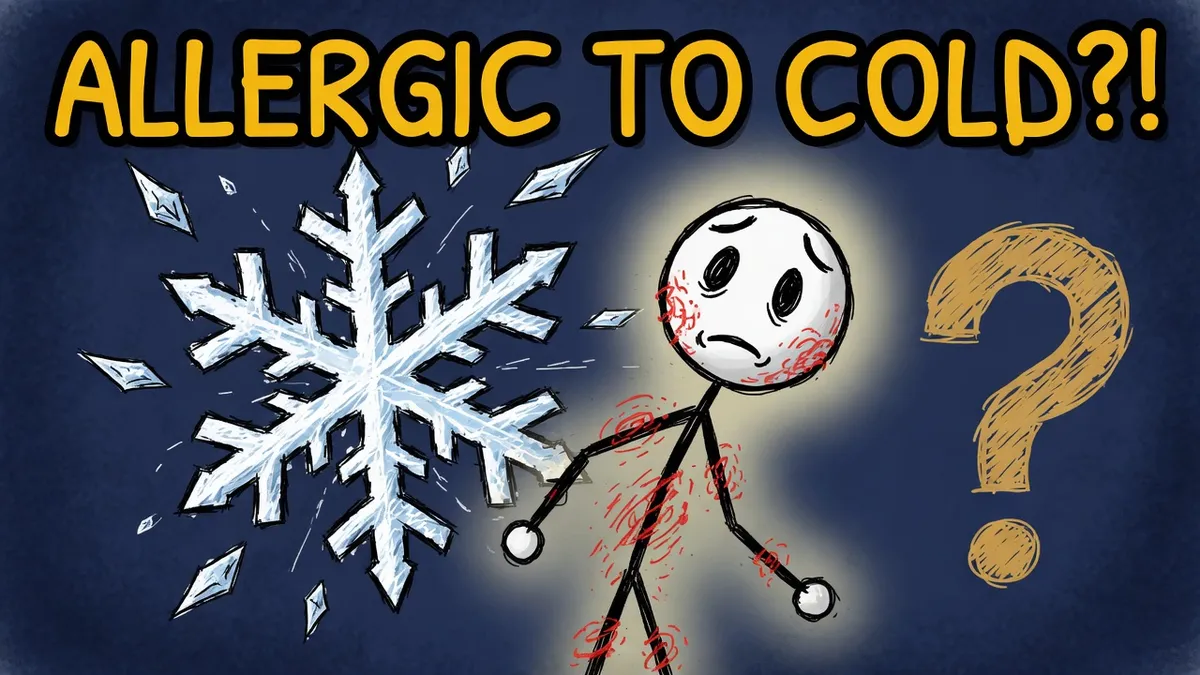
Being allergic to the cold sounds like a punchline, right up until you meet someone who has it. Hold a cold can and their fingers puff up. Eat ice cream and their lips swell. Step out into a winter morning and their exposed skin blooms with itchy red welts within minutes. It's a real, recognised condition called cold urticaria, and its most dangerous scenario isn't a snowy day at all. It's a refreshing summer swim.
01 · A real condition, with an asterisk
Cold urticaria (you say it er-tuh-KAR-ee-uh) is genuinely a medical diagnosis, and doctors do sometimes call it a “cold allergy”. But it comes with an asterisk, because it doesn’t work like a classic allergy to pollen or peanuts. In those, the immune system reacts to a foreign protein. Here, the trigger is purely physical: a drop in skin temperature. There’s no allergen, no invading substance. Just cold, and a skin that reacts to it as if it were under attack.
02 · The chemical behind the welts
So what actually raises the hives? Your skin is studded with immune cells called mast cells, little packets of inflammatory chemicals. In cold urticaria, the cooling and rewarming of the skin makes those mast cells burst open and dump their contents, above all histamine, into the surrounding tissue. Histamine is the exact same molecule behind hay fever and the itch of a mosquito bite, which is why the result looks so classically allergic: a raised, red, maddeningly itchy welt. The genuinely honest part of the science is why cold sets the mast cells off in the first place. Doctors don’t fully know. The medical literature simply calls the mechanism unknown.
03 · The tell-tale patternIt flares as you warm up
The signature of cold urticaria is where and when it appears. Hives show up on whatever touched the cold, your fingers around a glass, your lips around ice cream, whatever skin met winter air, and they often flare hardest as the skin warms back up. Walk indoors after a cold walk and that’s when your face really lights up. Individual episodes usually settle within an hour or two once you’ve warmed through. It’s uncomfortable, localised, and for a single cold hand, not remotely dangerous.
The most dangerous thing about a cold allergy is not the itch. It's water. Cooling a large area of skin all at once can trigger a body-wide histamine dump that crashes blood pressure and causes fainting. So a person with cold urticaria can jump into a cold lake, react, lose consciousness, and drown. It's one of the few allergies where the classic danger scenario is a summer swim.
04 · Why the whole body is the risk
That danger is worth understanding, because it flips the intuition. One itchy hand releases histamine from a small patch of skin: no problem. But immerse most of your body in cold water and mast cells everywhere fire at once, flooding the bloodstream with histamine in bulk. That can drop blood pressure hard enough to cause anaphylaxis, with fainting, a racing heart, and shock. This is exactly why doctors warn people with known cold urticaria away from cold-water swimming, and why some carry an epinephrine auto-injector. The itch is a nuisance. The mass reaction is the emergency.
05 · The ice-cube test and the odds
Diagnosing it is refreshingly low-tech. A doctor holds an ice cube against your forearm for a few minutes, then watches as the skin rewarms. If a raised red welt rises up right on the spot, that’s a positive result. Most cases are “acquired” and idiopathic, meaning they appear on their own, often in teens or young adults, sometimes after a viral infection, with no cause ever found. There’s also a separate, rarer inherited disease, familial cold autoinflammatory syndrome, that looks superficially similar but is a different illness entirely (it brings fever and joint pain, and doesn’t respond to the ice-cube test).
06 · The payoffManageable, and often temporary
The good news is that, for most people, cold urticaria is a condition you manage rather than fight. Non-sedating antihistamines head off the hives, stubborn cases can be treated with the injectable drug omalizumab, and simply avoiding sudden whole-body cold takes the real danger off the table. Best of all, it often doesn’t last: roughly a third of people find it quietly resolves within five to ten years. So yes, you can absolutely be allergic to the cold, in the same physical way some people are allergic to the sun. Your immune system, it turns out, can take offence at the weather itself, and occasionally, at both ends of the thermometer at once.
Quick questions
Can you really be allergic to the cold?
Yes. The condition is called cold urticaria, and it is medically recognised. Cold exposure triggers the skin to release histamine, producing hives, though it is a physical reaction to temperature rather than a classic allergy to a specific substance.
What is cold urticaria?
Cold urticaria is a condition where skin that is exposed to cold breaks out in itchy welts or hives. It happens when cold makes mast cells in the skin release histamine and other inflammatory chemicals.
What are the symptoms of a cold allergy?
Typical symptoms are temporary itchy welts and hives on cold-exposed skin, swelling of the hands from holding cold objects, and swelling of the lips from cold food or drink. Severe cases can cause fainting, a racing heart and shock.
What causes cold urticaria?
In most people the cause is unknown, which doctors call idiopathic. Some cases are linked to a virus, another illness or an inherited trait, and cold triggers the release of histamine that produces the hives.
Is a cold allergy dangerous?
It can be. A single itchy hand is not dangerous, but cooling a large area of skin at once can cause a whole-body reaction, including anaphylaxis with low blood pressure and fainting. This is why swimming in cold water is the main serious risk.
Can you die from cold urticaria?
It is rare, but a severe whole-body reaction can be life threatening. The biggest danger is swimming in cold water, where a person can faint from a drop in blood pressure and drown. People with severe reactions may be prescribed an epinephrine auto-injector.
How do doctors test for cold urticaria?
The standard test is the ice cube test. A doctor places an ice cube against your forearm for about 1 to 5 minutes, then watches as the skin rewarms. A raised red welt appearing on the spot is a positive result.
Who gets cold urticaria?
It can affect anyone but is most often diagnosed in young to middle-aged adults, and it is roughly twice as common in women as men. It sometimes appears after a viral infection, and it is not common overall.
Does cold urticaria go away?
Often, yes. The condition usually lasts some years, and about 30 percent of people report their symptoms resolving within roughly 5 to 10 years. Others manage it longer term with medication and by avoiding cold.
How do you treat a cold allergy?
The first-line treatment is non-sedating antihistamines, along with avoiding cold triggers. For cases that do not respond, doctors may use the injectable drug omalizumab, and severe reactions are treated with epinephrine.
Why do I get hives when I go outside in the cold?
If cold air reliably brings out itchy welts on exposed skin, cold urticaria is a likely explanation. Cold triggers histamine release in the skin, and the hives often flare most as the skin warms back up. An allergist can confirm it with an ice cube test.
Can eating or drinking cold things cause a reaction?
Yes. In people with cold urticaria, cold food and drinks can make the lips, tongue or throat swell. Swallowing very cold items can be risky because swelling in the throat can affect breathing, so it is worth discussing with a doctor.
Is cold urticaria the same as familial cold autoinflammatory syndrome?
No. Familial cold autoinflammatory syndrome (FCAS) is a separate inherited genetic disease that causes rash, fever and joint pain after generalised cold exposure. Unlike ordinary cold urticaria, it does not respond to a simple ice cube test and is not an allergy in the usual sense.
Can cold urticaria develop suddenly as an adult?
Yes. Acquired cold urticaria commonly appears in the teens and twenties and can start suddenly, sometimes after a viral illness. In most cases no specific underlying cause is ever found.
Our sources 8 checked
// every claim on this page was checked before it went up