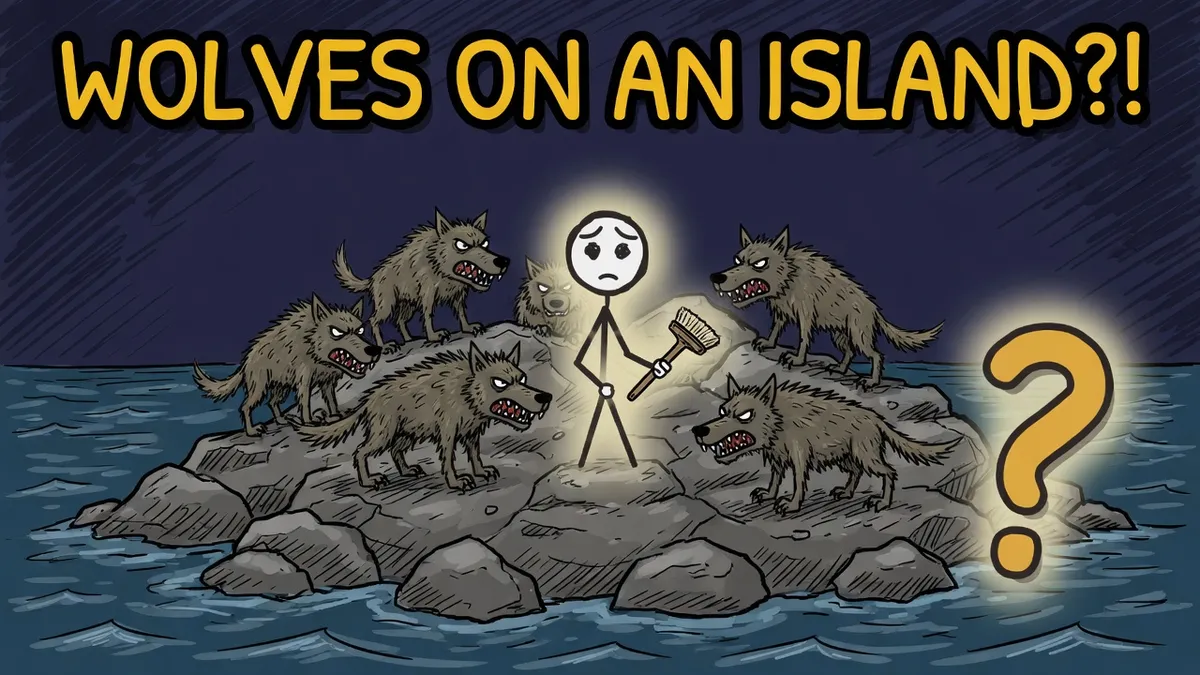
Picture a small island in the Baltic Sea, a couple of square kilometres of rock ringed by open water, home to seal hunters thousands of years ago. Now picture the bones archaeologists pulled from a cave there: wolves. Not dogs. Wild wolves, confirmed by DNA, that had eaten a diet of seal and fish exactly like the people around them. There is only one problem. Wolves cannot swim that far. Which means someone put them in a boat, carried them across the sea, and fed them. And that single fact quietly upends a story we thought we understood.
01 · The islandA place a wolf can't reach
The site is Stora Karlso, off Gotland in Sweden, and its geography is the whole mystery. It is a small island with open Baltic water on every side and no native land mammals: nothing large walks there on its own. Wolves can swim, but only across modest gaps, not wide stretches of open sea. So when wolf remains turned up in the island’s Stora Forvar cave, dating to somewhere between 3,000 and 5,000 years ago, the logic was inescapable. A wolf did not arrive by accident. A wolf that reached Stora Karlso was brought.
02 · Not dogsThe DNA settles it
The obvious guess would be that these were early dogs, tame companions who came along with their owners. Ancient DNA ruled that out. The animals were true gray wolves, with no detectable dog ancestry at all. That distinction matters enormously. Dogs on a boat is a familiar picture. Wild wolves on a boat is something else entirely: it means prehistoric people were handling, transporting, and evidently living alongside animals that were not domesticated, that were, genetically, the real thing.
03 · The shared dinnerFed on seal and fish
Then came the detail that turned a puzzle into a story. Chemical analysis of the wolves’ bones revealed a diet rich in marine food, seals and fish, the very same diet as the human seal hunters who used the cave. A wild wolf hunting on its own would not eat like that. This is the signature of an animal being fed by people. Put the pieces together, carried across the sea, kept on a tiny island, eating human food, and a remarkable picture emerges: someone was provisioning wolves, deliberately, thousands of years ago.
We tell the wolf story as one neat line: wild wolf, then gradual taming, then loyal dog. But these were genetically wild wolves that people caught, loaded into boats, ferried across open sea, and fed their own seal-and-fish dinners to, thousands of years after dogs already existed. In other words, humans were still "collecting" wild wolves as a separate pursuit, alongside owning dogs. The domestication of dogs was not the end of our experiments with wolves. It was just one branch. The strongest hook of all: the wolf could not swim there, so the only way it arrived is that a Stone Age person decided to bring it.
04 · The long road to the dogHow wolves became our own
To feel the strangeness, it helps to remember how domestication is usually thought to have gone. Dogs descend from gray wolves, though exactly when is genuinely disputed: estimates span from about 15,000 to 40,000 years ago. The leading model is not deliberate taming at all but a slow, self-driven process: bolder wolves scavenged the scraps around human camps, the least fearful were tolerated, and over countless generations selection for tameness split them off into dogs. On that view, dogs almost made themselves. Which is what makes Stora Karlso jar so much.
05 · Keeping the caveatsWhat we do and don't know
Good science means holding the line between evidence and interpretation. The solid parts are strong: the wolves were wild, they were transported, and they ate like the islanders. The island wolves were also smaller than mainland wolves, and one carried unusually low genetic diversity while another survived a serious injury, hints of an isolated, perhaps managed group. But the bigger claim, that humans deliberately “kept” them, is one the researchers themselves flag as provocative rather than proven. What is certain is enough to be astonishing: people and wild wolves, together, on an island in the sea. It is a reminder that our long bond with animals, from the wolf to the purring cat, has always been stranger than the tidy version.
06 · The payoffSo why were wolves on that island?
Because someone put them there. That is the quiet, extraordinary conclusion. On a scrap of rock a wolf could never reach on its own, prehistoric people brought wild wolves across the water and fed them from their own catch. It does not fit the clean tale of wolves gradually becoming dogs. It suggests instead that our ancestors’ relationship with wolves was wide and experimental and full of dead ends, that they captured and kept the wild thing itself, for reasons we can only guess at. The bones on Stora Karlso are not a story about dogs. They are a story about the day a person looked at a wolf and decided it was coming with them.
The animated version
Same answer, told as a little animated story with the strange little stickman acting it out. Dry, quick, and, obviously, correct.
Quick questions
Why were wolves found on an island they couldn't reach?
Stora Karlso is a small Baltic island with open water on all sides and no native land mammals, so wolves could not have walked or swum there. Their presence means prehistoric people transported them, most likely by boat, roughly 3,000 to 5,000 years ago.
Which island were the Stone Age wolves found on?
Stora Karlso, off the coast of Gotland in Sweden, in a cave called Stora Forvar. The site was used for centuries by seal hunters and fishers.
Can wolves swim to islands?
Wolves are capable swimmers over short distances and can reach nearby islands, but they will not cross wide stretches of open sea. Stora Karlso sits too far across the Baltic, so the wolves there had to be carried by humans.
Were these wolves actually early dogs?
No. Ancient DNA showed they were true gray wolves with no dog ancestry. That is what makes the find surprising: humans were moving and feeding wild wolves, not domesticated dogs.
How do scientists know humans fed the wolves?
Chemical analysis of the wolves' bones showed a diet heavy in seals and fish, the same marine food the human islanders ate. Wild wolves inland would not eat like that, so the diet points to human provisioning.
When were dogs domesticated?
Estimates range from about 15,000 to 40,000 years ago. The wide window reflects genuine scientific disagreement over when, where, and how many times it happened.
How did wolves become dogs?
The leading idea is self-domestication: bolder wolves scavenged food waste around human camps, the tamest were tolerated, and over many generations selection for reduced fear produced animals that split from wild wolves into dogs.
Did humans tame wolves on purpose?
Probably not at first. The dominant model is that wolves came to us via scavenging, and taming was gradual. The Stora Karlso wolves are unusual because they suggest deliberate capture and keeping of wild wolves, separate from the dog story.
What is the oldest evidence of pet dogs?
The Bonn-Oberkassel dog from Germany, about 14,000 to 15,000 years old, buried alongside two humans, is the oldest widely accepted domestic dog and a strong sign of an emotional bond.
Did the island wolves become dogs?
No. They show no dog ancestry and appear to be a dead end: captive or managed wild wolves rather than an ancestor of any dog lineage.
Why does this discovery matter for domestication science?
It shows human-wolf relationships were more varied than a single straight line from wolf to dog. People may have captured, moved, fed, and kept wild wolves in ways that never led to domestication at all.
Were the island wolves different from normal wolves?
Somewhat. They were smaller than mainland wolves, one had unusually low genetic diversity, and one survived a serious injury, all consistent with an isolated, possibly managed population. These are suggestive hints, not proof.
Could the wolves have arrived by natural rafting or ice?
It is far less likely than human transport. The island's persistent isolation and the wolves' human-matched marine diet both point to people carrying and feeding them rather than a chance natural crossing.
Our sources 6 checked
// every claim on this page was checked before it went up