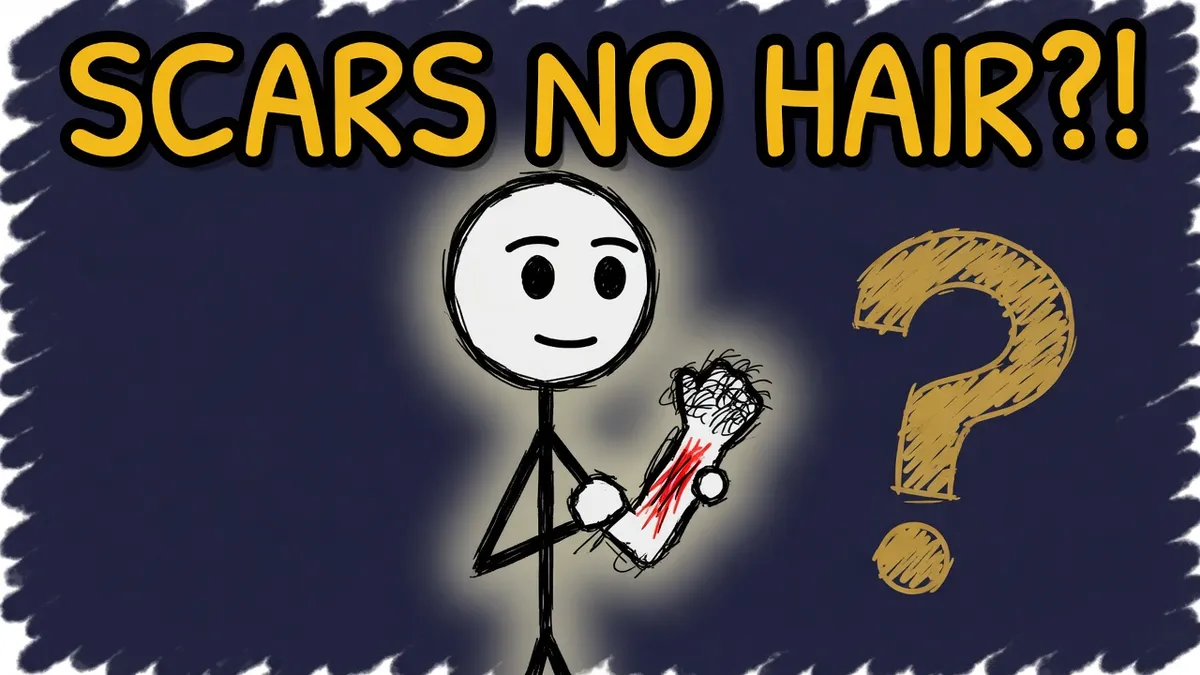
Find a scar on your body and really look at it. Notice what's missing. There's no hair growing out of it. There are no pores, no little bumps, none of the fine texture of the skin right beside it. It has an odd, smooth, almost plastic shine. That scar is not a patch of skin that healed back to normal. It's a patch of something else entirely, a fast repair job that left out most of the machinery. And the missing machinery is the whole story.
01 · The parts you can't seeSkin is full of tiny organs
Normal skin is more than a sheet. Below the surface layer sits the dermis, and it’s packed with tiny organs called appendages: hair follicles, oil glands, and sweat glands. These are the only structures that actually produce hair, oil and sweat. They’re intricate, three-dimensional little factories, and building one from scratch is genuinely complicated. Your skin is studded with thousands of them, and in normal skin they’re quietly working all the time.
02 · The rush jobSpeed beats perfection
Now cut deep enough to destroy those appendages, and your body faces a choice: rebuild each intricate follicle and gland perfectly, or slam the door shut fast before infection and fluid loss get in. Speed wins, every time. Rather than reconstruct the delicate machinery, cells called fibroblasts rush in and fill the gap with collagen, the same tough protein that gives normal skin its strength. That collagen patch is the scar. And crucially, it contains none of the factories that were destroyed. No follicles. No hair.
03 · Why it looks so differentCollagen laid the wrong way
The patch even looks wrong, and there’s a precise reason. In healthy skin, collagen fibres cross each other in a flexible basket-weave. In a scar, the fibroblasts dump collagen in a hurry, in dense bundles all aligned in one direction. That altered weave is why a scar feels stiffer than the skin around it, and why it catches the light differently, giving mature scars their characteristic smooth, glassy shine. The smoothness you’re seeing is really an absence: the tiny bumps of pores and follicle openings are simply gone.
A scar isn't just hairless. Because the same appendages are all missing at once, a scar also can't sweat to cool itself, produces no natural oil so it stays dry, and often won't tan evenly. Every one of those quirks is the same missing-factories problem wearing a different hat.
04 · Repair, not regenerationThe blueprint your skin lost
This is the key thing to understand about adult skin: it is fundamentally a repair system, not a regeneration system. It closes wounds; it does not reprint the original blueprint. Some animals can regrow lost body parts complete with all their structures. Adult humans, for the most part, cannot. So once a follicle is destroyed, the default outcome is a permanent bald patch, because the scar is a functional stand-in, a placeholder, rather than a true copy of what was lost. It heals, but it doesn’t rebuild.
05 · The exceptionWhen skin remembers how to be an embryo
Except “never” turns out to be too strong. In 2007, scientists made a startling discovery: give a mouse a large enough wound, bigger than about one square centimetre, and brand-new hair follicles can sprout right in the middle of the healing scar. Not from surviving follicles at the edges, but formed from scratch, as if the skin briefly remembered how to be an embryo again. It’s called wound-induced hair neogenesis, and it runs on the same signalling that builds follicles before birth. The catch: it only kicks in above a size threshold, and humans seem to have largely lost the trick, possibly because we have far fewer of the immune cells that trigger it.
06 · The payoffA patch, not a copy
So a scar doesn’t grow hair for the most honest reason there is: the machinery that grows hair was destroyed, and your body chose to seal the wound fast rather than rebuild it. What you’re left with is a patch, strong, protective, and permanently missing its factories. It’s a small daily reminder that your skin’s first priority isn’t perfection: it’s survival, closing the gap before anything gets in. The hairless shine is the receipt for a trade your body made in an emergency, and mostly, it never trades back. Though somewhere in a lab, in the way a wound can still occasionally spark a new follicle to life, there’s a hint that one day, maybe, it could.
Quick questions
Why doesn't hair grow on scars?
Scars are made of fibrous collagen laid down to seal a wound quickly, and this patch does not contain hair follicles. When an injury destroys the follicles in an area, adult skin does not rebuild them, so no hair can grow from the scar.
Can hair ever grow back through scar tissue?
Generally no, because the follicles that produce hair have been destroyed and are not regenerated. Shallow scars that spared the deeper follicles may still grow hair, but true full-thickness scars remain permanently bald without medical intervention.
Why are scars smooth and shiny?
Scars lack the pores, hair follicles and oil glands that give normal skin its texture, so the surface is flat and featureless. The collagen is also aligned in one direction rather than a basket-weave, which changes how the tissue reflects light and creates the shine.
Do scars sweat?
Most scars sweat little or not at all, because the sweat glands in that area were destroyed during the injury and are not rebuilt. This is why large scarred or burned areas can struggle to cool themselves.
Why don't scars tan like the rest of my skin?
Scar tissue often has an altered distribution of the pigment-producing cells called melanocytes, plus a different blood supply. As a result scars may stay paler, or sometimes darker, and often do not tan evenly with the surrounding skin.
Why is scar tissue a different colour?
New scars can look red or pink due to extra blood vessels, then fade over months. The final colour differs from normal skin because pigment cells and blood supply are not restored to their original pattern.
What is scar tissue actually made of?
Scar tissue is mostly type I collagen produced by cells called fibroblasts, packed densely to close and strengthen the wound. It lacks the hair follicles, oil glands, sweat glands and organised elastic fibres found in uninjured skin.
Why does the body form a scar instead of rebuilding normal skin?
Adult skin prioritises fast wound closure over perfect reconstruction, because sealing the barrier quickly reduces the risk of infection and fluid loss. Rebuilding intricate follicles and glands is slower, so the body settles for a functional patch.
Can new hair follicles ever form in adults?
In mice, large wounds can trigger entirely new follicles to form, a process called wound-induced hair neogenesis discovered in 2007. In humans this is rarely seen, so for practical purposes adult follicle regeneration does not happen on its own.
What is wound-induced hair neogenesis?
It is the regrowth of brand-new hair follicles from the centre of a healing wound, rather than from surviving follicles. It was demonstrated in adult mice and depends on signalling that mimics how follicles form in the embryo.
Why can mice regrow hair in wounds but humans usually can't?
Mice rely on immune cells called gamma-delta T cells that release a signal (Fgf9) to kick off follicle regeneration, and humans have far fewer of these cells. This difference is one leading explanation, though it is not fully settled.
Can a hair transplant put hair into a scar?
Yes, surgeons can transplant healthy follicles into scar tissue, though success depends on the scar's blood supply. This adds follicles the scar cannot grow on its own, rather than reviving the original ones.
Do all scars completely lack hair?
Not always. Shallow scars that did not destroy the deeper follicle may still grow hair, while deep, full-thickness scars are typically hairless because the follicles were lost.
Will this research lead to a cure for baldness or scars?
It is a promising direction, because it shows follicle regeneration is biologically possible, and scientists are studying the signalling pathways involved. However, it remains experimental and has not yet produced a proven human treatment.
Our sources 8 checked
// every claim on this page was checked before it went up