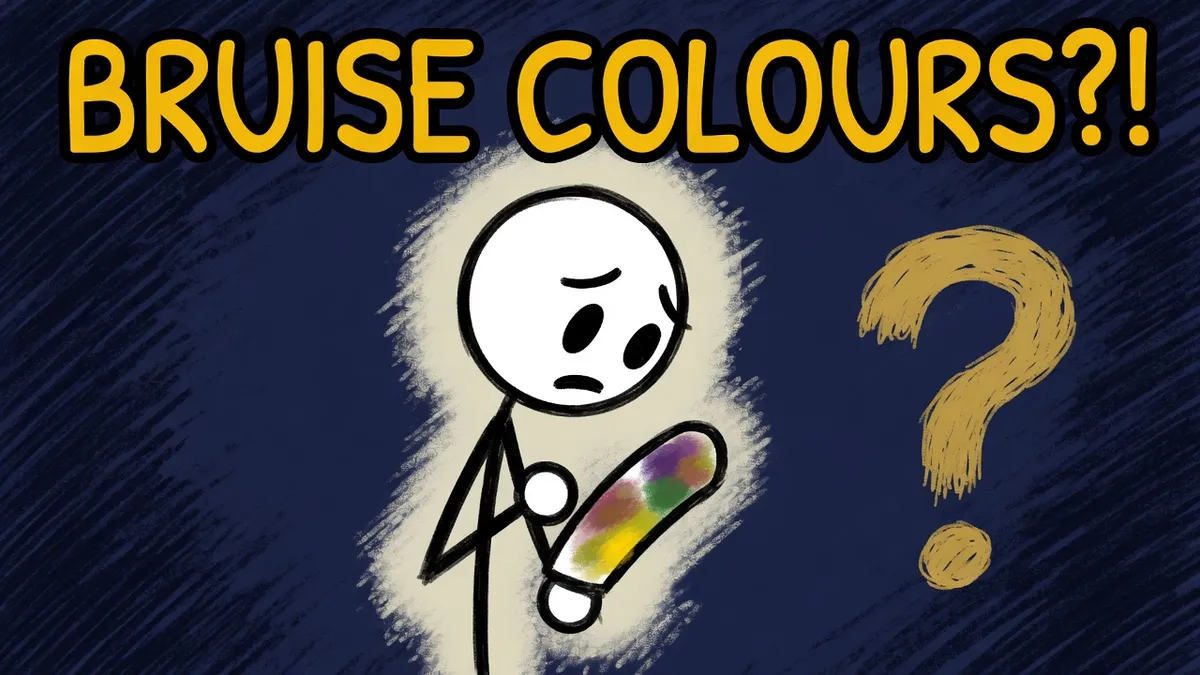
Knock your shin on a table and, over the next two weeks, you get a free science demonstration on your own leg. First the spot goes red, then an angry blue-purple, then a sickly green, then a fading yellow-brown, before it vanishes. It looks like the bruise is slowly rotting. It is doing the opposite. That parade of colours is your body carefully taking spilled blood apart, molecule by molecule, and recycling the pieces, and the palette it cycles through is the same one your organs use every single day, out of sight.
01 · What a bruise actually isTrapped blood, nowhere to go
A bruise, medically a contusion, is not damage to the skin. The skin is fine. The damage is underneath: a knock breaks tiny blood vessels called capillaries, and blood leaks out into the surrounding tissue. Because the skin above is unbroken, that blood cannot drain away or be wiped off. It is trapped, pooled just below the surface, showing through as a mark. And since your body cannot simply flush it out, it has to deal with the spill the only way it can, by breaking it down chemically, right where it lies.
02 · Red to purpleThe oxygen runs out
At first the bruise is red or pink, because the blood that just leaked out is fresh and still rich in oxygen, carried by the pigment hemoglobin, the same molecule that makes blood red in the first place. But trapped blood cannot refresh its oxygen. Within a day or two, the hemoglobin gives up its oxygen and turns a darker shade, and through the skin that reads as deep blue, purple, or nearly black. This is why a day-old bruise looks so much angrier than a fresh one: it is not getting worse, it is just running out of oxygen.
03 · The green stageDismantling the pigment
Around day five to ten comes the colour that surprises people: green. This is where the real recycling begins. Special enzymes start pulling apart the hemoglobin itself, and the first breakdown product is a green pigment called biliverdin. That green tint, far from being a bad sign, is proof the cleanup crew has arrived and is hard at work. The bruise has stopped being a pool of old blood and become a demolition site, with the pigment being taken apart into its component parts.
The rainbow a bruise cycles through is not random decoration. It is your body's blood-recycling assembly line, made visible. The green (biliverdin) and the yellow (bilirubin) are the exact same pigments your liver and spleen churn out every day as they retire worn-out red blood cells, and bilirubin is literally what gives bile its colour, and what turns people yellow in jaundice. So a healing bruise is a tiny external window onto a process that normally happens hidden inside your organs. You are watching your body take apart spilled blood and salvage the parts, right there on your arm.
04 · Yellow and brownThe last salvage
Toward day ten to fourteen the green fades to yellow, then a light brown. The biliverdin is converted by an enzyme into bilirubin, which is yellow, and the iron freed from the old hemoglobin is stored away as a golden-brown pigment called hemosiderin. Nothing is wasted: the iron, precious to the body, is reclaimed rather than thrown out. By this stage the bruise is almost gone, its raw materials mostly reabsorbed and returned to circulation, leaving only a pale ghost that soon disappears entirely.
05 · Why yours may differTiming, skin, and easy bruising
Not every bruise reads like a textbook. The timings vary a lot from person to person, and the same bruise can show several colours at once, so colour is not a reliable way to precisely date an injury. On darker skin tones the bright green-and-yellow parade is far less visible, and a bruise often just looks like a darker patch. And some people bruise more easily than others, with age thinning the skin, blood-thinning medicines like aspirin, heavy drinking, or low vitamin C, K, or B12 all making vessels more fragile. Frequent, unexplained bruising is worth mentioning to a doctor.
06 · The payoffSo why do bruises change colour?
Because a bruise is not sitting there rotting. It is being actively taken apart and recycled, and each colour marks a stage in that work: red for fresh blood, purple for oxygen lost, green and yellow for the pigment being dismantled into biliverdin and bilirubin, brown for the salvaged iron. It is the very same chemistry your body runs quietly inside your organs all the time, briefly brought to the surface where you can watch it. The next time a bruise turns a startling shade of green, you can see it for what it really is: not decay, but your body, cleaning up after itself in colour.
The animated version
Same answer, told as a little animated story with the strange little stickman acting it out. Dry, quick, and, obviously, correct.
Quick questions
Why do bruises change colour as they heal?
The trapped blood cannot drain away, so the body breaks it down chemically right where it sits. Each stage of that breakdown produces a different coloured pigment, from red blood, to dark deoxygenated blood, to green biliverdin, to yellow bilirubin. You are literally watching the chemistry happen through your skin.
What do bruise colours mean?
They roughly map to how old the bruise is. Red or pink is fresh, blue or purple is a day or two old, green is the midpoint of healing, and yellow or brown means it is nearly gone. The colours track your body dismantling the leaked blood.
Why do bruises turn blue or purple?
Within a day or two the trapped blood loses its oxygen. Deoxygenated hemoglobin is much darker than the bright red oxygen-rich kind, and through the skin it looks blue, purple, or nearly black.
Why do bruises turn green?
Around day 5 to 10 the body starts breaking down the hemoglobin in the trapped blood, producing a green pigment called biliverdin. That green tint is a sign the bruise is actively healing.
Why do bruises turn yellow?
The green biliverdin is converted by an enzyme into bilirubin, which is yellow. This usually shows up around day 10 to 14 and means the bruise is almost cleared. Bilirubin is the same yellow pigment found in bile.
Why do bruises turn brown?
As the old blood is cleared, iron from the hemoglobin is stored as a golden-brown pigment called hemosiderin. That brownish stage is the last one before the bruise fades completely.
How long does a bruise last?
Most bruises clear up on their own within about two weeks, no treatment needed. Larger ones, and ones on the legs, tend to take longer because gravity slows how fast the blood is reabsorbed.
What are the stages of a bruise in order?
Red (first day), then blue, purple, or black (day 1 to 2), then green (day 5 to 10), then yellow to brown (day 10 to 14), then gone. Timings vary from person to person.
What actually is a bruise?
It is blood that has leaked out of small broken blood vessels into the tissue beneath skin that is still intact. Because the skin is not cut, the blood is trapped and shows through as a mark. The medical name is a contusion.
Why do I bruise so easily?
Common reasons are thinner skin with age, blood-thinning medicines like aspirin and other NSAIDs, heavy alcohol use, and low levels of vitamin C, K, or B12. All of these make vessels more fragile or blood slower to clot.
Do bruises look different on darker skin?
Yes. On darker skin tones the classic red-to-yellow rainbow is less obvious, and a bruise often looks like a darker patch than the surrounding skin rather than going bright green or yellow.
Are the colours in a bruise the same as jaundice?
Yes, remarkably. The yellow of a healing bruise and the yellow of jaundiced skin are both bilirubin, the same pigment that colours bile. A bruise is a small, local version of the blood recycling the body does all the time.
When should I worry about a bruise?
Get it checked if it has not improved after about a week, is very large or still painful after a few days, keeps coming back in the same spot, appears with no injury you remember, or turns up on your torso, back, or face. Frequent unexplained bruising can point to a clotting problem.
Our sources 6 checked
// every claim on this page was checked before it went up