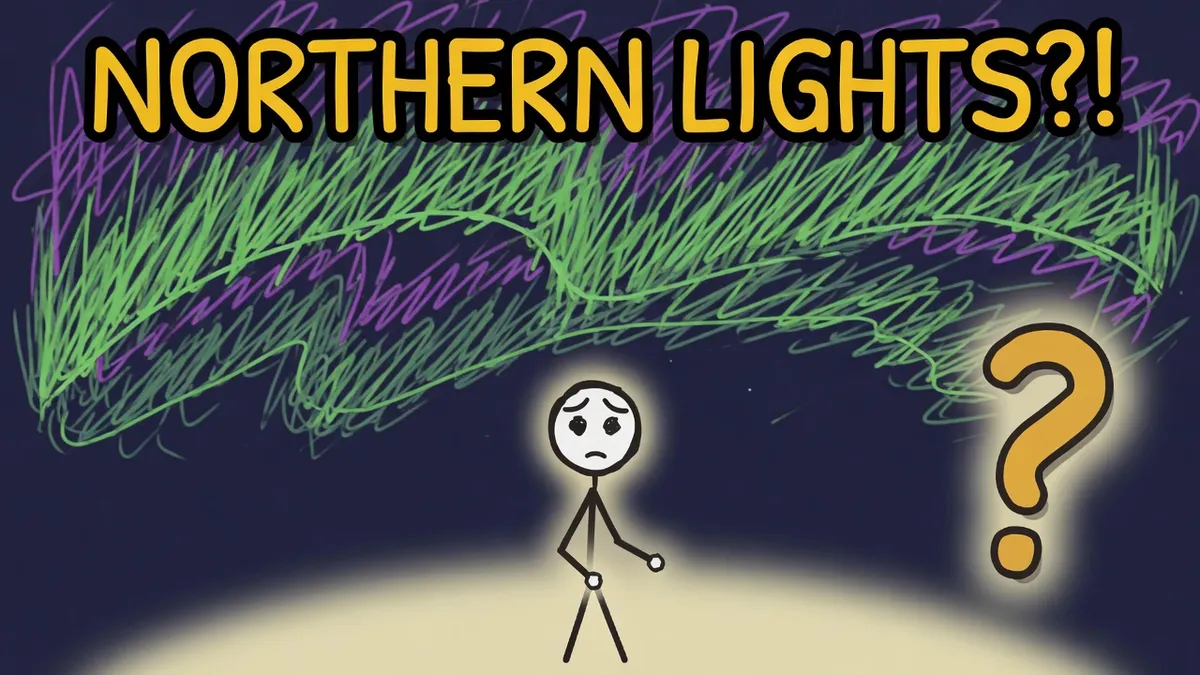
On a good night at high latitude, the sky stops behaving. It ripples. It folds into green curtains, throws up a red crown, and looks for all the world as if someone is painting with a light that does not care about clouds. People travel thousands of kilometres for it. Photographers stay out until their fingers stop working. And the honest question underneath the wonder is almost rude in its simplicity: why does the sky do that at all?
01 · The wrong storyIt is not a reflection of ice, and it is not a spirit lamp
Folk explanations are charming and almost always wrong. The lights are not the Sun bouncing off polar ice. They are not a permanent ring of fire. They are not (sorry) the souls of the departed putting on a show. They are a space-weather event that happens to be beautiful. The engine sits on the Sun. The steering is Earth’s magnetic field. The stage is the thin upper air, high enough that aeroplanes do not fly there and low enough that we still call it atmosphere.
02 · The fuelThe Sun is throwing particles at us all the time
The Sun is not a polite lightbulb. It constantly sheds a stream of charged particles, the solar wind, into the Solar System. Sometimes the Sun gets dramatic: flares and coronal mass ejections fling denser, faster clouds of plasma outward. When one of those hits Earth’s neighbourhood, the magnetosphere, the magnetic bubble around the planet, gets shaken. That is the fuel line for aurora. Quiet wind can still make polar lights. Stormy wind makes the big, viral, phone-camera nights.
The lights are not "in space" in the sci-fi sense. They are Earth's own air, being excited like a neon sign, tens to hundreds of kilometres above your head.
03 · The steeringWhy the poles get the show
If solar particles just rained straight down everywhere, life would be harder and the sky would look different. Earth’s magnetic field mostly deflects the assault. Near the magnetic poles, though, field lines act like guide rails. Particles can spiral down into the upper atmosphere in oval rings around each magnetic pole. Those rings are the auroral ovals. That is why the northern lights favour places like northern Scandinavia, Iceland, Canada and Alaska, and why the southern lights do the same job in Antarctica and the far south. When a storm is fierce, the ovals swell. Suddenly mid-latitude skywatchers get a night they will talk about for years.
04 · The glowOxygen and nitrogen are the paint
Here is the part that feels like chemistry class, because it is. Electrons slam into atoms and molecules in the upper atmosphere and kick them into higher energy states. When those particles relax, they emit photons at specific colours. Atomic oxygen is the star of the show: green is the common, vivid emission; red often comes from higher, thinner air where a longer-lived oxygen state can radiate before collisions snuff it out. Nitrogen adds blues, purples and some reds, especially near the lower fringes of curtains. So the palette is not random magic. It is a map of which gas was hit, how hard, and how high.
That also explains a quiet fact people notice on phone photos: cameras often pull more red and purple than your eyes did. Night vision is biased, green is easy for us to see, and long exposures cheat. The aurora was still real. The sensor just had more patience.
05 · The motionWhy curtains move like living things
Still photos make aurora look like frozen architecture. In person it can writhe. The particle rain is patchy. Currents in the magnetosphere surge. The oval shifts. Energy dumps come in bursts called substorms. The result is folds, rays, arcs and pulses that reorganise the sky in minutes. It feels alive because the driver, solar-terrestrial coupling, is restless.
If you have ever watched a meteor shower and thought the night sky was busy, aurora is a different kind of busy: not streaks of rock, but whole sheets of atmosphere switching on.
06 · The forecastWhen the sky is more likely to cooperate
You need darkness, clear skies, and particles. High latitudes help with the first and third on ordinary nights. Around solar maximum, and after big solar storms, the third can arrive even for people who do not live under the usual oval. Space-weather agencies publish geomagnetic indices (Kp and friends) as a rough “how stirred is the magnetosphere” score. High is promising, not a ticket. Clouds still win. City lights still win. Nature remains rude.
And no, staring at the Sun will not help you see aurora. The particles that matter already left the Sun days earlier. Look at the night sky. Check the forecast. Dress warmer than you think.
07 · The payoffA reminder that space weather is local
The northern lights are the friendliest face of a harsh fact: we live inside a magnetic shield under a star that is not quiet. Most days that shield is invisible. Some nights it writes in green across the dark. The same daytime blue sky is Rayleigh scattering of sunlight; the night’s green curtains are something else entirely, particles from the Sun lighting the upper air like a neon tube. Once you know that, the wonder does not shrink. It gets denser. You are not watching a myth. You are watching the Earth-Sun system, doing chemistry, overhead.
If you want another sky puzzle that is stranger than it looks, try ball lightning, a different kind of atmospheric light that still refuses to sit still for science.
Quick questions
What causes the northern lights?
Charged particles from the Sun (mostly electrons) enter Earth's upper atmosphere near the magnetic poles and collide with oxygen and nitrogen. The collisions excite those gases, which then emit light as they return to lower energy states.
Why are the northern lights green?
Green is the most common aurora colour because atomic oxygen emits strongly around 557.7 nanometres at typical auroral altitudes (roughly 100 to 200 km), and human eyes are especially sensitive to green. That combination makes green curtains the default look of a strong display.
Why are some northern lights red?
Red aurora usually comes from oxygen glowing at higher altitudes (often above about 200 km), where collisions are rare enough for a long-lived red emission to escape. Intense solar activity helps make red visible.
What is the difference between aurora borealis and aurora australis?
They are the same phenomenon in the two hemispheres. Borealis is the northern lights; australis is the southern lights. Both form in auroral ovals around the magnetic poles.
Why can you only see the northern lights near the poles?
Earth's magnetic field funnels solar particles into rings around the magnetic poles (the auroral ovals). Most of the time those ovals sit at high latitudes. During strong geomagnetic storms the ovals expand, and aurora can appear much farther south (or north).
Do solar flares cause the northern lights?
Solar flares and especially coronal mass ejections (CMEs) can drive the geomagnetic storms that power the brightest aurora. Quiet solar wind can still produce polar aurora; big storms make the show bigger and more widespread.
How high up are the northern lights?
Typical aurora glows from roughly 100 km upward into several hundred kilometres. Green oxygen emission is often strong near 100 to 200 km; red oxygen emission prefers higher, thinner air.
Are the northern lights dangerous?
The light itself is not a hazard to stand under. The solar storms that drive major aurora can disrupt satellites, radio and power systems. For a person on the ground watching the sky, the main risks are cold, dark roads and looking at the Sun (never look at the Sun to 'see aurora').
Can you hear the northern lights?
Some people report crackles or whooshes. The science is not settled. The light itself is generated high above the denser air that carries ordinary sound well. Any real sounds would need careful separation from wind, ice and imagination.
Why do the northern lights move and shimmer?
The magnetic field and particle rain are not steady. Bursts of particles, changing currents in the magnetosphere, and shifting oval structure make curtains fold, pulse and race across the sky in minutes.
Best time of year to see the northern lights?
You need a dark sky, so winter nights at high latitudes help. Aurora can happen any clear dark night when activity is up; solar-cycle peaks and strong storms raise the odds. Local forecasts of geomagnetic activity (Kp index and similar) matter more than the calendar alone.
What does Kp mean for aurora?
Kp is a planetary index of geomagnetic disturbance, roughly 0 to 9. Higher Kp means a more disturbed magnetosphere and a better chance that the auroral oval expands toward mid-latitudes. It is a guide, not a guarantee of a perfect show overhead.
Are northern lights and rainbows related?
No. A rainbow is sunlight split by water droplets in the lower atmosphere. Aurora is particles from space exciting gases in the upper atmosphere. Both make colour in the sky, by completely different physics.
Will phones and cameras see more colour than my eyes?
Often yes. Cameras can collect light longer and boost faint reds and purples that night vision struggles with. Your eyes still see real colour in bright displays, especially green; photos are not 'faking' aurora so much as revealing dimmer hues.
Our sources 12 checked
// every claim on this page was checked before it went up