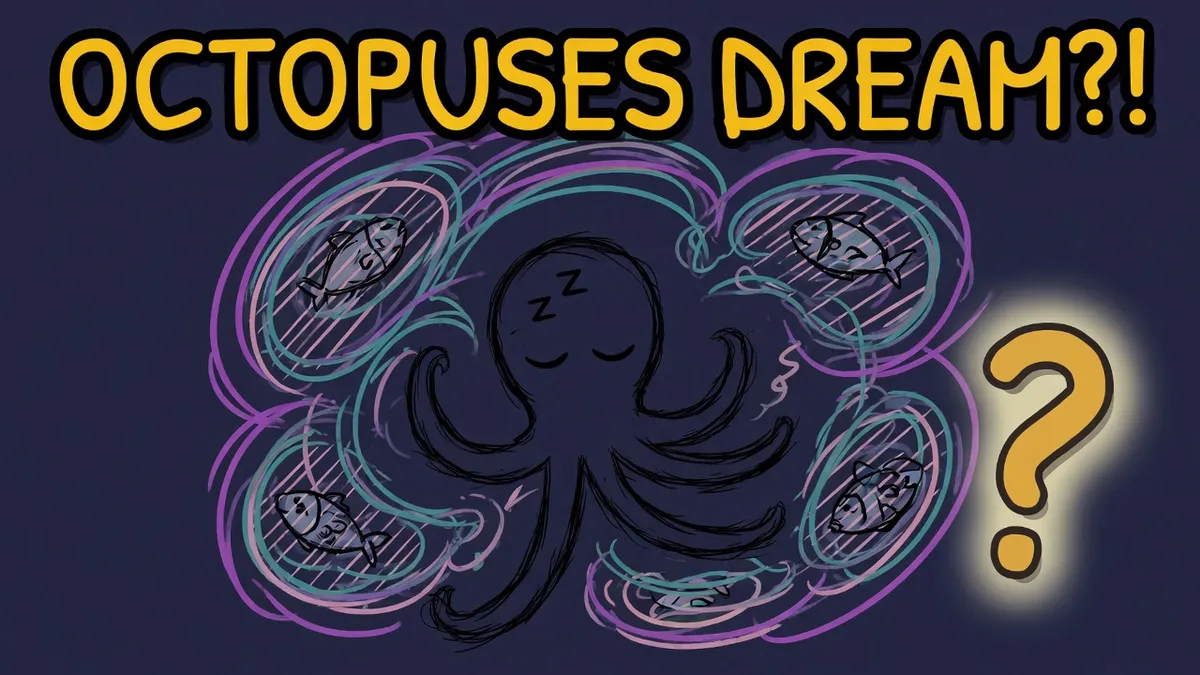
Watch an octopus sleep and, for most of the time, it does what you would expect: it goes still, pale, and quiet. Then, every half hour or so, it comes briefly alive. Its skin ripples through colours and textures, dark to light to mottled, its eyes flick beneath the surface, its arms twitch. For about forty seconds it looks, unmistakably, like a creature in the grip of a dream. It is one of the most haunting things in all of animal behaviour, and it leaves scientists with a question they cannot yet honestly answer: is it dreaming?
01 · They really sleepTwo stages, like ours
First, the settled part. Octopuses genuinely sleep. They meet the strict behavioural criteria: they go still, they become harder to wake, and if you deprive them of sleep they make up for it afterwards. And their sleep is not uniform. Like ours, it comes in two stages: a long, calm “quiet sleep”, when the animal lies pale and motionless, and a brief, dramatic “active sleep”, when everything switches on at once. That an invertebrate has structured sleep stages at all is already a small marvel.
02 · The active stageForty seconds of fireworks
It is the active stage that stops people in their tracks. Roughly every 30 to 60 minutes, for about forty seconds, the sleeping octopus erupts into motion: its skin races through the same colours and patterns it uses while awake, its eyes move rapidly, its suckers and muscles twitch. Then it subsides back into quiet sleep. If you have ever watched a dog’s paws paddle as it sleeps and thought “it’s dreaming of chasing something”, the octopus version is that, turned up to eleven and painted across the entire body.
03 · Why "REM-like"The echo of our own sleep
Those features, rapid eye movements, twitching, a body hard to rouse, are the classic signatures of REM sleep in vertebrates, the very stage in which humans do most of our vivid dreaming. Brain recordings deepen the parallel: during active sleep, an octopus’s central brain lights up in a pattern resembling wakefulness, strongest in regions tied to learning and memory, while quiet sleep produces slow rhythms that look like the “sleep spindles” of mammals. Scientists stop short of calling it true REM, since octopuses are not vertebrates, and say “REM-like” instead. But the resemblance is real, and it is uncanny.
The jaw-dropper is evolutionary. Octopuses are molluscs, closer kin to clams and snails than to us, and our last common ancestor lived around 500 million years ago, a simple creature with nothing like a complex brain. Their nervous system was built on a completely independent blueprint, with two-thirds of their neurons out in their arms. Yet they arrived, on their own, at a two-stage sleep cycle with a REM-like phase that looks eerily like ours. That means REM-style sleep may be such a useful trick that evolution invented it at least twice, on two totally separate branches of life. The magic is not "an octopus dreams like you." It is that a creature this alien sleeps like you at all.
04 · The tempting storyPractising the hunt?
Because the active stage replays waking skin patterns, it is tempting to narrate it: the octopus is reliving its day, rehearsing a hunt, fleeing a remembered predator, colour by colour. It is a lovely idea, and it might even be partly true. But there is an equally good, more mundane explanation: the flickering could simply be the body idling through familiar patterns, keeping its camouflage machinery in tune, a kind of muscle memory with no story attached. Both fit the evidence. The honest position is that we do not know which, and “practising the hunt” is speculation dressed as narration.
05 · The wall we can't crossWhy "do they dream" has no answer yet
Here is the deep problem, and it is not a gap in our instruments. Dreaming is a subjective, inner experience, and we have no way to reach inside another animal’s mind to check whether anything is being experienced at all. We can measure the twitching, map the brain activity, time the colour bursts. We cannot ask the octopus what, if anything, it saw. This is the same wall that stands between us and the question of why we dream ourselves: even in humans, the inner life of sleep is famously hard to pin down. In an octopus, it is harder still.
06 · The payoffSo do octopuses dream?
We do not know, and saying so plainly is the whole point. What we do know is astonishing enough: a soft-bodied mollusc, separated from us by half a billion years of evolution, sleeps in stages, twitches and flickers through a REM-like phase, and does it all with a brain built on a completely different plan from ours. Whether there is a dream behind those racing colours may be a question we can never fully answer. But the fact that we are forced to ask it, of an animal so utterly unlike us, is one of the most quietly profound things the ocean has to offer.
The animated version
Same answer, told as a little animated story with the strange little stickman acting it out. Dry, quick, and, obviously, correct.
Quick questions
Do octopuses dream?
No one can confirm it. Sleeping octopuses enter an 'active sleep' phase with twitching, eye movements, and racing skin colours that looks strikingly dream-like, and some scientists suggest they may be reliving daytime experiences. But dreaming is a private inner experience we cannot measure in another animal, so this stays a hypothesis, not a proven fact.
Do octopuses sleep?
Yes. Studies confirm octopuses genuinely sleep, meeting the behavioural criteria: reduced movement, a raised threshold to wake, and rebound after sleep loss. They alternate between a calm 'quiet sleep' and a brief, vivid 'active sleep'.
Why do octopuses change colour while sleeping?
During active sleep their skin flickers through the same patterns they use awake. Researchers think this could be the brain idly rehearsing camouflage, or possibly a dream-like replay of the day. Both explanations are still speculative.
Do octopuses have REM sleep?
Not exactly, but they have something that resembles it. Their 'active sleep' shares hallmarks of vertebrate REM sleep, rapid eye movements, muscle twitches, and wake-like brain activity, which is why scientists call it 'REM-like' rather than true REM.
Do animals dream?
Many animals show sleep phases like REM that are associated with dreaming in humans, and behaviour that hints at it. But because we cannot access an animal's inner experience, dreaming can never be directly confirmed in any non-human, only inferred.
What are the two stages of octopus sleep?
'Quiet sleep', when the octopus is still and pale with narrowed pupils, and 'active sleep', short bursts of about 40 seconds of colour changes, texture shifts, eye movements, and twitching that recur roughly every 30 to 60 minutes.
What happens in an octopus's brain when it sleeps?
In a 2023 study, active-sleep brain activity looked like the waking brain, strongest in memory-related lobes, while quiet sleep produced slow oscillations resembling the 'sleep spindles' seen in mammals. Both are independent echoes of mammalian sleep.
Do octopuses practise hunting in their sleep?
This is a popular framing, but it is speculation. One idea is that the sleeping octopus replays experiences like stalking prey or fleeing a predator. There is no proof it is deliberate 'practice'; it may just be the brain and skin idling through familiar patterns.
How long do octopuses sleep and how often do the colours flash?
Active-sleep bursts are short, around 40 seconds, and recur roughly every 30 to 60 minutes between longer stretches of quiet sleep.
Which octopus species were studied?
The 2021 behavioural work used the Brazilian reef octopus (Octopus insularis); a 2023 neural study used another species. Both found the same two-state sleep pattern.
Is octopus sleep really similar to human sleep?
Behaviourally, yes, surprisingly so, despite about 500 million years of separate evolution. That parallel is what makes it scientifically striking, but 'similar' does not mean identical, and it does not prove octopuses have human-like dreams.
Could octopuses have nightmares?
A 2023 preprint described rare, disturbed active-sleep episodes that the authors cautiously called possibly 'nightmare-like'. It is preliminary, not peer-reviewed, and based on very few animals, so treat it as an intriguing observation, not established fact.
If we cannot prove they dream, why do scientists even suggest it?
Because the behaviour and brain activity resemble the sleep stages linked to dreaming in humans. Scientists raise it as a possibility worth investigating while being careful to say it is unproven. That honesty is the point, not a weakness.
Our sources 5 checked
// every claim on this page was checked before it went up