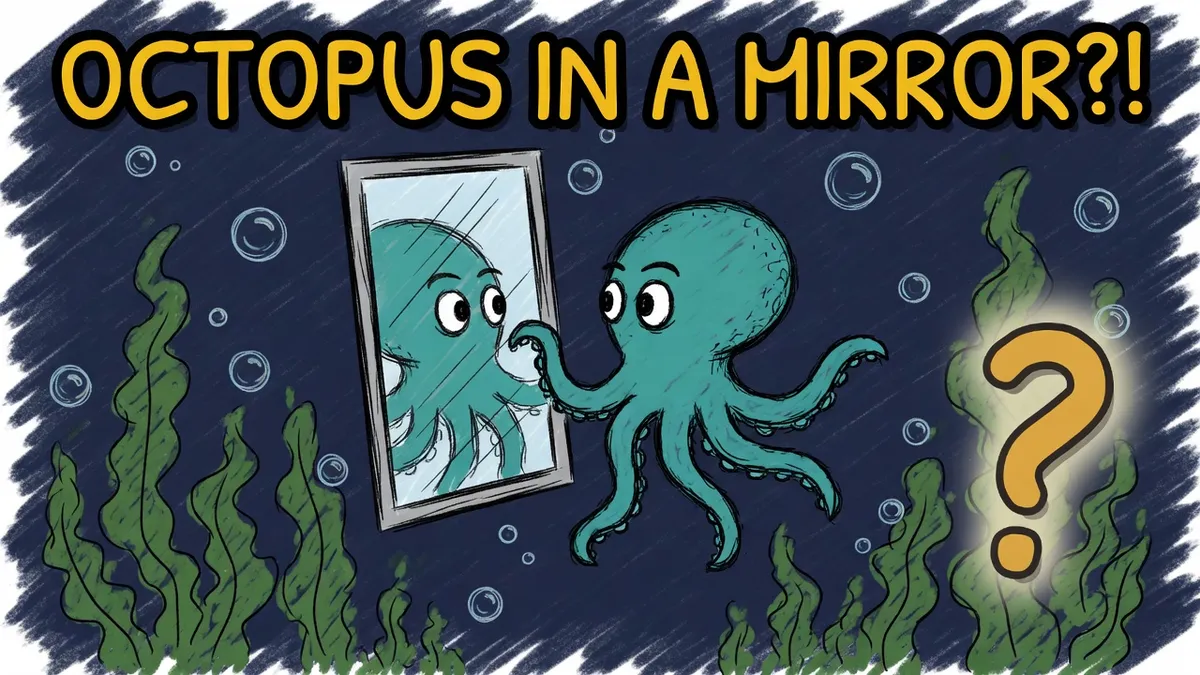
Put a mirror in front of most animals and they see a rival, or nothing at all. Put one in front of an octopus, and something more interesting happens. In a 2026 experiment, octopuses learned to glance at a mirror and use the reflection to find food hidden behind them, the first time any invertebrate has been shown to do this. The headlines practically wrote themselves: octopus passes the mirror test, octopus is self-aware. Except that is not what happened, and the real result is quietly more fascinating than the myth.
01 · The experimentFinding food that isn't there
At Dartmouth, researchers set up a simple test. Food was placed where an octopus could not see it directly, but could see it in a mirror. Three California two-spot octopuses learned to read the reflection and head to the correct hidden spot, getting it right about 73 percent of the time. To anyone who has watched an animal attack its own reflection, this is remarkable: the octopus was not fooled by the mirror, and it was not ignoring it. It was using it, as a source of information about the world.
02 · The crucial distinctionUsing versus recognising
Here is the line the headlines blurred. There are two completely different mirror abilities. One is mirror use: treating a reflection as a window onto your surroundings, the way you use a car’s rear-view mirror to see what is behind you. The other is mirror self-recognition: understanding that the reflection is you, a proposed marker of self-awareness. The octopuses demonstrated the first. They gave no sign of the second. Using a mirror to find lunch does not require you to know the octopus in the glass is yourself.
03 · The famous testWhat the mirror test really measures
The classic “mirror test”, devised in 1970, is about that second, harder ability. An animal is marked somewhere it can only see with a mirror; if it uses the reflection to touch the mark on its own body, it is said to pass. Very few animals do: great apes, dolphins, elephants, magpies, and, surprisingly, the cleaner wrasse, a small reef fish. Octopuses are not on that list. A 2022 attempt found no clear evidence they recognise themselves, with the mark-directed behaviour better explained by touch. So the 2026 study did not add octopuses to the self-aware club. It showed them doing something else.
The tempting headline is "octopus is self-aware." The real story is the opposite, and better: the octopus is smart enough to use a mirror without ever needing to know the reflection is itself. It treats the glass purely as a tool, a window onto the space behind it. That decoupling is the fascinating part. It shows a sophisticated cognitive skill, working out where something is from an indirect image, can exist entirely apart from self-awareness, in a creature whose "mind" is smeared across eight semi-independent arms. Intelligence and self-recognition are not the same ladder.
04 · The alien mindEight arms, half a billion years
Part of why this lands so hard is what an octopus is. It has around 500 million neurons, roughly a dog’s worth, but about two-thirds of them are in the arms, not the central brain. Each arm can taste, feel, and react with striking independence, which is why people say an octopus has “nine brains” (really one integrated system with a lot of distributed control). This is a body plan built on a completely different blueprint from ours. That such a creature can extract spatial meaning from a mirror is a window into a mind utterly unlike our own, and one that arrived at cleverness by its own route, much as a chameleon arrived at its own tricks.
05 · The deeper pointCleverness, invented twice
The reason scientists care is evolutionary. Octopuses and humans share a common ancestor that lived roughly 500 million years ago, a simple creature with nothing like a complex brain. Everything sophisticated in an octopus mind evolved separately from everything sophisticated in ours. So when an octopus does something we thought only vertebrates could, using a mirror to reason about hidden space, it suggests that kind of intelligence is not a one-off fluke of our branch of life. It can arise more than once, on wildly different hardware. That is a profound hint about how common minds might be.
06 · The payoffSo can octopuses really use mirrors?
Yes, genuinely, and the honest version is more interesting than the hyped one. Octopuses can use a mirror as a tool to find what they cannot directly see, a first for any invertebrate. They have not been shown to recognise themselves in it, and claiming otherwise oversells a careful result. What the study really reveals is that a mind built on eight arms, half a billion years from our own, can look into a mirror and understand the space it reflects, without ever needing to know whose face is looking back. And that may say more about the many shapes intelligence can take than passing the old test ever would.
The animated version
Same answer, told as a little animated story with the strange little stickman acting it out. Dry, quick, and, obviously, correct.
Quick questions
Do octopuses recognise themselves in a mirror?
No, not on current evidence. Octopuses have learned to use a mirror to find hidden food, but that is spatial navigation, not self-recognition. Preliminary self-recognition tests found no clear evidence they identify the reflection as themselves.
Can octopuses use mirrors?
Yes. In a 2026 Dartmouth study, three California two-spot octopuses learned to use a mirror's reflection to locate food hidden behind them, succeeding about 73 percent of the time. It was the first time any invertebrate showed this ability.
Did the study prove octopuses are self-aware?
No. The researchers were careful to say the octopuses used the mirror as a spatial tool, like a driver using a rear-view mirror. They made no claim of self-awareness, and using a mirror to find food does not require it.
What is the difference between mirror use and mirror self-recognition?
Mirror use means treating a reflection as information about the surrounding world, for example spotting prey behind you. Mirror self-recognition means understanding that the reflection is your own body. The first is a spatial skill; the second is a proposed marker of self-awareness.
What is the mirror test?
It is an experiment where an animal is marked somewhere it can only see using a mirror. If it uses the reflection to touch the mark on its own body, it is said to pass, which many scientists treat as evidence of self-recognition.
What animals pass the mirror test?
A short list: great apes (chimpanzees, bonobos, orangutans, and some gorillas), bottlenose dolphins, Asian elephants, Eurasian magpies, and the cleaner wrasse, a small reef fish that passed in 2019.
How smart are octopuses?
Very smart for an invertebrate. They use tools, solve problems like opening jars, navigate mazes, and now use mirrors to find hidden food, hinting they build internal maps of their surroundings.
How many brains does an octopus have?
It is often said to have nine: one central brain plus a nerve cluster at the base of each of its eight arms. More precisely, it is one integrated nervous system with heavily distributed control, not nine separate minds.
How many neurons does an octopus have?
About 500 million, roughly on par with a dog. Unusually, around two-thirds of them sit in the arms rather than the central brain, so each arm can taste, move, and react with a lot of local control.
Do octopuses use tools?
Yes. The veined octopus carries coconut shell halves and reassembles them into portable shelter, reported in 2009 as the first tool use ever documented in an invertebrate.
Why does the octopus mirror result matter?
Before this, using a mirror to understand your surroundings had only been seen in vertebrates. Octopuses split from our lineage around half a billion years ago, so finding the skill in them suggests this kind of spatial intelligence evolved more than once.
Are octopuses conscious?
It is an open scientific question. Their rich behaviour and large, distributed nervous system make them a focus of consciousness research, but no single experiment, including the 2026 mirror study, has settled whether they are self-aware.
Our sources 6 checked
// every claim on this page was checked before it went up