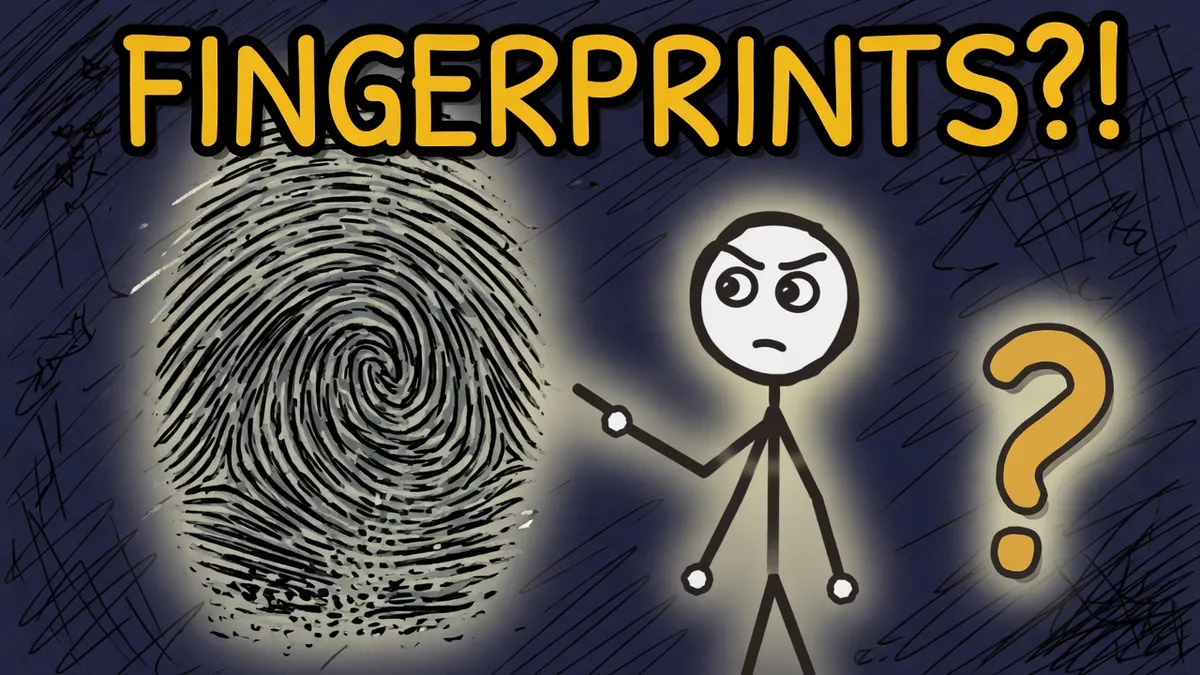
Here's a fact you almost certainly learned in school: fingerprints are there to help you grip. The idea is beautifully intuitive, those little ridges work like the tread on a car tyre, biting into surfaces so things don't slip out of your hands. It's in textbooks. It's the answer everyone gives. And when a scientist finally strapped a fingertip to a machine and measured it, the whole neat story fell apart. On a smooth surface, fingerprints don't help you grip. They might make it very slightly worse.
01 · The testSomeone finally measured it
For roughly a century, “fingerprints are for grip” was repeated as settled fact without anyone directly checking. Then, in 2009, a researcher rigged up a device that dragged a smooth sheet of acrylic across a volunteer’s fingertip while precisely measuring the friction between the two, a clean, direct test of the one thing fingerprints are supposed to be brilliant at. The result flipped the textbook on its head.
02 · The mechanismSkin grips like rubber, not sandpaper
The surprise makes sense once you know how fingertip skin actually behaves: like rubber. For soft, rubbery materials, friction doesn’t depend on jagged edges biting in, it depends on how much surface is genuinely touching. And that’s the problem with ridges. They stick up, so only the tops make contact, with the valleys between them touching nothing. Compared with smooth, flat skin, fingerprints actually reduced the area in contact with the surface by about a third. Less contact means less friction. On a smooth surface, your prints are gently working against you.
So the tidy explanation we've all repeated for a century appears to be a myth, which leaves a genuinely great mystery. If these astonishing, unique patterns aren't for holding on, what are they for?
03 · The wet-grip ideaThe tyre analogy, rescued for the rain
The first leading idea saves the tyre comparison, just not the way you’d expect. Tyres don’t have treads to grip a dry road; a slick, smooth tyre actually grips dry tarmac better. Treads are for the wet. They give water somewhere to escape so the rubber can still reach the road. Fingerprint grooves may do the same job, channelling water off the fingertip so more skin can meet a slippery surface. It’s a plausible and popular idea, though the cleanest experimental evidence for “wet grip” in humans actually comes from a related feature: the wrinkling of water-soaked fingers, which one 2021 study found genuinely improves grip on wet objects and does nothing for dry ones. So treat wet grip as a strong hypothesis for the static ridges rather than a proven fact.
04 · The real magicFingerprints are tuned antennas for touch
The second idea is the beautiful one, and it suggests fingerprints aren’t mainly about grip at all, they’re about your sense of touch. When you run a fingertip across a surface, the ridges catch on every tiny bump and set the skin vibrating. And their spacing isn’t random. It appears tuned so that stroking a textured surface produces vibrations at a very particular frequency, right around 250 hertz. That number matters, because it’s almost exactly the frequency the Pacinian corpuscles, the deep touch receptors buried a couple of millimetres under your skin, are most sensitive to. Researchers showed this with a ridged mechanical fingertip: the ridges act like a tiny amplifier, converting fine texture into precisely the signal your nerves are built to hear.
05 · The superpowerWhy your fingertips feel so much
This is why your fingertips are almost absurdly sensitive. You can feel the difference between silk and satin, notice a single hair trapped under a page, register a bump a fraction of a millimetre high. In fact, one study found people could distinguish surfaces whose ridges differed by only about 10 nanometres, a scale so small it’s far below anything the eye can resolve. A large part of that acuity may come from these ridges translating the microscopic world into vibrations your brain can read. Your fingerprints aren’t gripping the surface; they’re reading it.
06 · The payoffYou don't grip the world, you read it
So the humble fingerprint, the thing we use to unlock phones and catch criminals, turns out to have been misunderstood for generations. It probably isn’t there to help you cling to things. Its likely real jobs are subtler: keeping a grip when your hands are wet, and, above all, turning the tip of every finger into an exquisitely fine texture sensor. The next time you run a fingertip over something and feel every grain of it, that’s not grip doing the work. It’s a set of tuned little antennas, quietly reading the surface of the world one vibration at a time, and, admittedly, occasionally getting you arrested.

The animated version
Same answer, told as a little animated story with the strange little stickman acting it out. Dry, quick, and, obviously, correct.
Quick questions
Do fingerprints actually help you grip?
On a smooth, dry surface, apparently not. They may even hurt slightly. A 2009 study found fingerprint ridges reduced the skin's contact area by about a third, and since fingertip skin grips like rubber (friction scales with contact area), less contact means less friction. The 'treads for grip' idea seems to be a myth.
Then why do we have fingerprints?
The two leading ideas are wet grip and touch. The grooves may channel water away like tyre treads, helping you hold slippery objects. And, more compellingly, the ridges appear tuned to amplify vibrations at the frequency your fine-texture touch receptors detect best, effectively turning each fingertip into a precise texture sensor.
How do fingerprints improve your sense of touch?
As you drag a fingertip across a surface, the ridges catch on every tiny bump and set the skin vibrating. Their spacing appears tuned so those vibrations peak near 250 Hz, the sweet spot of the deep Pacinian corpuscles, the receptors that encode fine texture. The ridges act like a tiny amplifier feeding a signal your nerves are built to hear.
How sensitive are human fingertips?
Extraordinarily. In one study, people could feel the difference between surfaces whose ridges differed by only about 10 nanometres, a scale far smaller than anything you can see. A large part of that acuity may come from fingerprint ridges translating microscopic texture into vibrations.
Why is everyone's fingerprint different?
The basic ridge pattern is shaped in the womb by genetics and chance, how the skin buckles and folds as it grows, plus small random forces in the fluid around the fetus. Even identical twins, with the same genes, end up with different prints, which is why they work as an ID at all.
Are fingerprints actually unique?
Almost certainly between two different people, but 'proven fact' overstates it. The odds of two people matching are often quoted as below one in 64 billion, and no identical pair has ever been documented. Yet courtroom experts asserted 'no two prints are alike' for roughly a century before anyone rigorously tested the claim, and a 2024 AI analysis from Columbia found that different fingers of the same person are far more similar than long assumed. So: unique enough to identify you, but treat the absolute version as a very strong assumption rather than a mathematical law.
Can two people have the same fingerprints?
There's no verified case of it, not even among identical twins. The estimated probability of a full match is famously below one in 64 billion. The honest caveat is that this is a claim backed by enormous accumulated experience rather than something ever proven from first principles. But for any practical purpose, no: your prints are your own.
Do identical twins have the same fingerprints?
No, and that fact is the clue to how prints form. Identical twins share their DNA, so their broad pattern type (loop, whorl, arch) and ridge counts tend to match. But the exact path of each ridge is set in the womb by physical chance, finger position, blood flow, cord length, the rate of growth, tiny random buckling of the skin, which differs even between two babies sharing a uterus. A 2023 study traced the ridges to competing BMP and Wnt signalling in the developing skin. Same genes, different fingerprints.
When do fingerprints form?
Before you're born. The ridges begin forming around 10 weeks of gestation, the primary ridges are complete by about 17 weeks, and the full pattern is locked in by roughly 24 weeks. From that point it never changes. The fingerprint you're scanned with as an adult is the one you already had in the second trimester.
Do fingerprints grow back if you scrape or burn them?
Usually yes, and in the exact same pattern. The blueprint for your ridges lives in the deep basal layer of the skin, so superficial cuts, scrapes, abrasions and minor burns heal back to the identical print within a few weeks. Only an injury deep enough to destroy the underlying dermis leaves a permanent scar, and even then, the scar itself just becomes a new fixed, identifiable feature of the print.
Can you lose your fingerprints?
Temporarily, and, rarely, permanently. Heavy manual work, some skin conditions like eczema, and certain chemotherapy drugs (capecitabine is the notorious one) can wear the ridges smooth for a while; one cancer patient was reportedly held at US immigration because his fingertips had gone blank. Permanent loss comes from deep scarring, or from adermatoglyphia, an extremely rare inherited condition, nicknamed 'immigration delay disease,' in which people are simply born with no fingerprints at all.
Do your fingerprints change as you get older?
The pattern doesn't, it's fixed for life. What changes is the skin around it: with age it loses collagen and elasticity, so the ridges flatten and can become shallower and harder for a scanner to read. Years of manual labour can wear them down too. But the underlying loops and whorls are exactly the ones you were born with.
Take the quiz on this
A quick 4-question check on what you just read. Get them right to earn XP: no points for just scrolling.
Our sources 10 checked
// every claim on this page was checked before it went up