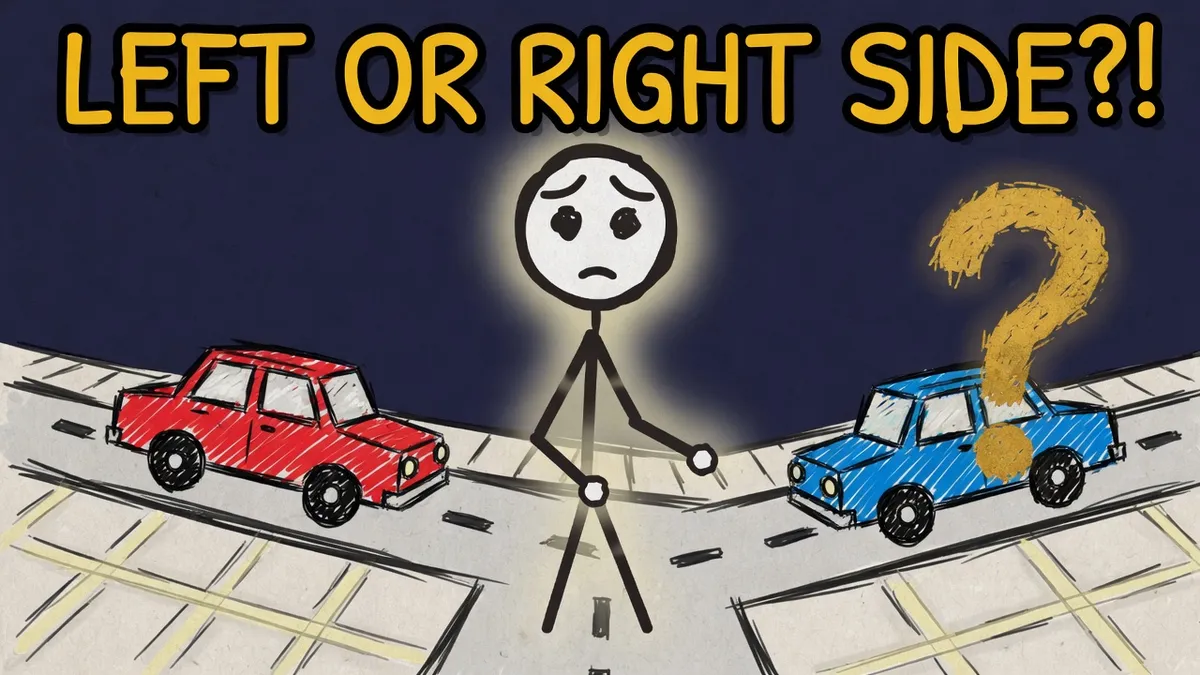
Here is something almost nobody notices about a thing they do every single day: which side of the road you drive on was not really decided by anyone. There was no grand meeting, no logic, no vote. About a third of the world drives on the left and the rest on the right, and which side your country landed on is mostly a fossil, a hardened trace of old swords, old wagons, and, more than anything, who once conquered whom. You are steering according to the ghost of an empire.
01 · The splitA third of the world drives on the left
Start with the scale of it, because it surprises people. Driving on the left is a global minority, but a large one: roughly a third of the world’s population, spread across about 75 countries and territories. Those countries hold around a sixth of the planet’s land and a quarter of its roads. It isn’t a handful of eccentrics either. It’s the UK, India, Japan, Indonesia, Australia, South Africa, and much of the Caribbean. So this isn’t “everyone drives on the right, plus Britain.” It’s a genuine, populous, worldwide divide, and the interesting question is how two conventions ended up carving the map between them.
02 · The swordWhy riders kept to the left
The oldest thread is the one about weapons, and it’s worth being upfront: it’s a good story that is hard to prove. Most people are right-handed, and a swordsman on horseback wore his blade on his left hip so he could draw it across his body with his right hand. Keep to the left of the road, the reasoning goes, and any stranger coming the other way passes on your right, your sword side, where you can meet a threat fastest. Mounting worked the same way: you swing up from the left so the scabbard doesn’t foul the horse, which is easier done from the roadside than the middle of the traffic. It all hangs together neatly. But neat is not the same as evidenced, and historians treat the sword explanation as plausible tradition rather than documented fact. Take it as a likely instinct, not a proven decree.
03 · The wagonHow America went right
The move to the right has a better paper trail, and it runs through freight. Picture a big American hauling wagon, the kind that opened up the early United States. It had no comfortable driver’s seat up front. Instead the teamster rode the rear-left horse of the team, or walked alongside on the left, keeping his stronger right hand free for the reins and the whip. From that left-hand position, when another wagon came the other way, he wanted it to pass on his left, close to him, where he could look down and make sure his wheel hubs cleared theirs. That meant steering his own team to the right. Multiply that by thousands of wagons on the same roads and the right side simply became the way it was done. It’s a more mundane reason than the sword, and precisely because it’s mundane, it’s easier to believe.
Once you see it, you can't unsee it: the side you drive on has almost nothing to do with what's safest, and almost everything to do with which armies and empires reached your country first.
04 · NapoleonThe general who spread the right
Continental Europe drives on the right, and the popular credit goes to Napoleon. That’s partly true and partly tidied up. Right-hand traffic in France came first from the Revolution: before 1789 the aristocracy swept along on the left and forced the peasantry to the right, and when it became unwise to look aristocratic, the gentry quietly joined everyone on the right. Paris made keeping right the rule in 1794. What Napoleon did was export it. As his armies marched, right-hand traffic followed into the Low Countries, Switzerland, much of Germany, Poland, and parts of Italy and Spain. The places that held out against him, Britain, Portugal, the Austro-Hungarian lands, tended to keep left. So the map of European driving is, quite literally, a map of who lost to Napoleon.
One thing to drop overboard: the tale that he did it because he was left-handed. That’s folklore. The switch to the right was already rolling in France before Napoleon held power, and there’s no good evidence he was left-handed at all. It’s a colourful flourish stapled onto a real event, and it deserves the same fate as most colourful flourishes: enjoyed, then set aside.
05 · The empireWhy so much of the world went left
If Napoleon explains a chunk of the right, the British Empire explains almost all of the left. Britain kept to the left, and as it built roads, railways and rules across a quarter of the globe, it carried that convention with it. India, Australia, New Zealand, much of southern and eastern Africa, and a scatter of Caribbean islands all inherited left-hand traffic and drive that way still. This is the real reason left-driving, for all that it’s a minority, is so widespread: not many small independent choices, but one very large one, made in London and printed onto the map wherever the empire went.
Japan is the elegant exception that proves the point. It was never a British colony, yet it drives on the left. The route is different: Japan had an older habit of keeping left, but the modern rule set hard when it built its first railways in the 1870s with British engineering help, running on British left-hand standards. That spread from the rails to the roads, and left-hand driving became national law by 1924. Same source, Britain, delivered by train instead of by empire.
06 · Dagen HThe day a whole country swapped
Which raises the obvious question: can you change your mind? Once, spectacularly, a country did. Sweden drove on the left, awkwardly marooned among right-driving neighbours, with most of its cars already built left-hand-drive for the wrong side. So on Sunday, 3 September 1967, it switched the entire nation overnight, an event called Dagen H, for högertrafik, right-hand traffic. In the small hours all non-essential traffic was banned, every vehicle came to a stop, moved carefully to the right side of the road, waited, and set off again at 05:00 driving on the right. A whole country changed hands between one breakfast and the next.
07 · The lessonWhy the crashes briefly fell
And here’s the part that catches everyone out. You’d expect chaos, a spike in crashes as millions of people fought decades of muscle memory. Instead accidents went down. In the weeks after Dagen H, collisions and insurance claims dropped sharply, motor-insurance claims fell by something like 40%. The reason is almost funny: everybody was terrified. People crept along, checked twice, treated every junction as genuinely dangerous, and drove better than they ever had. Then, within a couple of years, the fear faded, the roads felt normal again, and the numbers drifted back to roughly the trend they’d been on all along. The safety dip had nothing to do with the right side being better. It was pure, temporary attention. That’s the real lesson buried in Dagen H: most road danger is complacency, and the moment driving stops feeling risky, the risk quietly returns.
08 · The lock-inSo why don't we all just match?
So if one small country pulled it off, why doesn’t everyone converge on a single side? Because the bill is now astronomical. Switching means rebuilding intersections and slip roads, remaking every sign, reconfiguring buses so the doors open kerbside, refitting or replacing vehicles, and retraining every driver in the country, all for a benefit that really only bites at a few border crossings. This is path dependence at its purest: an early, half-accidental choice hardens into place, and the cost of undoing it grows until change becomes unthinkable. Sweden managed it in 1967 because it was small, rich, and superbly organised, and even then it was a monumental national effort. For everyone else, the maths never adds up. Switches do still happen, Samoa went the other way in 2009 to import cheaper used cars, but they’re rare, and they only make sense at the margins. The honest answer to why we drive on different sides is that we started differently, and starting over is simply too expensive. You’re not driving on the correct side. You’re driving on the side that history handed you, and can’t afford to hand back.
Quick questions
How much of the world drives on the left?
Roughly a third of the world's population, spread across about 75 countries and territories. It's a minority, but a big one: it includes India, Japan, Indonesia, the UK, Australia, South Africa, and much of the Caribbean. Left-hand-traffic countries make up about a sixth of the world's land area and roughly a quarter of its roads.
Why did people originally keep to the left?
The traditional explanation is the sword. Most people are right-handed, so a rider wearing a blade on his left hip wanted his right arm nearest to anyone coming the other way, ready to draw if a stranger turned out to be a threat. Keeping left put oncoming traffic on his sword side. It's a tidy story and probably has some truth in it, but it's hard to evidence, so historians treat it as plausible tradition rather than proven fact.
Why do Americans drive on the right?
The best-attested reason is the freight wagon. Big American teams like the Conestoga had no driver's seat: the wagoner rode the rear-left horse or walked on the left, keeping his right hand free for the reins and whip. From that left-side perch he wanted oncoming wagons passing on his left, where he could watch his wheel hubs clear theirs, so he kept to the right. Once thousands of wagons did the same, the right side became the norm.
Did Napoleon really make Europe drive on the right?
Partly. Right-hand traffic in France predates him: revolutionary Paris made keeping right the rule in 1794. But Napoleon's conquests then spread that convention across the Low Countries, Switzerland, much of Germany, Poland, and parts of Italy and Spain. Countries that resisted him, like Britain, Portugal, and the Austro-Hungarian lands, tended to keep left. So Napoleon was a powerful spreader of right-hand traffic, not its inventor.
Was Napoleon left-handed, and is that why?
The claim that Napoleon switched Europe to the right because he was left-handed is folklore. There's no good evidence he was left-handed, and the change was already underway in France before he took power, driven by the Revolution. It's a fun detail that got bolted onto a real historical shift after the fact.
Why does so much of the world drive on the left?
The British Empire. Britain kept left, and as it colonised and built infrastructure it exported that rule: India, Australia, New Zealand, much of southern and eastern Africa, and many Caribbean islands all inherited left-hand traffic. That single empire is why left-driving, though a global minority, is so widespread.
Why does Japan drive on the left if it was never a British colony?
By a separate route. Japan had an old custom of keeping left, but the modern rule was cemented when it built its first railways in the 1870s with British engineering help, which used British left-running standards. That spread to roads, and left-hand driving was made law nationwide by 1924. So Japan drives left thanks to British railways, not British rule.
When did Sweden switch sides?
On Sunday, 3 September 1967, known as Dagen H (H for högertrafik, right-hand traffic). Between 01:00 and 06:00 all non-essential traffic was banned, cars stopped, moved to the right, and waited before setting off again at 05:00. Sweden had been an island of left-hand driving surrounded by right-driving neighbours, and most Swedish cars were already built with the steering wheel on the left, so the switch actually put drivers on the safer side.
Did accidents go up or down after Sweden switched?
They went down at first, which surprised people. In the weeks after Dagen H, accident and insurance claims dropped sharply, motor-insurance claims fell by around 40%, because everyone was nervous and drove with enormous care. Within a couple of years, once the fear wore off, rates drifted back to roughly where the long-term trend had been heading. The dip was about caution, not about the new side being magically safer.
What does Sweden's switch teach us about road safety?
That attention matters more than we admit. The temporary safety boost came entirely from drivers being frightened into paying attention, not from any feature of driving on the right. It's a real-world demonstration that a lot of crashes come down to complacency: when people treat driving as genuinely dangerous, they get much safer, and when it feels routine again, the risk creeps back.
Why doesn't every country just switch to the same side?
Because switching is now enormously expensive and disruptive. You'd have to rebuild intersections, move signage, reconfigure every bus and its doors, and retrain millions of drivers, all for a benefit that mostly matters at borders. This is a classic case of path dependence: an early choice gets locked in, and the cost of changing it outgrows any gain. Sweden managed it in 1967, but it was a small, wealthy, well-drilled country, and even then it was a huge national undertaking.
Has any country switched from right to left?
Yes, though it's rarer. Samoa switched from right to left in 2009, largely so it could import cheaper used cars from left-driving Australia and New Zealand. Most modern switches, though, have gone the other way, toward the right, as countries fell in line with their neighbours: much of former British Africa, for instance, changed to the right over the 20th century.
Does the side you drive on affect where the steering wheel goes?
Yes: the driver sits on the side nearest the centre of the road, to see oncoming traffic and judge overtaking. So left-hand-traffic countries use right-hand-drive cars (wheel on the right), and right-hand-traffic countries use left-hand-drive cars. That's why a British car has its wheel on the right and an American one on the left.
Which came first, driving on the left or the right?
Keeping left is generally the older habit for people on horseback and on foot, which is why the sword explanation is usually told about the left. Right-hand travel rose later with heavy wagons and then the French Revolution, and it spread fastest in the 19th and 20th centuries. So the modern right-hand majority is, in a sense, the newer convention that overtook an older left-hand one almost everywhere Britain didn't reach.
Take the quiz on this
A quick 4-question check on what you just read. Get them right to earn XP: no points for just scrolling.
Our sources 10 checked
// every claim on this page was checked before it went up