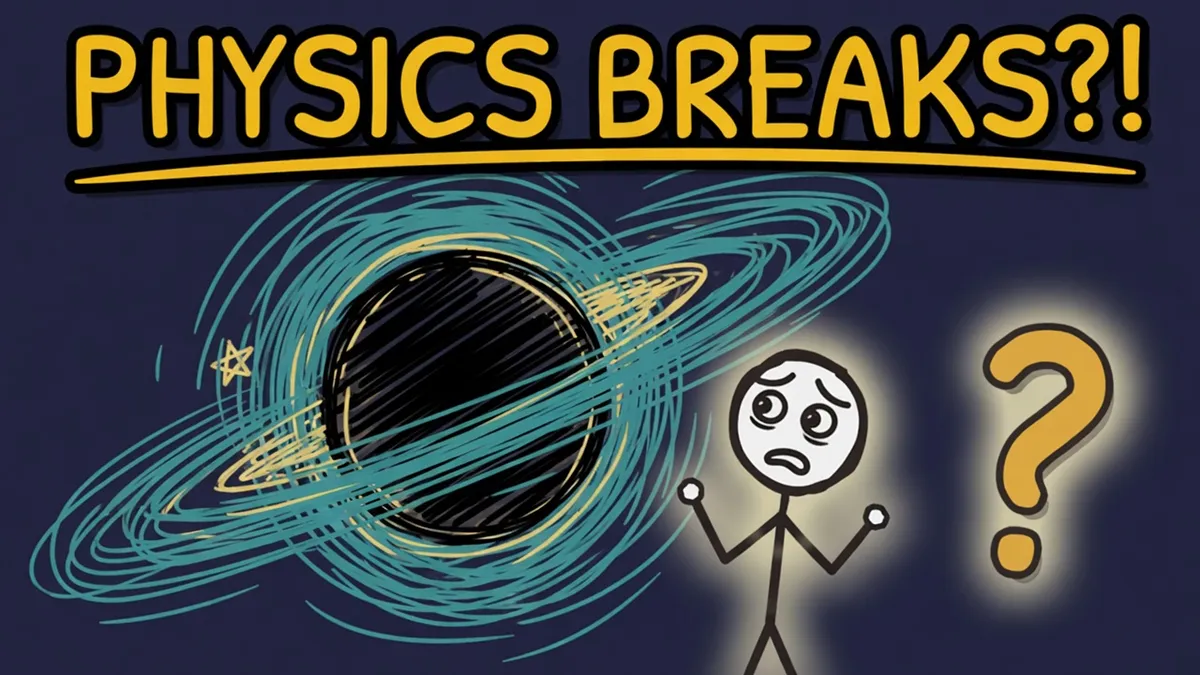
You have heard it a hundred times: a black hole is where the laws of physics break down. It sounds like the universe has a lawless zone, a place where the rulebook simply stops applying. But that is not quite what happens. Black holes do not tear up the rules. They do something more interesting and more humbling: they take our two greatest theories of reality, hold them up against each other, and show us the one place where they refuse to agree. The "breakdown" is not in nature. It is in us.
01 · Two rulebooksWhere the trouble comes from
Modern physics runs on two spectacularly successful theories. General relativity describes gravity and the large-scale universe: stars, galaxies, the bending of spacetime. Quantum mechanics describes the very small: particles, atoms, the jittery rules of the subatomic world. Each works almost perfectly in its own domain. The problem is that a black hole forces both into the same tiny space at the same time, and there they contradict one another. A black hole is not lawless. It is the one arena where our two sets of laws collide.
02 · The real edgeHorizon versus singularity
It helps to separate two very different places. The event horizon is the famous boundary of no return, the point past which not even light can escape. But it is not a wall, and nothing dramatic happens to physics there: at the horizon of a large black hole, the known laws work just fine. The trouble is deeper in, at the singularity, the central point where general relativity predicts matter is crushed to infinite density. That is where the equations stop making sense. The horizon is a boundary; the singularity is the crack.
03 · The infinitiesA signpost, not a verdict
When a theory hands you an infinity, it is almost never telling you that something in nature is truly infinite. It is telling you that your theory has been pushed past the point where it works. That is exactly how physicists read the singularity: the infinite density is a red flag that general relativity, brilliant as it is, cannot describe conditions this extreme. To go further, you would need a theory that unites gravity with quantum mechanics, a theory of quantum gravity. We do not have a finished one. Candidates like string theory and loop quantum gravity are still unproven.
Here is the surprise. Far from being physics-breakers, black holes may be the most law-abiding objects in the universe. They obey their own precise set of thermodynamic laws, four of them, that line up almost eerily with the ordinary laws of heat and entropy governing steam engines and cups of coffee. A black hole has a temperature. It has an entropy. It even evaporates on a schedule. What actually "breaks" is not the black hole. It is the seam where our two rulebooks are stitched together, and the black hole just holds a magnifying glass up to it.
04 · The laws they keepBlack holes have a temperature
In the 1970s physicists worked out that black holes follow rules that mirror thermodynamics. The area of the horizon behaves like entropy and never decreases; the surface gravity behaves like temperature. Then Stephen Hawking showed something stranger still: quantum effects near the horizon let a black hole leak faint radiation, now called Hawking radiation, so it slowly loses mass and could, over unimaginable spans of time, evaporate entirely. That gave black holes a genuine temperature. A truly lawless object could not have one. These do.
05 · The genuine puzzleThe information paradox
If there is a place black holes seem to threaten a real law, it is the information paradox. Quantum mechanics insists information can never be destroyed. Yet if a black hole swallows something and then slowly evaporates into featureless radiation, where does the information about what fell in go? Hawking’s early maths suggested it was simply lost, which would break quantum mechanics. But recent work, around 2019 and 2020, on how the radiation’s entropy behaves suggests the information does come back out after all. The rule bends alarmingly, then holds. Exactly how it escapes is still being pinned down.
06 · The payoffSo can black holes break the laws of physics?
No. They mark the edge of what our current laws can describe, and that edge is precious: it is the clearest signpost we have toward the deeper theory we are still missing. Black holes even keep getting more law-abiding as we understand them better. Recently, physicists extended the classic thermodynamic laws, once written only for idealised, unchanging black holes, to realistic ones that grow and evolve. The rulebook is not falling apart. It is being finished. A black hole is not a hole in physics. It is physics, pointing at the one question it has not yet answered, much like the silence where alien signals should be: a mystery that maps the boundary of what we know.
The animated version
Same answer, told as a little animated story with the strange little stickman acting it out. Dry, quick, and, obviously, correct.
Quick questions
Do black holes break the laws of physics?
No. They do not violate physics so much as expose where our current theories stop working together. General relativity and quantum mechanics both hold up until you reach the singularity at the centre, where they disagree and neither can describe what happens. That gap is a limit of our knowledge, not a broken law of nature.
What happens at a singularity?
General relativity predicts matter is crushed to a point of infinite density and infinite spacetime curvature. Physicists do not take that infinity literally; it signals the theory has been pushed past its limits. A working theory of quantum gravity, which we do not yet have, is expected to describe what really happens there.
Why do physicists say general relativity 'breaks down' in a black hole?
Because its equations produce infinities at the singularity, and infinities are a red flag that a theory is too simple for that extreme. The curvature and density become so large in such a tiny region that quantum effects on gravity must matter, and general relativity alone cannot handle them.
What is the black hole information paradox?
It is the clash between two rules. General relativity suggests information that falls into a black hole is lost, while quantum mechanics says information can never be truly destroyed. When Stephen Hawking showed black holes slowly evaporate, it raised the question of whether the information about what fell in vanishes forever, which would break quantum mechanics.
Do black holes destroy information?
Probably not, according to recent theory. Hawking's original 1976 calculation suggested they do, but work around 2019 to 2020 on the 'Page curve' indicates the escaping radiation carries the information back out, preserving quantum mechanics. Exactly how it escapes is still being worked out.
What is Hawking radiation?
It is faint radiation that quantum effects cause a black hole to emit near its event horizon. Because of it, a black hole slowly loses mass and, over immense timescales, could evaporate entirely. It also means black holes have a real temperature.
Is Hawking radiation proven?
Not by direct observation. It has never been detected from a real black hole because the signal is unimaginably faint, colder than the space around it. Supporting evidence comes from laboratory 'analogue' experiments that mimic a horizon, not from an actual black hole.
What is the difference between the event horizon and the singularity?
The event horizon is the outer boundary of no return, a region of space where nothing, not even light, can escape. The singularity is the central point where density and curvature blow up. Known physics works fine at the horizon of a large black hole; it only fails at the singularity.
What are the four laws of black hole thermodynamics?
They mirror ordinary thermodynamics. The zeroth: surface gravity is uniform over the horizon. The first: mass change ties to changes in area, spin, and charge. The second: horizon area never decreases. The third: you cannot reduce surface gravity to zero. Horizon area behaves like entropy and surface gravity like temperature.
Does a black hole violate the conservation of energy?
No. Even when a black hole loses mass through Hawking radiation, the total energy is conserved: the radiated energy comes from the black hole's own mass. The thermodynamic laws that govern black holes are built to respect energy conservation, not break it.
Is a singularity actually infinitely dense?
That is what general relativity predicts, but many physicists doubt it is literally true. Some quantum-gravity-inspired models propose the core is extremely but finitely dense, with the singularity replaced by something new. It remains speculative because we cannot see inside.
Will we ever know what is inside a black hole?
Not with current physics. The event horizon hides the interior, and describing the core needs a theory of quantum gravity we do not yet have. Candidates like string theory and loop quantum gravity aim at this, but none is confirmed, so the interior stays an open question.
Did anything change in black hole physics recently?
Yes. Theorists have extended the classic thermodynamic laws, which described idealised unchanging black holes, to realistic ones that grow and evolve over time, with a new entropy formula that still obeys the second law. So the rulebook is getting more complete, not falling apart.
Our sources 6 checked
// every claim on this page was checked before it went up